
CAPTIVE CURIOSITY
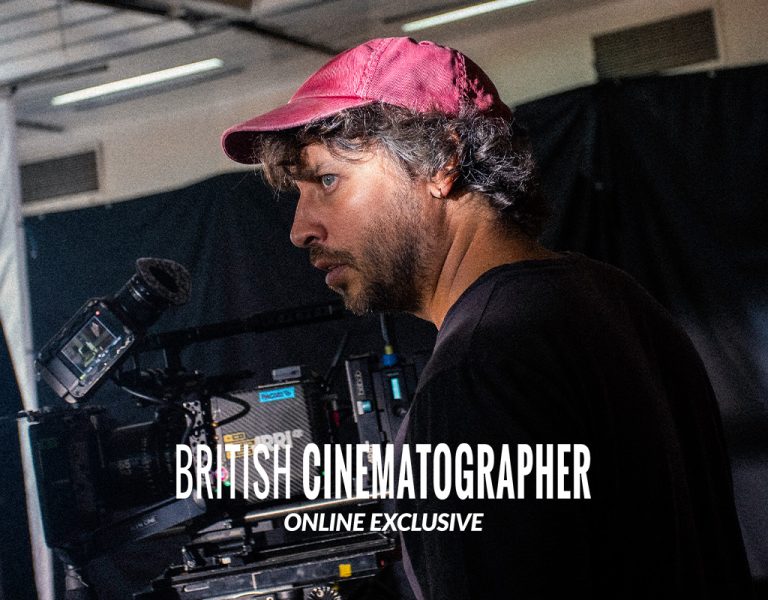
Robbie Ryan BSC ISC reveals how he created tension—largely within the confines of a basement setting—and the VistaVision adventure he enjoyed, working with rare cameras to craft one of Yorgos Lanthimos’ most technically ambitious films.
Spanning The Favourite, Poor Things, Kinds of Kindness and now Bugonia, Robbie Ryan BSC ISC and Yorgos Lanthimos’ partnership is built upon a mutual love for creatively ambitious productions, experimenting with the cinematic artform and exploring new technical territory.
Bugonia pushes cinematographic limits once again as the pair made the bold decision to shoot entirely on VistaVision to achieve a rich, immersive and visceral result and one of Lanthimos’ most visually and technically daring productions.
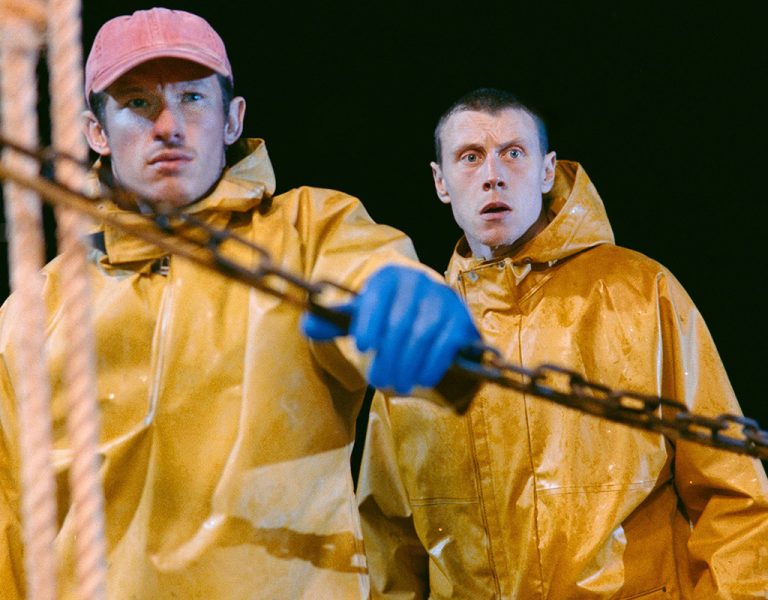
Set in today’s age of paranoia and conspiracies, Bugonia adapts the 2003 Korean sci-fi comedy Save the Green Planet, but under the direction of Lanthimos it takes on a new visual and tonal approach. The psychological and darkly comic thriller follows conspiracy-obsessed cousins Teddy (Jesse Plemons) and Don (Aidan Delbis), who kidnap ruthless CEO Michelle (Emma Stone). Convinced she is an alien plotting Earth’s destruction, they shave her head, coat her in anti-alien lotion and interrogate her about a supposed scheme involving bee extinction and a lunar eclipse.
“Yorgos is always a standout for me; he’s such a fantastic director,” says Ryan, who was instantly intrigued when Lanthimos floated the idea of shooting Bugonia entirely on VistaVision. “We’re all used to 35mm still photographs, and that’s basically VistaVision—the purest form of very honest 35mm image. But the cameras were big, ungainly and noisy, and CinemaScope, which adapted standard 35mm for widescreen, quickly overshadowed it. In a lovely alternate world, VistaVision might have thrived—the quality and images are gorgeous.”
The pair first tested VistaVision for a reanimation flashback in Poor Things needing a different texture. Its native 1.5:1 ratio merged well with that film’s 1.66:1 frame. Shot on Kodak Ektachrome, the luminous result impressed them but the noisy Beaumont VistaVision camera made dialogue recording difficult.
A bold VistaVision
Exploring a new story with Bugonia, Lanthimos wondered if they could overcome the noise issue and shoot it entirely in VistaVision. IMAX technician Scott Smith pointed Ryan to the rare Wilcam W-11, the only sync-sound VistaVision camera. But as it was undergoing renovation at the time, the camera was unavailable for Poor Things.
A year later, Ryan tested the refurbished Wilcam at Panavision Woodland Hills. It was quieter, smoother and immediately caught Lanthimos’ interest. Tests with Stone and Plemons confirmed the camera’s noise was not disruptive and sound designer Johnnie Burn assured the filmmakers new sound tools could manage the noise reduction without affecting performance.
Despite being spurred on by their enthusiasm, there were hurdles to overcome. Although VistaVision is still a 35mm negative format, the horizontal pull of VistaVision halved shooting time per roll, so a 1,000-foot roll gives just five minutes of footage. Kodak supplied 2,000-foot loads to help, but the workflow remained slower and unwieldy.
Ryan points out that, although the Wilcam is quieter, it is quirky, fragile, not fully sync-sound and required careful management. “It’s an old and less reliable camera and reloads took five minutes,” says Ryan. But the interruptions became part of the rhythm of the new process. “I got to like it,” he laughs. “When the film rolled out, I’d get a cup of tea. It became a five-minute break.”
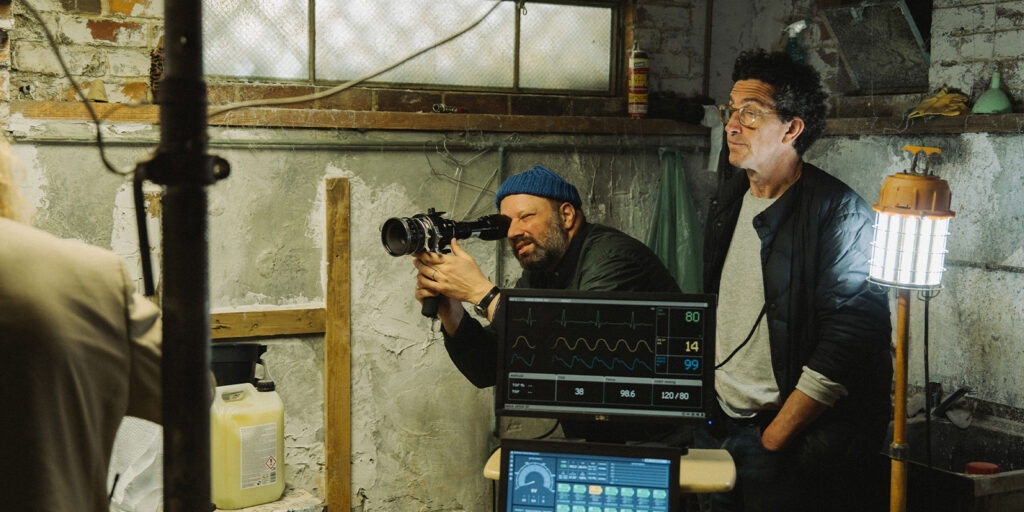
Outside of some action shots or sequences with no dialogue, most of the film was captured on the Wilcam-11. The process is “something you really need to commit to”, highlights Lanthimos, so the filmmakers designed the way to shoot according to the format. “When you have a heavy, big camera, it would be a more static kind of film, especially in those scenes in the house and in the basement,” the director adds.
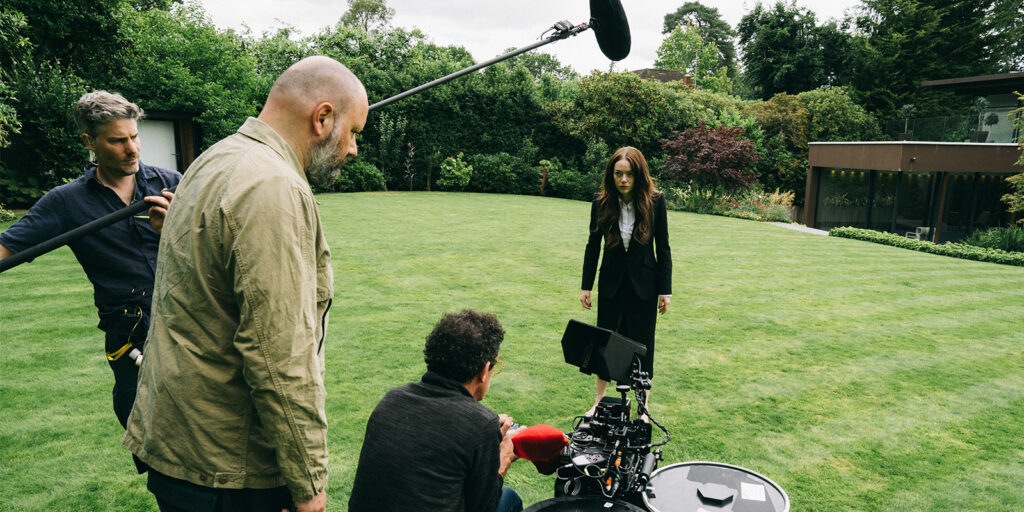
Working with such a rare and delicate system brought with it additional pressure for the camera team. “Nobody’s really shot with the Wilcam before, so it was a learning curve for everyone,” says Ryan, who singles out 1st AC Olga Abramson for her diligence and patience. “As soon as something goes wrong, everybody looks at the camera team. I appreciate that’s a stressful environment, but they did a great job.”
VistaVision technician Brian Udoff’s expertise was also essential when facing new shooting situations working with the format. “The Wilcam can do quite a few things,” Ryan explains, “but you can’t do a whip pan. Yorgos likes them, so we tried one when shooting a chair being thrown at the wall. We panned fast to follow the chair but because the film runs horizontally, when you pan too fast, you go faster than the pull-down and the image jumps as the camera jams.”
Character focused
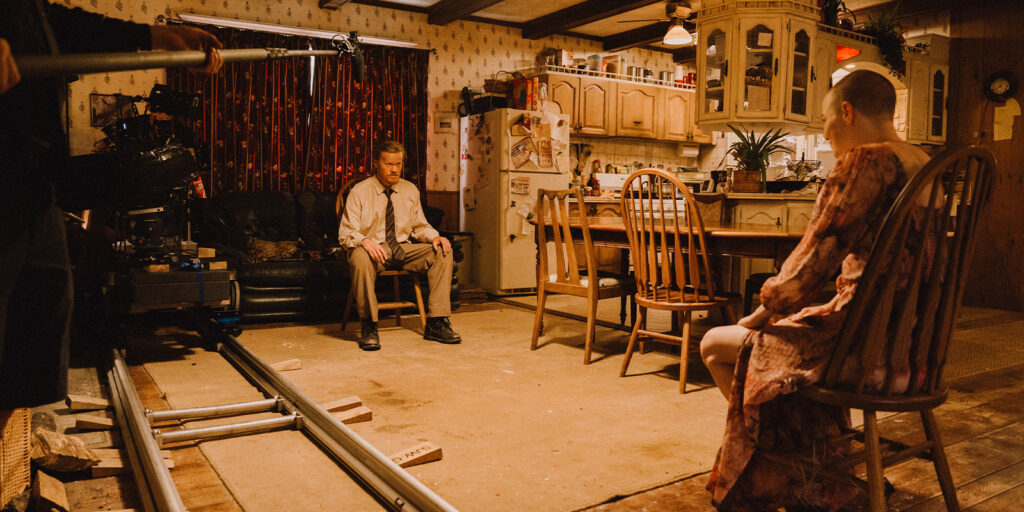
Unable to shoot handheld due to the Wilcam’s weight, the team adopted a more anchored approach, working with dollies and cranes. By limiting the environment in which the conflict takes place, the filmmakers “enhance the focus on the characters and what they represent, but also reveal that what appears obvious in the beginning might not be true,” Lanthimos says.
It was generally a one-camera shoot apart from some longer dialogue scenes which required two cameras. “And because the story was set inside the basement a lot of the time, the camera didn’t move much which felt right for the narrative,” Ryan adds.
But as Lanthimos’ cinematic approach is often based on impulsiveness, when one of the VistaVision cameras broke down one day, the director suggested moving to handheld for a basement sequence. “I’m totally used to doing something one way and then being told to switch to handheld. He’s so intuitive and spontaneous and I love that about him. You’ve got to be ready to adapt but I enjoy that.
“Yorgos is always edit orientated in his design and what he’s thinking of for a sequence. He knows what’s going to work for a section, but might not impart that information until close to the time you’re doing it. Like when we were shooting a sequence where there’s an explosion he said, ‘Maybe we should do this one at 150 frames per second.’ So we then sourced a 150 frames per second camera.”
Imperfections and happy accidents became part of the process of shooting in VistaVision, resulting in new solutions, crafting the film’s rhythm and reinforcing the creative and collaborative philosophy that defines Lanthimos’ sets.
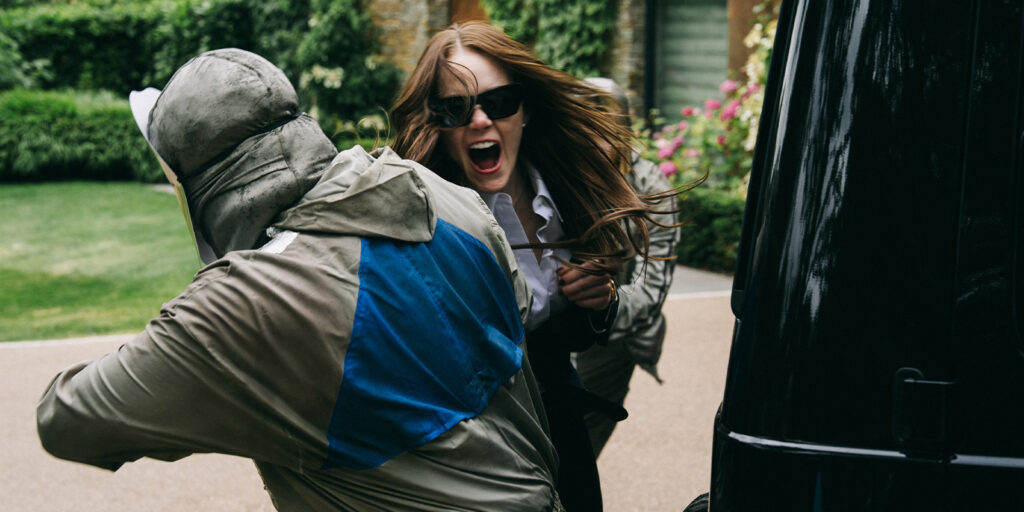
A scene in which Michelle is captured was shot in a house near High Wycombe on the Beaumont using a mixture of crane and Libra remote head on a dolly. “The Beaumont pretty much fits on most pieces of kit, but we needed to get used to it. For those moves, we tried a mixture of Steadicam, Libra head on arms or on dollies but never landed on one being the right kit. But that’s filmmaking; you have to adapt. But generally, it was mostly on dolly.”
Panavision prototype lenses, initially developed for Paul Thomas Anderson’s One Battle After Another, through close collaboration between Dan Sasaki and Anderson, became Bugonia’s workhorse glass. To achieve a look similar to the Super Speeds while covering the VistaVision format, the Panavision Special Optics team built a new set of prototype primes for One Battle After Another.
Ryan also used Panavision Primos for longer focal lengths, up to 180mm. “It was all about primes rather than zoom lenses,” he says. “As we made a creative decision to shoot a lot close-up we used the 35mm Panavision prototype lenses a lot as well as the 29mm and 21mm. They have their quirks and the results were beautiful.”
Lighting with restraint
As much of Bugonia’s narrative takes place in and around the house within which Stone’s character is confined, primarily the basement which becomes central to the story and visual language, production designer James Price revelled in the challenge of designing and building a fully functioning, 360-degree immersive environment. The house was constructed in Henley-on-Thames, UK, where the majority of the film was shot, doubling for America. “The house was amazing and James built it in six weeks,” says Ryan. “Builders would take longer than that!”
Instead of film lights, the house was wired like a real house, incorporating functioning power sockets and built-in fixtures. “As it was lit practically we would just turn lights on and off as needed, building tension,” he adds.
That restraint and embracing what the set provided aligned with Lanthimos’ style and any imperfections made the scene more authentic, helping create an unsettling atmosphere in the basement in which Teddy and Don are holding Michelle captive.
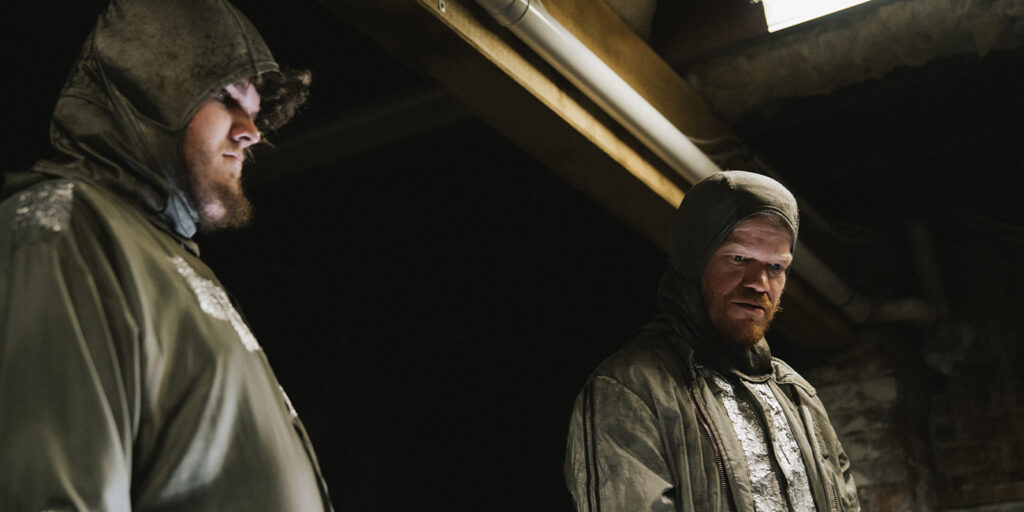
“Yorgos is great at finding the beauty in any lighting condition. For anything close to the world we live in, we didn’t add film lights which forces you to embrace shadows, to wing it a bit. Sometimes it doesn’t look perfectly lit, but that imperfection has its own beauty,” Ryan says. “As a cinematographer, you’re tempted to add a little light. But when you’ve got a rule book saying you should not do that, it forces you to prepare for that eventuality, and the result has a beauty to it.”
In technically intricate situations—such as a slow motion black-and-white flashback—Ryan still adopted a grounded approach, but this time working with film lights including a 20K outside the bathroom window to simulate daylight. Shooting at a studio in Reading to capture an otherworldly setting in which one sequence takes place, the crew went from practical lighting to an extensive lighting rig.
The intensity of the basement setting is increased in lengthy dialogue sequences which unfold in the oppressive space. Ryan and Lanthimos discussed how to differentiate each visit to the basement through subtle lighting shifts. The earlier sequences were darker while later visits became brighter, incorporating practical sources like fluorescents and exposed bulbs to shape the mood, while working closely with gaffer Jonny Franklin.
“Jonny is so talented so it was reassuring knowing you had the Rolls-Royce of gaffers,” Ryan says. “He also created a nice moonlight rig off a high lift crane featuring Creamsource Vortexes which he put a soft silk over.”
Colour also creating atmosphere, sometimes through happy accidents the filmmakers embraced. For instance, the area near the basement stairwell sometimes glowed with an unexpected reddish cast which came from the pink insulation foam under the stairs. “When tungsten light hit it, especially if we were shooting on daylight stock, it became more red which we leant into in the grade.”
There was often a green spike in the fluorescents which are common in old houses. These featured alongside warm tungsten and blue LED work lights to create a realistic impression of the normal range of lighting in a house. “It looks like it’s quite designed, but it was quite a haphazard room we tried to make feel as real as possible.”
Capturing contrast
Outside the house setting, the basement’s oppressive environment contrasted with the sterile office space in which Michelle works and lush, green exterior scenes of Teddy’s character cycling or close-ups of bees that open the film. The team took over a floor of an office in Slough which offered the cold, authoritarian feeling they sought for Michelle’s workplace.
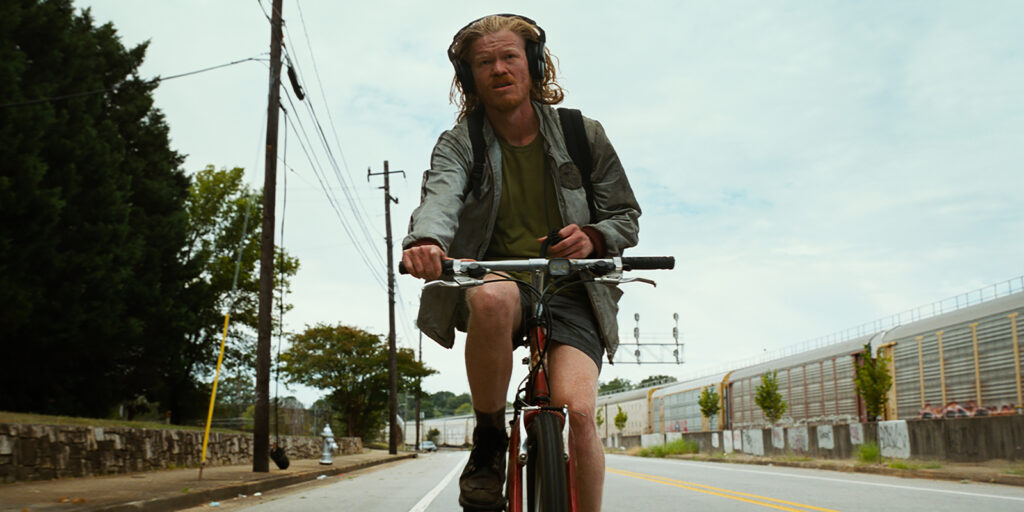
And for the scenes of Teddy on his bike, shot in summer, the countryside setting of Henley delivered the warmth, serenity and natural beauty to offset the claustrophobic interior environments. While the majority of the film was shot in the UK, some exteriors were captured in Atlanta, delivering a more believable setting for select sequences.
Shots of Teddy cycling were captured with the assistance of a talented grip team who introduced Ryan to the ??what?? remote head system created by an Atlanta-based company which was just coming off Superman and offered the required stabilisation and speed.
But ultimately Lanthimos wanted to explore faces more than places when working with the exciting VistaVision format. “He was more curious to create a film based around portraiture,” Ryan explains. “And the faces in this film were amazing. VistaVision shows every pore of Emma and Jesse’s face in close-ups. It flips the expectation of what you would think about the VistaVision format.”
Lanthimos adds: “Because VistaVision is a larger format, it gave a sense of this larger format portraiture that you find in still photography. It was more about the people and making them kind of larger-than-life and almost statuesque.”
Although unusual for a Lanthimos film, drones captured a beehive sequence on hilly terrain. He wanted the camera to move fast which a track or crane could not achieve on that terrain, so therefore an ARRI Arriflex 235 mounted on a heavy-duty drone was flown by operator Ben Platts, contending with hedgerows preventing the drone building up momentum.
While Ryan captured the majority of the film, often with a single camera—there were times when extra shooting support was needed. Close-up establishing shots of bees pollinating were captured by Ryan and second camera operator Matt Fisher, who also shot Steadicam sequences. “Every time we shot a scene around the beehives, we had to wear complete bee suits, so there were about 30 crew in these suits walking really slowly, looking like spacemen and women. It was such a funny sight,” Ryan says.
Processing was carried out at Cinelab, collaborating closely with Adrian Bull and his team who also worked on Poor Things. “We shot on Eastman Double-X Negative black-and-white film (5222) for the flashbacks and then the rest on Kodak VISION3 250D, VISION3 500T and quite a bit of VISION3 50D. We really liked the 50 Daylight and VistaVision combination and Cinelab’s support and expertise was essential throughout,” Ryan says.
Colourist Greg Fisher at Company 3, who has also worked on Lanthimos’ last few films, once again helped shape the final look in the grade. “He’s so diligent and has such a passion about every project that it’s a lovely knowing somebody of Greg’s level has got your back,” Ryan adds.
A format of the future?
As excitement builds around VistaVision and its power as a storytelling tool, with directors like Paul Thomas Anderson (One Battle After Another), Brady Corbet (The Brutalist) and Lanthimos embracing it, Ryan believes it might just be a format of the future.
The choice of format is infused in every frame of Bugonia, from close-ups of Stone and Plemons to claustrophobic basement sequences. “A lot of people talk about IMAX, but I think VistaVision is a perfect format because for many years, the SLR was basically a VistaVision-size film still. I’d love to do a photochemical VistaVision in future, like Paul Thomas Anderson did. I haven’t done one since 2004 and even then it was rare.”
Shooting an entire feature in VistaVision was an enlightening and educational experience: “It was a learning curve as we weren’t hearing how anyone else did it. One Battle After Another was being shot at the same time which was great because we were finding our own way and solving our own problems,” he says, advising others embarking on the same process to “test like crazy”.
“It’s like driving a vintage car. It’s not an easy format. Some are saying, ‘Oh, the cameras have been reconfigured so they are shoot ready’, but it’s not like that. It’s still a great format to shoot on, but it’s not easy and it has its own quirks. But it’s worth it and the results are amazing.”