
SHOOTING AT SEA
Largo is a short film about a Syrian child refugee living in foster care in the UK who attempts to build a boat and sail home to find his parents. Director of photography Rick Joaquim SASC explains how the filmmakers shot the climax of the film with a child actor performing stunts in the sea on a shoestring budget.
Our goal with Largo has always been to put the audience in the shoes of its young protagonist, Musa, and in doing so inspire some empathy for refugees after a decade of apathy and hostility pushed on us by news media and politicians.
To achieve this, our cinematography would need to be subjective, so the audience sees the story through the eyes of a child, but also simple, so the production caters to the needs of our lead actor, Zack Elsokari, who was just 10 years old and making his on-screen debut. Likewise, all the other departments would need to be working in the same parameters and in harmony with each other.
For the majority of the film, this would be as challenging as expected. But for the climax of the film, a stunt sequence shot in the sea, in British weather no less, this would pose a host of unique challenges and, inevitably, a few surprises. In the very first meeting I had with writer-director duo Salvatore Scarpa and Max Burgoyne-Moore (or Max & Salv for short), we were already talking in-depth about the practical and creative challenges ahead of us.
How do we make the scene feel dangerous and chaotic, but in reality ensure it is safe and controlled? How do we maintain a visual language between this sequence and the rest of the film? How do we keep the focus on the young actor’s performance, both on-screen and behind-the-scenes, despite all the distractions?
Ironically, shooting in the sea is inherently dangerous and chaotic, but making it feel dangerous and chaotic on-screen is incredibly difficult because you need to do everything possible to make it safe and controlled for your cast and crew.
The first step is assembling a team with experience and expertise. For this sequence, we managed to get Roy Taylor as stunt coordinator and second unit director in the water, Leonard Woodcock as stunt coordinator on the safety boat and on dry land, and Richard Stevenson as camera operator in and under the water, plus several stunt and safety divers.
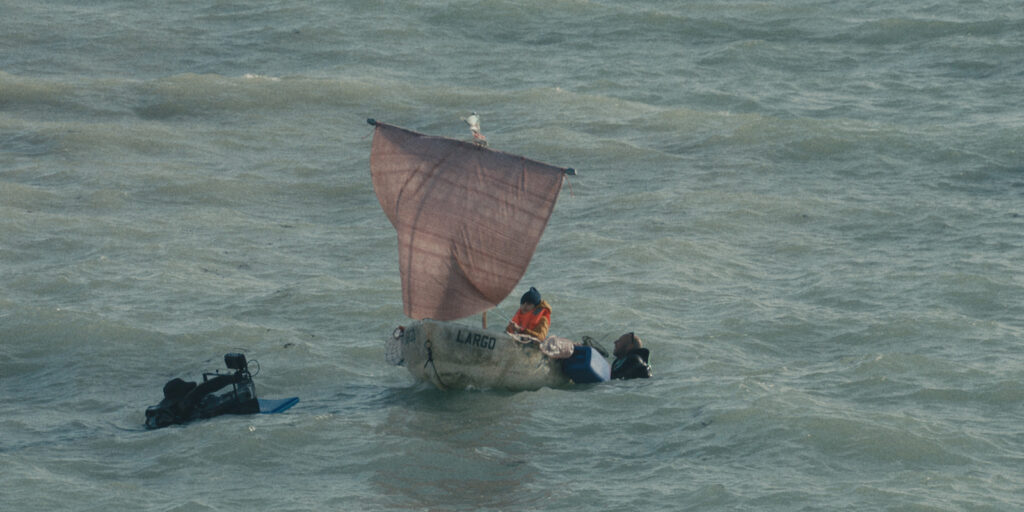
You might be looking up their previous credits and thinking, “I can’t afford a team like that,” but the truth is Largo was shot on a shoestring budget and we only managed to get them for one day. Their presence is a testament to the power of a great script and tenacious producers. With this team in the water, the directors and I were confident we could achieve the controlled chaos we needed.
The next step is preparation. When you’re shooting out at sea, there’s a lot you can’t control, but a lot of ways you can plan ahead to ensure you don’t waste time. You can’t control the sun, but you can schedule the shoot at a time of day that makes the most of the natural lighting and keeps the majority of your action back-lit, which stops it feeling flat against a featureless horizon. Make friends with your 1st AD and download the Sunseeker app on your phone too.
You can also scout a location that provides some visually interesting geography to keep the audience orientated and stops it looking like it was shot in a water-tank if it wasn’t. There’s nothing wrong with shooting in a tank, but on Largo we realised it was going to be cheaper (both on location and in post-production) to do it for real in the sea. Don’t forget that the location and time of day also need to factor in the tides. Finally, as always, you can’t control the weather, but you can be generous and considerate to your crew, then they will be there for you come rain or shine.
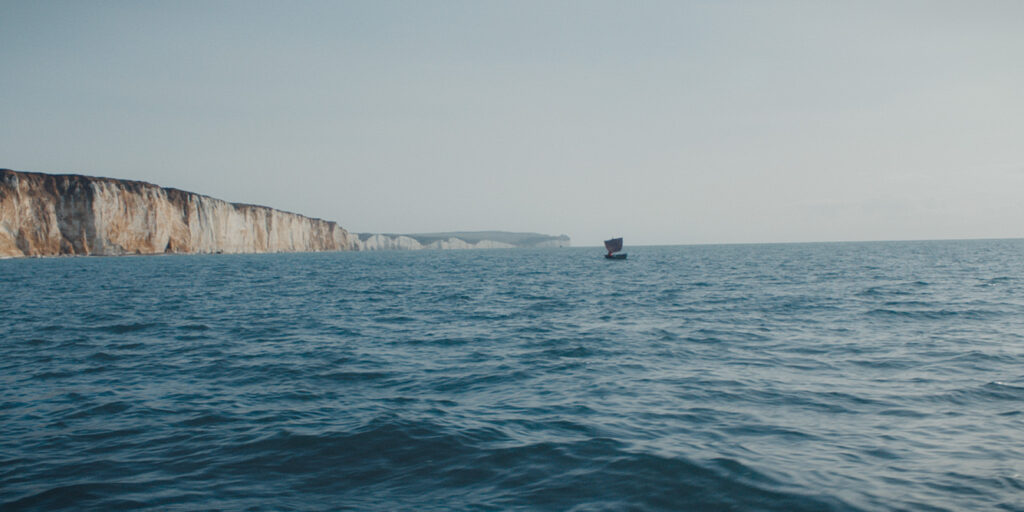
The next step is even more preparation. The directors and I don’t usually do storyboards, but we got out the pen and paper and drew every shot of this sequence weeks ahead of the shoot, so there was time for everyone to understand the vision and problem solve before it was too late. Here’s a great example of a problem we discovered and solved during this process: our production designer, Joana Dias, who was making a boat that needed to look like it was made by a 10-year-old boy but was safe enough to be used by a 10-year-old actor, realised the stunt divers needed ways to manoeuvre the boat in the waves and wind, but would be invisible to camera, so she disguised handholds and guideropes as props attached to the boat. In fact, she ended up making three different boats that served slightly different functions during the shoot.
The final step is shooting it. In the water, we had the stunt and B camera team on an ARRI Alexa Mini in waterproof housing with an Angenieux 16-40mm lens so we could reframe quickly without getting out of the water. On dry land, we had the directors and A camera team on an Alexa Mini with an Angenieux Optimo 24-290mm lens so we could capture the action from relatively far away. We had also chosen a location with a high pier that gave us an elevated vantage point to shoot the A camera from and helped shield the stunt and B camera team from the elements. The combination of handheld A cam and superzoom B cam amidst the waves and wind, plus the stunt team puppeteering the boat and directing little Zack, perfectly created the illusion of danger and chaos we needed to put the audience in the protagonist’s shoes and give the climax its emotional impact.
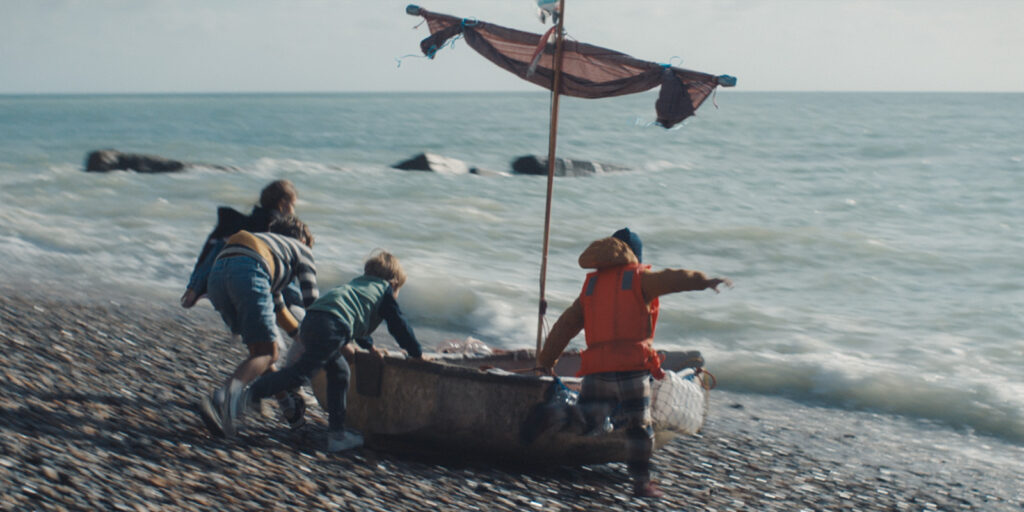
The visual language for the rest of the film, which would be tonally much calmer and practically easier to control, was designed to complement and contrast this sequence. Our production designer, Joana Dias, costume designer, Celestine Healy, and colourist, Karol Cybulski, took the blue-green of the sea, grey of the skies, and harsh orange of Musa’s life-jacket and infused them into every other scene. Our gaffer, Adam Trz, worked magic with natural and practical lighting throughout too. We kept the Alexa Mini across the board but on dry land shot on Panavision Ultra Speeds for the remaining three days of the shoot not at sea. These are some of my favourite lenses and they really helped create this naturalistic but filmic look the story needed.
Inspired equally by Steven Spielberg and Vittorio De Sica, our director duo wanted the camera to stay at the eye level of Musa/Zack throughout the film, so the audience can feel how big and scary the world seems when you’re a child, especially if you’re a child in unfamiliar surroundings, as a refugee is. This “visual rule” worked really well on land and at sea. I find it strangely helpful to impose limitations like this on ourselves so we don’t get carried away and waste time overcomplicating things. So we tried to never look down on Musa, but always at his level or just below, which made us feel connected to him.
Another key part of the film’s visual language is how we alternate between epic wides when Musa feels free and cluttered close-ups with dirty foreground when he feels trapped. Together they really convey his isolation. And it’s another “visual rule” that we could commit to both on land and at sea.
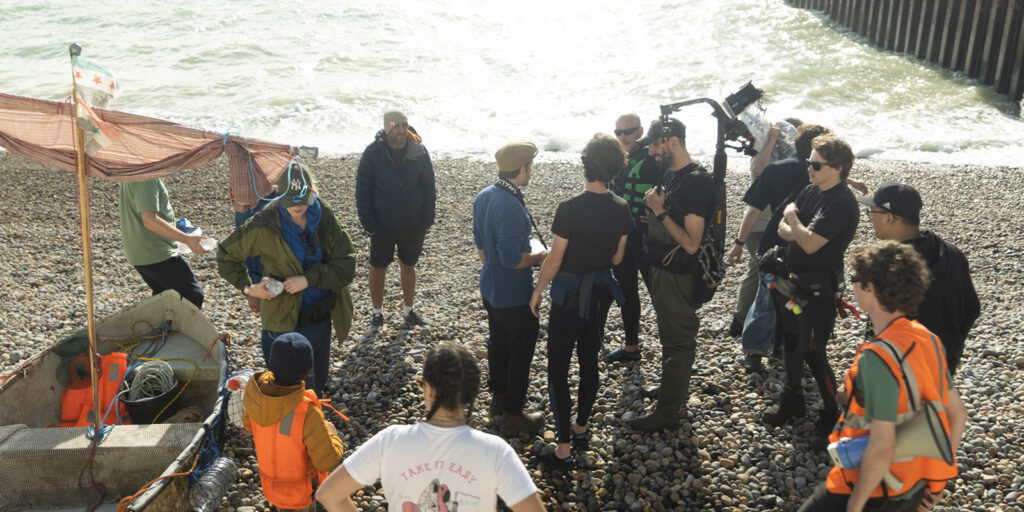
A major visual difference between the sequence at sea and the rest of the film on land is the camera movement. On land, we use a lot of long, slow, steady camera moves on the dolly. At sea, we’re all handheld. At first this was a practical necessity because we couldn’t stabilise a camera on the little boat due to budget, but creatively it also emphasises the panic and desperation in the climax of the story.
The common thread to all these creative decisions was keeping the focus on the performances and creating a really intimate connection between the audience and Musa. The simplicity of the visual language really helps avoid distractions for the audience on-screen and for the actor Zack behind-the-scenes. For the stunt sequence at sea, which still requires a really complex and difficult emotional performance from Zack, we avoided cutting and resetting as much as possible, and kept rolling even when we did need to reset, just to keep him lost in the moment and make sure we captured every last second of his performance. This also meant the stunt team could focus on their jobs and not worry about ruining takes, because all the coverage would have the same frantic energy so we would be able edit around any glimpses of them. There’s no VFX work at all in the sea sequence, it’s all done for real, and the audience is right there in the water with Zack throughout. I think the result is really powerful.
If it isn’t clear from all the name-dropping I’m doing, the secret to the film’s success and how we pulled off that climactic sequence is the close collaboration of the team we assembled. I owe a special thanks to my A camera team: Christian Wood as 1st AC, Luke de Borde as 2nd AC, Scott Rhodes as grip, and Amir Happy as our camera trainee. It’s also worth noting Amir was one of several displaced creatives who worked on the production as part of a programme to help refugees rebuild their careers in the UK film industry, which was run by the film’s producers with the charity Good Chance and hopefully will continue on other productions.
Largo is an ambitious short film with a really important message. It’s currently “for your consideration” for the live-action short film Oscar and BAFTA, and playing on the festival circuit, but next year it will be screening for free in schools throughout the UK as part of Refugee Week to help raise awareness and bring empathy back into the narrative around refugees.