AN UNLIKELY LOVE STORY
Huntsman is a short narrative drama filmed in Somerset, England. Set the morning after New Year’s Eve, a boy tries to salvage his relationship with the girl that he’s seeing, but as we learn his story, we find the truth is far more complicated. It’s a film about modern-day relationships and about how most people are after a relationship for the chase or for the hunt.
This film was a challenge, not just technically or logistically, but politically. The story centres heavily on The Hunt, which, at the moment in the UK, is an explosive topic and often divides people.
With the UK government currently discussing a ban on The Hunt across the UK, I felt that now more than ever, this story should be told. But the film doesn’t take a pro-hunt or anti-hunt stance; it takes a neutral stance and leaves the viewer to pick a side – because this is not a politically motivated film, it’s a film about a boy who loves a girl.
During location scouts in pre-production, we visited countless different places, explaining the theme of the film. Despite the film’s neutral stance on The Hunt, the crew was faced with fear from the community, including arguments, online hate, and threats to burn down establishments if we wanted to film in those locations. What I saw was a community divided.
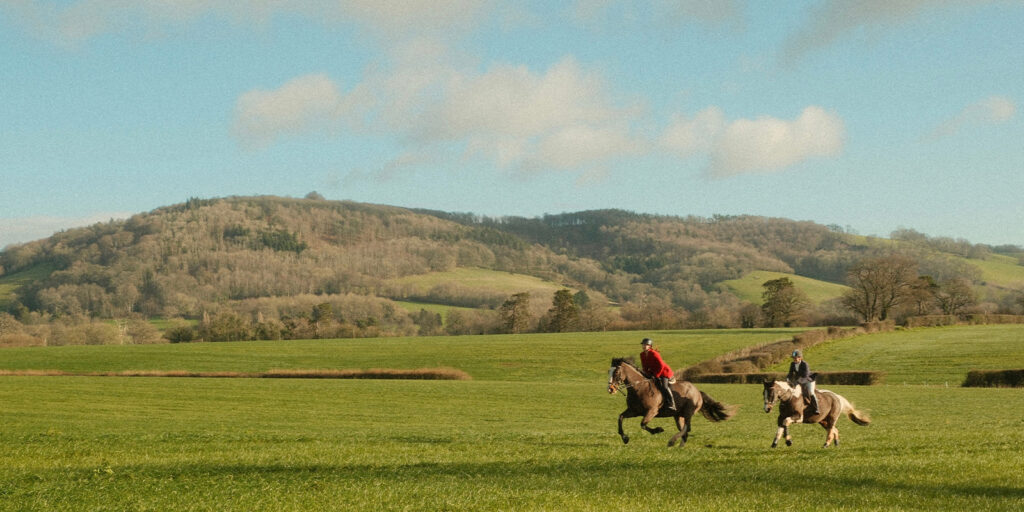
However, the main question I’ve been asked is, “Why did I want to do this?” One reason was that I knew I wanted to tell a rural story in the UK, with something that illustrated heritage. Still, the other reason was that one of the main themes of the film is hunting down what we want and what happens when we get it, and I believed there is nothing more metaphorically or viscerally gripping than The Hunt to illustrate this.
Using natural light
The DP, Jake Langley, and I are firm believers that natural light is the best light you can get, and with this film predominantly taking place outdoors, it was great. Lighting was kept to an absolute minimum on this project; we used natural light wherever possible and lit interiors only when necessary. However, the downside is timing: when you want natural light, our shoot days are bound to sunrise and sunset and with a film set in winter, this was a challenge.
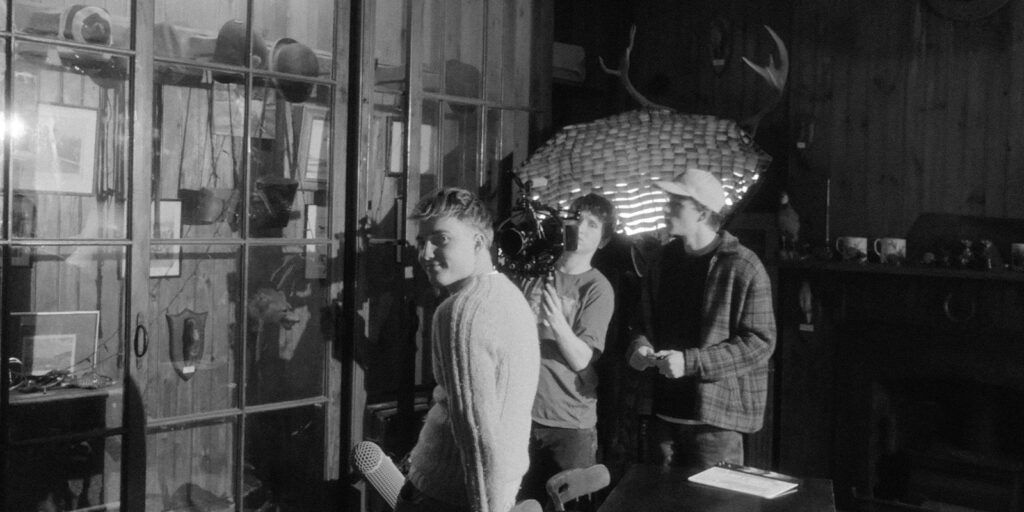
Jake said, “We knew we wanted sharp sunlit shadows on our interior scenes to try and build some drama and to show a passing of time throughout the film. We quickly realised we couldn’t rely on natural light for this effect due to constant cloud cover and rain. The solution we deployed was two large lights rigged on light stands outside of our locations, shooting through the windows in a warm white. This allowed us much finer control, letting us create shadows with a dual-key and bounce-light setup. When paired with wonderful anamorphic lens flares coming from the window, we managed to sell the idea of natural lighting progressing throughout our story.”
Because of the grounded, rural approach, I wanted the project to be very conscious of cinematography decisions. We shot on a Blackmagic camera with a range of Sirui anamorphic lenses and a 2.35:1 aspect ratio. The anamorphic lenses were key for holding the width of the countryside and letting the landscape breathe in the frame. That horizontal space helped keep distance between people, animals, and the environment, and gave the images weight.
Grounding the story
Shooting this was a logistical challenge. I was insistent that any shots with the horses and The Hunt had to be tracked in a car or moving in some way. I wanted the viewer to feel they were right beside The Hunt as they gallop across the Quantock Hills, almost as if they were on a horse next to them.
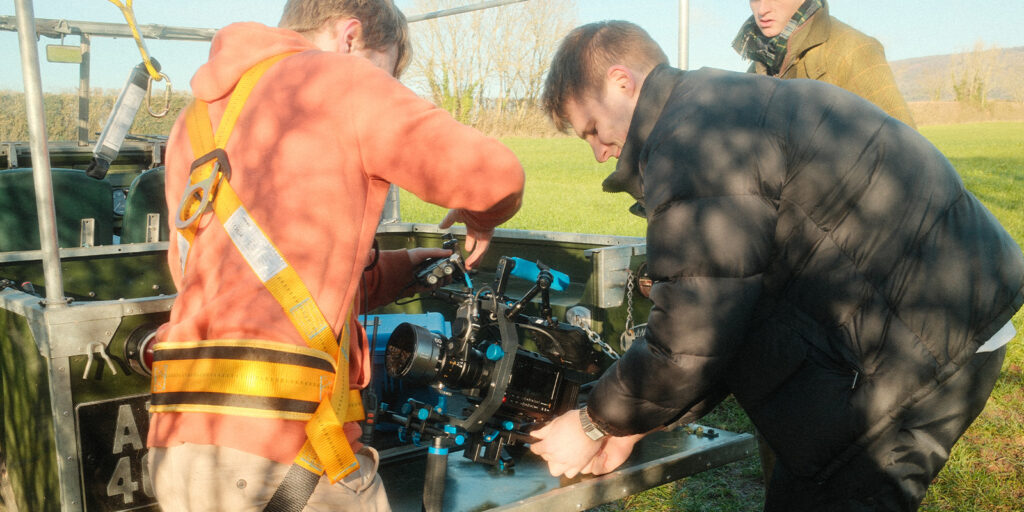
Jake added, “Our first shoot day covered all of the horse shots. We knew early in the planning stage that most of these shots would be tracking shots of the running horses, to maintain pacing and tension. We knew we would have to have a camera car run alongside the horses, run wireless video transmission and a wireless follow focus system to a camera assistant sitting in the car’s passenger seat.”
We harnessed Jake to the camera car and shoulder-mounted the camera rig. This, paired with the Sirui anamorphic lenses, the natural light, and the Quantock setting, allowed us to capture both the elegance of the horses and the dangerous speed at which they went.
I’m a firm believer that the 2.35:1 ratio almost gives the viewer their peripheral vision for the film; we get the feeling that we’re right behind the characters as we learn their stories and witness their struggles. It’s not like 4:3, where we get tunnel vision. I want the viewer to be completely submerged in the story, and when you’re trying to give the feeling of riding next to a horse, the aspect ratio was crucial.
With the Blackmagic as an A-cam paired with the Sirui Lenses, we also had a Canon C200 as a B-Cam with Samyang lenses. The B-Cam wasn’t necessarily used; if anything, it was a backup. The drawbacks you have to deal with when working in these rural areas include a lack of power. There were some days when we had run out of generator power, and we would struggle to power camera batteries, lights, or anything. But because this story was set in a rural environment, the natural light would help the scenes.
Huntsman was a project I hope people will relate to and empathise with in so many ways, because they have either experienced it or are experiencing it. Because of the politically sensitive subject, this film felt like we were walking on ice, but we were comfortable with this, as at the centre of the explosive theme was a grounded story of a modern-day relationship.