
COLD CALL
New horror Black Phone 2 boasts a number of shocking sequences, but none as memorable as the climactic finale set on a frozen lake. DP Pär M. Ekberg FSF recalls how he and the team put it together.
The most intricate scene in the film was undoubtedly the climactic sequence set on a frozen lake. This scene demanded a delicate balance of practical and visual effects, complex lighting for both day and night, and precise coordination across departments.
Initially, we considered shooting on location, but unpredictable weather, ice conditions, safety concerns, and the challenges of night shoots quickly ruled that out. Instead, we opted to construct the lake on a stage, which introduced its own set of challenges.
The set had to be large enough to feel expansive, convincingly mimic ice, and integrate seamlessly with a blue screen background for the Colorado Rockies, crafted in post-production.
A critical element was the ice itself—characters needed to shine lights through it to search for bodies, chop holes, and even plunge into the water. To achieve this, we built two key sets. The main stage, designed by the talented Patti Podesta and her team, featured a meticulously layered ice surface with practical foreground elements like snow, trees, and rocks to conceal the blue screen seam.
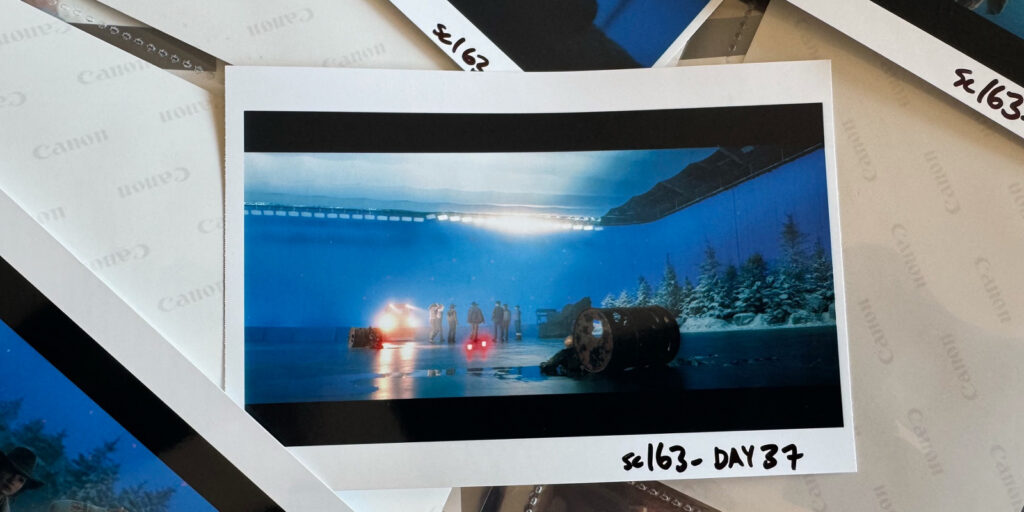
This allowed VFX supervisor Ivan Moran to add depth, perspective, and translucency in post, bringing the ice and distant mountains to life. For scenes requiring direct interaction with water, we constructed “The Tank Top”—a smaller ice platform elevated over a water tank for inserts and actor interactions. A separate underwater tank handled all subsurface shots.
Filming most of this sequence at Studio City in Toronto, I worked to create consistent lighting across these sets, despite challenges like limited ceiling height for rigging on the largest stage. The sequence blended formats, with parts scripted for a Super-8 aesthetic and the rest captured on Sony Venice with mixed optics for a final anamorphic 2.40:1 aspect ratio. This mix demanded careful calibration to maintain visual cohesion.
Adding to the complexity, this sequence served as the film’s big resolution—the culmination of the entire plot—requiring us to track a pivotal storyline while constantly jumping between sets and bouncing around the narrative timeline for practical reasons, like actor availability, stunt safety, and set resets. Yet, we had to keep everything tightly woven in feel and pacing. My focus was ensuring the lighting and camera work mirrored the story’s chronological progression, evolving subtly from tense buildup to cathartic release. This meant meticulous planning: adjusting light temperatures and intensities to reflect shifting “time of day” across non-linear shoots, while camera movements built emotional momentum without betraying the jumps. It was a high-wire act of coherence, blending technical precision with narrative flow.
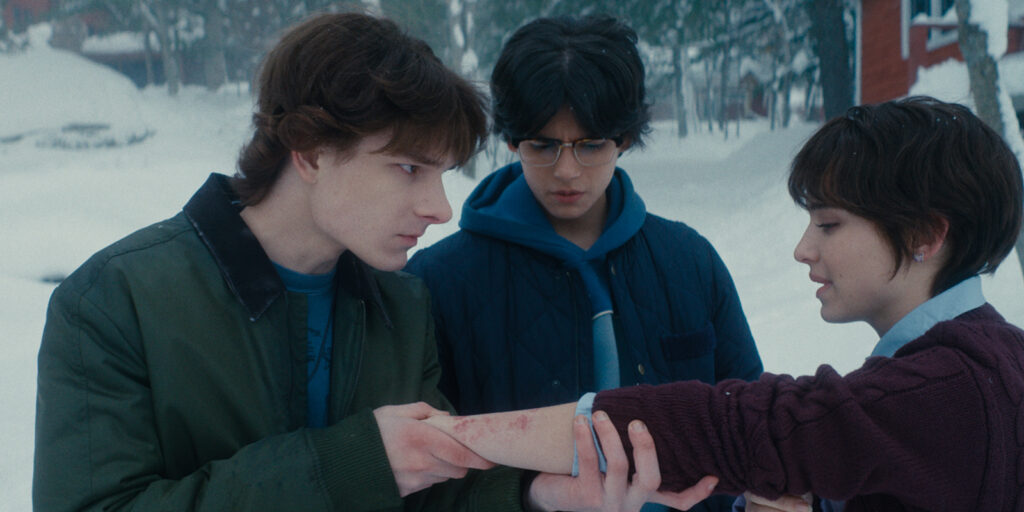
The final sequence was a true test of filmmaking craft—combining SFX, VFX, stunts, prosthetics, animals, vehicles, and water work, all while telling a nuanced, emotionally charged story. I’m incredibly proud of how this complicated sequence came together, balancing practical challenges with aesthetic ambition. The only complications we didn’t face were weather and babies!
The ice lake sequence is the climactic pay-off of the film, tying together its emotional and narrative threads in a thrilling, visually striking way.
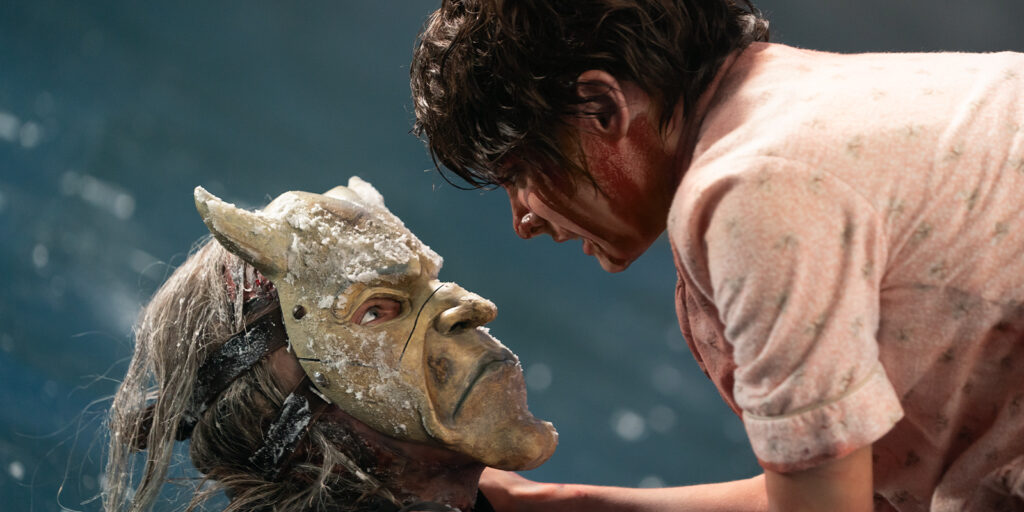
In this scene, the antagonist, known as the Grabber, unleashes his full supernatural force, revealing his dark intentions even to those less attuned to the psychic undercurrents surrounding our protagonists, Gwen and Finn.
With the entire ensemble gathered on the frozen lake, the Grabber battles to maintain his magical power, which hinges on keeping the remains of his past victims trapped beneath the ice. Gwen and Finn, however, fight to free these souls, aiming to destroy the Grabber’s evil influence. What unfolds is an epic clash of good versus evil—flesh-and-blood characters against a menacing otherworldly spirit—packed with intense action beats and stunning visuals.
Grabbing opportunities
I chose to highlight this scene because it encapsulates everything exhilarating about complex filmmaking. It demanded seamless collaboration across departments, intricate logistics, and constant communication to execute a sequence of this scope.
Most crucially, it required us to balance the technical demands—special effects, stunts, and visual effects—with the story’s heart: the mood, pacing, character arcs, and the deepening relationships that have evolved since the film’s start.
The Grabber’s malevolence amplifies in this scene, revealing new layers of his character, while the protagonists’ bonds intensify, driving the emotional stakes higher. Crafting this puzzle without losing the narrative’s core was a challenge I relished, and I’m proud of how it delivers both spectacle and substance.
The ice lake sequence demanded the full range of camera tools we used throughout the film, carefully selected to enhance both the narrative and visual texture. For the majority of the production, including this sequence, I relied on the Sony Venice 2, paired with Cooke Full Frame Anamorphic lenses to deliver a lush 2.39:1 aspect ratio.
This combination of camera and lenses provided a cinematic depth and richness ideal for the movie’s epic scope. I also leaned into the gorgeous warm tones this camera and lenses are able to deliver. For high-speed moments requiring resolution and that distinct anamorphic feel, I turned to the Hawk MHX lenses, which performed beautifully.
A third of the script, including key moments in this sequence, unfolds in the supernatural realm and Gwen’s dream sequences, where we embraced a Super-8 aesthetic to evoke an unsettling, otherworldly vibe. The same way it was used in the original movie “The Black Phone”. Using a mix of vintage and new or revamped Super-8 cameras (Beaulieu and Kodak) and lenses, we achieved a grainy, jittery, slightly defocused look—perfectly “dirty” in the best way—that shines on the big screen.
The format’s inherent quirks, like limited registration, sensitivity to dirt, and need for high light levels, added visceral texture to these dream sequences, making them hauntingly memorable.
However, the Super-8’s limitations posed challenges for VFX-heavy moments and intimate dialogue sequences. To address this, I developed a hybrid format I called “Super-12,” a cropped 2.39:1 version shot on Super-16 with Arri 416 cameras and vintage Zeiss High Speed lenses. This approach retained the gritty, imperfect charm of Super-8—grain, texture, and all—while offering higher resolution for complex VFX work. For select shots, we also used the full width of the Super-16 negative to maximize flexibility. This blend of formats allowed us to balance technical precision with the raw, evocative aesthetic that the story demanded.
And, as a little challenge, I slipped in a single zoom (Angenieux 8-81) shot in this sequence—see if you can spot it in the film; it’s not too hard to find!
Lighting the lake
To light the ice lake sequence, I aimed for a minimalist yet versatile setup that evoked the ethereal glow of a snowy, moonlit night—a look I know well from my childhood in Sweden. The centerpiece was a massive overhead soft box spanning the entire stage ceiling, built with a grid of ARRI SkyPanels diffused through magic cloth. This created a dim, starry ambiance that reflected beautifully off the ice set, capturing the serene yet haunting tone of the scene.
I divided the overhead into 32 checkerboard-patterned squares, each independently controlled via the dimmer board. This allowed me to shift the intensity dynamically, focusing light on specific areas of the ice while fading others for subtle directionality. For the few daytime shots, I could ramp up multiple squares to achieve a brighter, more even spread.
The dimmer-controlled system proved invaluable for seamlessly adapting lighting levels between formats—Super-8 and Super-16 film for the dream sequences and Sony Venice 2 HD video for the main action. The Super-8 parts required high light levels to perform, while the Venice 2 works great in low light situations.. By fine-tuning the SkyPanels’ output through the dimmer board, I could instantly adjust intensity and color temperature to suit each format’s unique needs, ensuring visual consistency across the sequence’s varied textures without relighting the set.
Complementing the softbox, I used truss runs and towers rigged with rows of Vortex lights to provide soft backlight edges, enhancing definition and creating shimmering reflections in the ice. These also doubled as directional sunlight for daytime scenes. To illuminate the bluescreen background for the Colorado Rockies, I deployed separate truss runs and floor rows of SkyPanel 60s, ensuring clean VFX integration.
On the ground, a few SkyPanel 360s offered soft but directional fill, through silk rags, while directional Q6 and Q8 units mimicked the warm, directional glow of vehicle headlights, adding narrative realism. Once the rigging was complete, I controlled the lighting primarily through the dimmer board, with minimal adjustments to towers and ground units, allowing flexibility and efficiency during the shoot. I applied the same principles to the Tank Top set, ensuring visual consistency across both set-ups. We also had a very big and tall goal post type Blue Screen that was engaged for low angle shots where the camera would otherwise have been looking straight at my soft box. We lovingly referred to this as “The Behemoth”.
Shout-out to my electrical and grip brothers and sisters led by the excellent gaffer Michael Hall and excellent key grip Jimmy Holmes. They did a marvellous job.
Making moves
Our approach to camera movement was consistent throughout the film and fully realised in the ice lake sequence, balancing emotional depth with dynamic energy. For the actors’ key emotional performances, we prioritised a calm, restrained camera language, often letting the camera rest or subtly adjust to their movements. This approach amplified the poetic drama, allowing the beauty of the performances to shine without distraction. In contrast, the dream sequences and select action beats embraced a more dynamic, handheld style, particularly with the Super-8 format. The grainy, jittery texture of Super-8 paired perfectly with this active, visceral camera work, heightening the unsettling, otherworldly feel of those moments.
For controlled scenes, we relied heavily on Steadicam, dolly, or the Moviebird crane paired with the Matrix remote head, which offered precise, fluid movements to complement the narrative’s intensity. I just love that head. This combination allowed us to craft a visual language that supported both the emotional weight and the kinetic energy of the sequence, ensuring every move served the story. Obvious shout-out here to A-camera/Steadicam operator Steven French.
Summarising the ice lake sequence feels like trying to capture a whirlwind—it was an immense challenge that demanded meticulous planning, creative problem-solving, and seamless collaboration across every department.
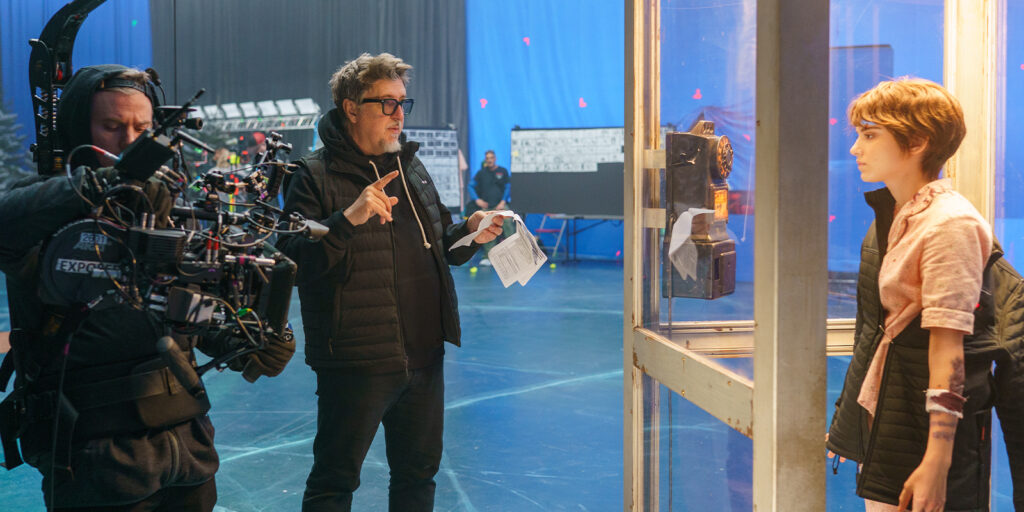
As a director of photography, my goal is always to interpret the director’s vision while weaving in my own visual style, and this sequence was a perfect example of that balance.
Director Scott Derrickson brought an extraordinarily clear and vivid vision to the table, with an internal map of the sequence’s geography, timeline, and emotional beats that guided us from the moment we stepped onto the stage. Leaning into Scott’s clarity was invaluable, especially when navigating the initial hurdle of visualizing such an intricate, multi-layered sequence—something I believe audiences will feel when they see the film.
What made this sequence truly special, though, was the collaborative spirit of our team. As a DP, I strive to be both a co-creator and a leader, fostering an environment where every department’s expertise can shine while keeping the story’s heart at the forefront.
From the production design (killing it with the demanding ice surface) to VFX, stunts to lighting, we worked as a unified force to bring this ambitious vision to life, balancing technical precision with emotional resonance. I’m deeply proud of how the sequence turned out, and I hope audiences are as captivated by its intensity and beauty as we were in crafting it.
I’d be remiss not to give a final shout-out to our exceptional second unit DP, Ben Lichty. His ability to seamlessly pick up the pieces that didn’t fit into the main unit’s schedule was a game-changer. Ben not only executed my lighting and camera vision with precision but also infused his own creative flair, elevating the sequence while maintaining its cohesive look.
This project reminded me why I love this craft: it’s about building something extraordinary together, where every voice contributes to a shared vision. I hope that collaborative spirit shines through on screen, leaving viewers as inspired as we were.