
LAIRY BIKER
Nick Morris brings a restrained, emotionally precise visual style to Harry Lighton’s Pillion, balancing kink, tenderness and British grit through vintage lenses and composed camerawork.
When Nick Morris was first contacted by writer-director Harry Lighton about shooting British comedy-drama Pillion, there was no script. Just a copy of the Adam Mars-Jones novella Box Hill. Set in the ’70s, the story follows Colin, a young man who enters into an intense dominant/submissive relationship with Ray, an older biker. Morris was intrigued but concerned. “My initial response was ‘Wow. Well, this is a very unique world, but I wonder how it would translate in 2025?’”
Casting Harry Melling and Alexander Skarsgård as Colin and Ray, respectively, Lighton lightened the tone, as he brought the affair into the 21st century. “It started as a really precise emotional drama, but gradually we rediscovered it as kind of a rom-com,” says Morris, noting that Lighton desired a “pared-back” visual style to match on-screen events. Influenced by Nick Waplington, the British photographer known for documenting subcultures, as well as Alfonso Cuaron’s Roma, the director “wanted it to be very, very considered and really restrained, in terms of what we did with the camera.”
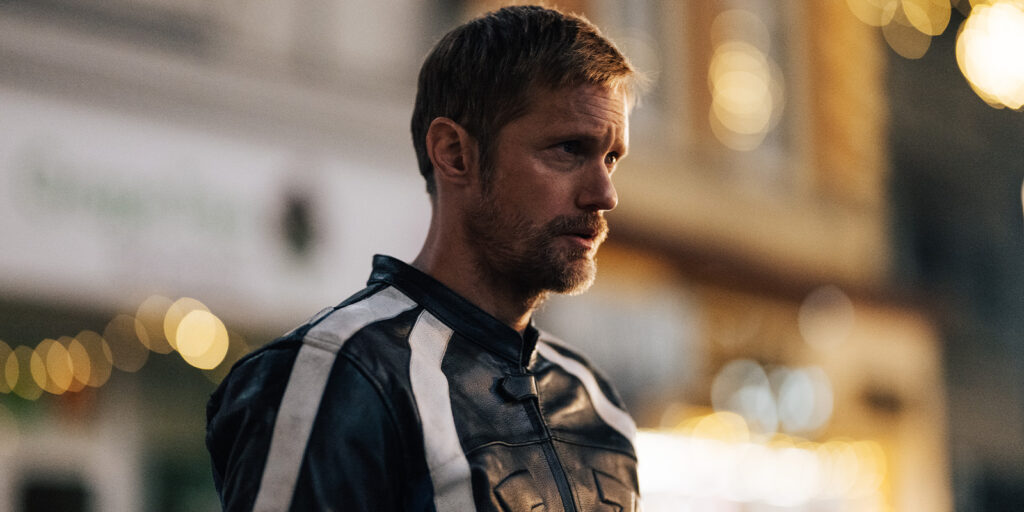
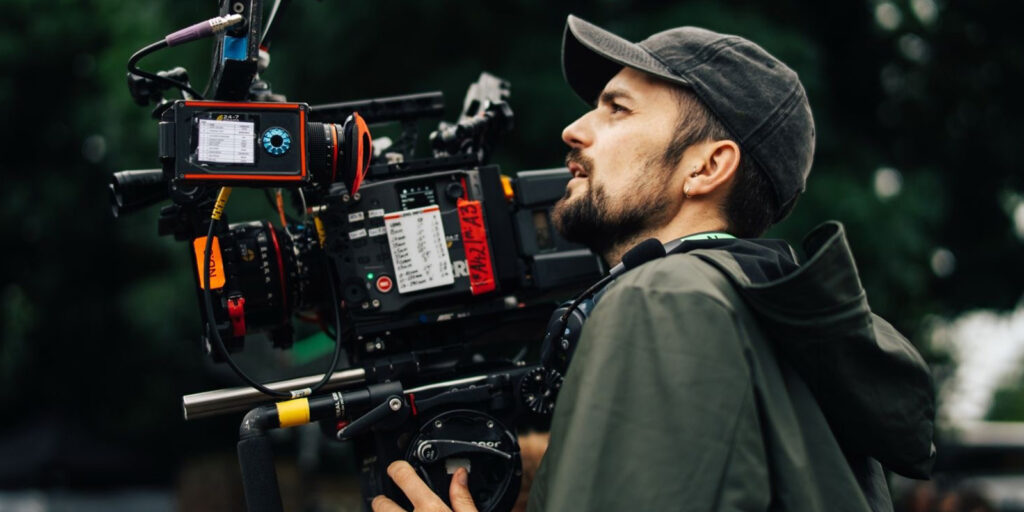
With the film playing out either in domestic settings in suburban England, or the occasional woodland exterior, Morris dreamt of shooting on film, looking first at 35mm and then at 16mm. “I do love 16mm as a format, but I felt it was going to be too degraded, too nostalgic, too softened.” He knew the film was all about challenging what a ‘traditional’ relationship looks like, and shouldn’t be overtly romantic. After testing around nine cameras, he chose to shoot digital, with the ARRI Alexa 35, with which he’d shot the first season of Sky Atlantic show Sweetpea. “It’s just super bulletproof and really reliable.”
Pairing the Alexa 35 with Canon K35 lenses, Morris tested the optics in an outdoor setting, in preparation for the key scene where Ray and his fellow bikers take Colin and the other subs into the woods for a day out. These vintage lenses offered the right amount of sensuality. “We were like, ‘Oh, actually, wouldn’t it be really nice when we look up at Ray and there’s the soft trees behind them, that there’s a swirl of something romantic in the bokeh around him.’ Harry reacted very well to that.”
Handling the camera, there was no Steadicam on set. Instead, they used Dolly track, tripods and a DJI Ronin RS4 Pro used with a RED Komodo X. The scene where Ray and Colin wrestle in Ray’s living room, for example, was all shot with the lightweight DJI gimbal. “It’s a very tiny little space, and we’re very low to the ground,” says Morris, who operatedremotely while key grip Ed Livesey got close to every grunt and groan in the scene.
Intimate craft
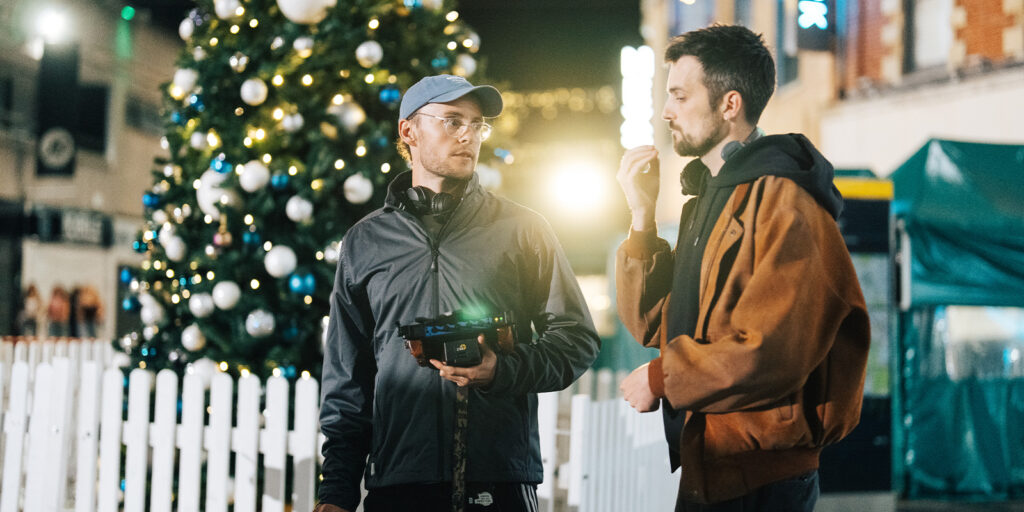
Set partly around Christmas time, the big issue was timing, with a five-week shoot scheduled across August and September 2024. Taking place on Christmas Day, Ray and Colin’s first date, initially set in a woodland, was shifted to an alleyway off Bromley High Street, when it was clear how tricky it would be to create a wintry forest in summer. The council even erected Christmas lights to give the backdrop a festive feel. “Considering our resources, I was thrilled with how those scenes turned out,” says Morris.
Lighting-wise, Morris strived to contrast the warm domesticity of Colin’s parents’ home with the stark interiors of Ray’s apartment. “We approached the lighting in an environmental sense, where we almost never had anything on the floor. We kept things completely out the way of the actors.” Morris even leant into the lighting set up in the location where Ray’s home was shot. “It was full of overhead spotlights, which are normally the bane my life.” Instead of covering them up, they were embraced to add a certain harshness to the space.
With the script also demanding a lot of biking scenes, especially when Colin takes Ray’s steed for a joyride at night, the production used a Bickers’ motorbike banking rig. “It attaches to the front forks of the bike and drags the bike on the road. Meaning as you turn corners, it will bank with them effectively. It’s much more believable than a low loader,” explains Morris, who also utilised a small Technocrane to capture an array of on-the-move angles. “That was probably our most expensive shoot day.”
When it came to the film’s explicit moments, “Harry was really adamant that he didn’t want to hold any punches on the sex of it all,” notes Morris. “[He felt] it’s going to be really toothless if it’s not graphic.” Among them, the woodland sequence, which included a ninety-second unbroken take, following bike stunts before finding trestle tables where the subs are waiting for their masters.
Morris praises Robbie Taylor Hunt, the film’s intimacy coordinator, for helping put the actors at ease. “If they’re not handled quite right, those scenes become a real quagmire to work through. And instead, we managed five takes of that one-er, while the light was dropping, all with a really jubilant vibe.”
In post, Morris worked with long-time collaborator – colourist Toby Tomkins at Harbor Picture Company to refine the look, “Toby is such an asset – we see the world in the same way.”
Pillion screened in Un Certain Regard at Cannes, and was recently crowned Best British Independent Film at the BIFAs. “It wasn’t until standing in the Cannes ovation, that I realised that the film we’d made was so accessible. That all these people could see themselves in this little film we made about bikers in Bromley. I think that’s Harry’s exceptional talent as a director – he finds something universal in the most unusual places.”