
TOMB RAIDERS
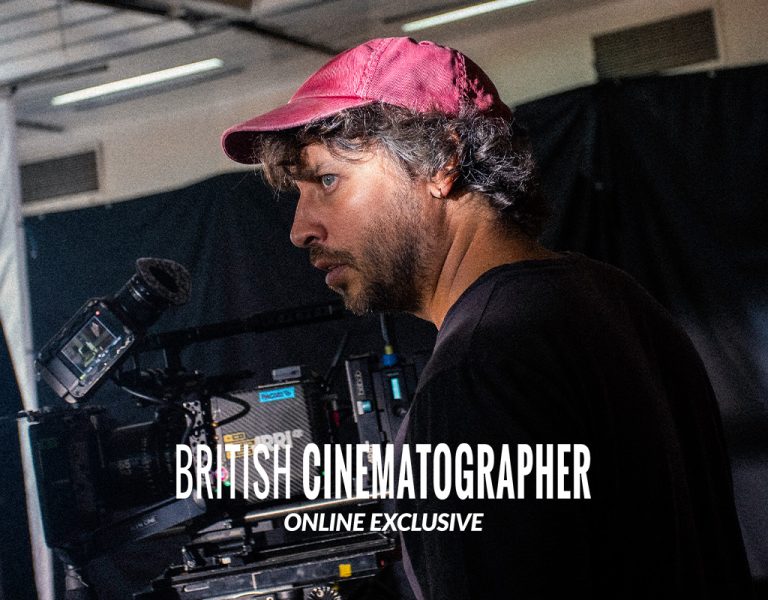
Following archaeologist Kathleen Martinez’s search for Cleopatra’s tomb, Cleopatra’s Final Secret features desert and underwater expeditions on the Mediterranean Sea. DP Mikołaj Bakalarz runs through the challenges and joys that this historic journey presented.
How do you bring cinematic visuals to documentaries, whilst working with a small team in one of the most extreme environments on the planet? How do you tell an unscripted story that unfolds in front of your eyes, with only a fraction of the budget usually seen on the big screen? That’s the sort of improvised yet intentional filmmaking I always admired and aspired to make.
Cleopatra’s Final Secret, produced by Lion TV, took a lot of preparation and planning, not just visually, but physically and mentally, to overcome conditions that both kit and crew want to limit exposure to – dust and sand, mixed with salt water and extreme heat. From day one, I knew this was going to be a challenge.
Visual research
Dune is one of my favourite stories, and Greig Fraser ACS ASC’s visuals for its latest adaptation are in my opinion some of the finest that cinema has ever produced – especially when it comes to desert filmmaking. So, when I found out I would be shooting a feature doc set in a stunning Egyptian landscape, following one woman’s quest to uncover the holy grail of ancient archaeology – the lost tomb of Queen Cleopatra – I was both excited and terrified.
As often happens, a development producer had suggested very ambitious visual language (in this case inspired by Denis Villeneuve’s recently released epic). But the reality, versus what can be suggested to a commissioner in an instant, is a very different story. Visually, I began my research by rewatching Dune for the nth time, and browsing through ShotDeck to find references of great cinematography in desert environments – I forensically reviewed Indiana Jones, Mad Max, Sicario, Lawrence of Arabia and many others. ShotDeck became an invaluable tool for this project, helping shape ideas of the type of images myself and the team would be looking to capture on location.
The biggest challenge to achieving these sorts of visuals was going to be the environment. Having spent a significant amount of time working in the deserts of Jordan and Tunisia before this shoot, I knew that the heat and the sand can prove to be really challenging, especially when your crew is tiny.
Not only do cameras overheat, but lenses get dusty, and the sunscreen ends up all over your kit. You physically can’t handle shooting or carrying gear around for a long time, due to heat exhaustion. The terrain you operate in is full of hazards – you walk carefully to avoid spraining your ankles and tripping on sharp rocks. In general, you spend more time doing the simplest of tasks – both because things are harder in the heat, and because you must be more careful than usual. Most importantly, you focus on making sure your teammates are doing alright, that you’re all hydrated, able to do the job and return home safely.
Every time you’re about to enter an ancient tomb, you ask if it’s been checked for rattlesnakes, flesh-eating scarabs, or any potential mythical plagues…
This project had more than just the heat to deal with – it followed a live expedition, both on the land and sea. It took us into mysterious underground tunnels, ancient tombs with mummified skeletons, and into the depths of the Mediterranean Sea. It also included talent such as the world’s leading archaeologist in the search for Cleopatra’s Tomb, Kathleen Martinez, as well as the world’s most renowned oceanographer, Robert Ballard – the man who in 1985 found the Titanic.
They were joined by the Egyptian Navy, and a slate of archaeological experts and underwater specialists rarely assembled in one room together. All these things combined to make this project one of the most unique documentaries you will ever watch, so the stakes were high. We had to make sure that what the camera saw was as beautiful and awe-inspiring as it was in real life.
Crafting the kit
The A-camera used on most of the shoots was a Sony FX9. It was supplemented with a range of other cameras, some to be used in deep underground tunnels and tombs, others on small boats with very little space to manoeuvre. Since we couldn’t always be in multiple places at once, we sometimes handed out iPhones to contributors – just in case they made a major discovery, and we didn’t have an operator with them to film it. This approach allowed us to capture genuine reactions whenever possible.
As always with documentaries, story is king and takes precedence over any visuals. Both the director Alex Kiehl and I like shooting our docs on prime lenses, so my main lens package for most of the film was a set of rehoused Leica-R primes.
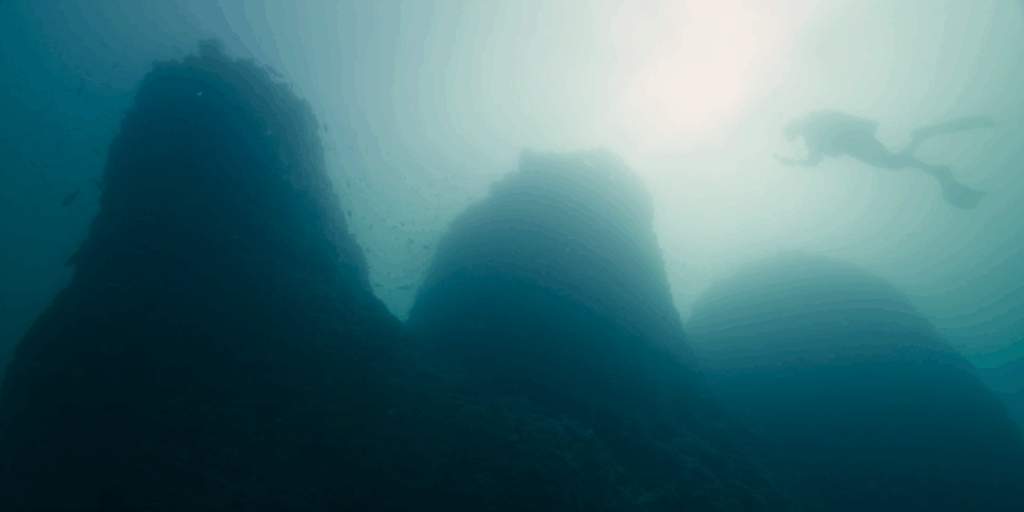
The underwater sequences were shot by three fantastic DPs – Michael C. Barnette, Jeff Hester and Rich Stevenson – on a RED Gemini, and the aerials on a DJI Inspire 2 and 3 by a local Egyptian team.
Cinematic colour
From the beginning, Alex and I wanted to ensure everything looked as cinematic as possible and used the natural light to our advantage. Whatever was happening, we would look for ways to backlight and find angles that looked best, without sacrificing the content of the story. We shot sequences with our archaeologists early in the morning, or late in the afternoon to get that golden hour feeling, which further amplified the beauty of the natural landscape and the epic nature of the story. As much as possible we favoured shooting with the sun low, and we constantly looked for ways to film the action backlit or side-lit.
A unique aspect of this production was the contrast between water and land-based expeditions happening at the same time. In most archaeological films, the primary focus is on land, but in here, we had to overcome the challenge of working in two completely different environments and keep consistency across the film.
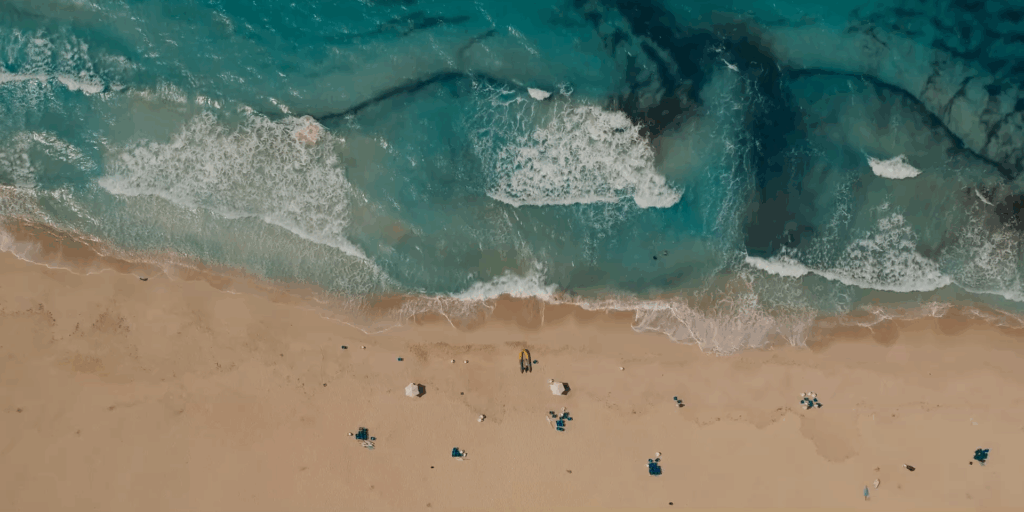
We directed our underwater team and the drone team to also shoot in a cinematic style to match what we were doing on the ground. We regularly shared references and ideas to ensure we were all on the same page with the look we were trying to achieve.
With drones we almost exclusively shot at golden hour, and we asked our divers to favour backlight, shoot towards the sun, and look for ways of not just showing what’s going on but rather telling the story in a cinematic way that engages the imagination of the viewers. We did not simply want to show what’s in front of us, but to make the viewers feel the mysterious and awe-inspiring events unfolding in front of their eyes, just like they were happening for the divers and the archaeologists in real time. Across the land, sea and air, we worked on achieving consistency and intentionality in the visuals we were creating.
Darkness and mystery
The key discovery that enabled this unique expedition to go ahead was an ancient tunnel that leads from the Taposiris Magna Temple directly into the Mediterranean Sea. From the beginning we knew that this tunnel was going to play a major role in the film and set the scene for what the story was going to be about. We had the ability to light the interiors of the tunnel, but to amplify the mystery of the place we didn’t want the viewers to see too much. Our goal instead was for the tunnel to appear as it would have done to Kathleen when she first ventured deep underground to explore this mysterious space that had remained hidden for millennia. Most of the underground coverage was shot with the contributors lighting their way with their own phones, again just like they would have done that first time. The less the viewers see, the more they can imagine what this place could have been like 2000 years ago.
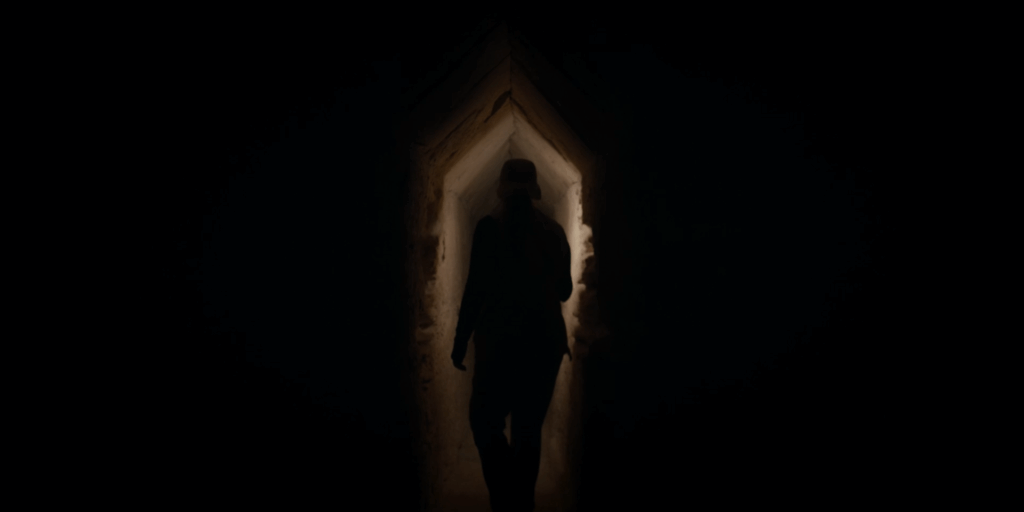
This is where silhouettes became a key aspect of the film. Regardless of where it is, a silhouette has a natural way of feeling mysterious, as it conceals the identity of the subject from the viewers. In the same way we shot silhouettes on the ground, the reveals of the peculiar underwater structures were also shot in a silhouette to amplify the sense of wonder and spark the viewers’ imagination of what could be hidden beneath the sea.
Timing is key
The hottest day on the production schedule happened on our one-day trip to the Temple of Isis on the isle of Philae in Aswan – one of the hottest, sunniest and driest cities on the planet, situated on the eastern edge of the Saharan desert, some 900km south of Cairo.
As this was going to be only a small portion of the film and it was one of the only bits of the story that isn’t directly part of an archaeological expedition, it was agreed that we would only get one filming day for this location, which essentially meant only about five hours of work to accomplish what we came there to do due to the expected heat.
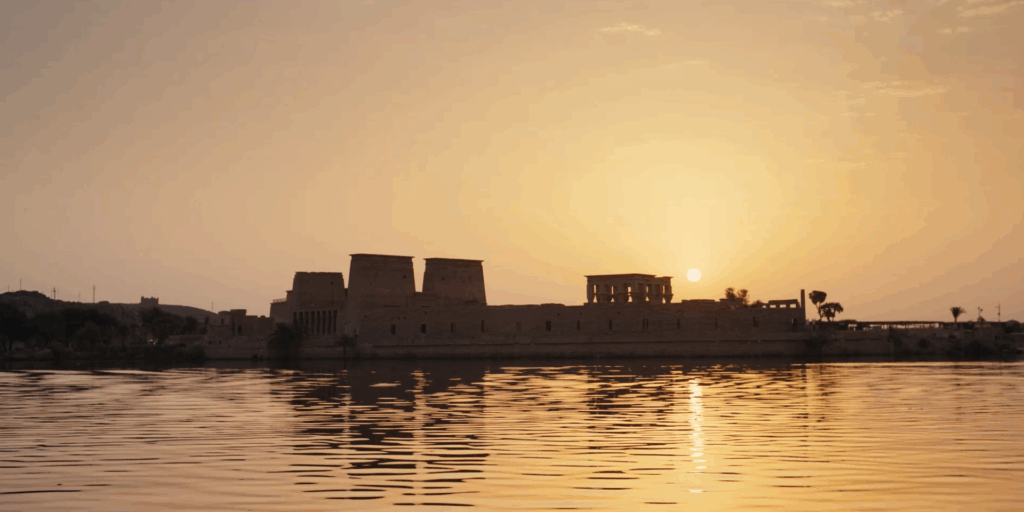
Although usually we would start shooting at about 7.05am, this time we found ourselves leaving the hotel for the location at 4am – we wanted to shoot the temple with the sun just above it and give ourselves enough time to get our coverage before the day got too hot. We happened to be there on the hottest day in Egyptian recorded history, with temperatures reaching nearly 51 degrees Celsius. To film the perfect reveal shot, we ensured we would be on the Aswan Lake well before sunrise, and by using one of the sun-tracking apps we figured out where to put the boat for the best view.
Ensuring consistency
Our determination for creating a consistent look throughout our filming meant that we had a very clear vision of what we wanted the film to look like, and we worked very hard to ensure this vision would always be preserved – even if at some point crew had to change. This happened… unfortunately for me, the final bit of the filming clashed with another job I was already booked on, but thanks to my relationship with the director and the vision we created together, the team were able to continue without me and work with an awesome Egyptian DP Seif El Din Khaled, who was able to pick up where I left off and shoot the ending in the same style.
Despite the scale of the project, our team only consisted of a handful of people. But precisely because of the intensity of the shoots, the longevity of this challenging endeavour, and by spending our free time playing Exploding Kittens, we became firm friends, with an amazing story to tell.