TRANSFORMING COMEDY
Earning star and creator Mawaan Rizwan a BAFTA, BBC comedy Juice takes bold swings both tonally and visually. DP Miguel Cármenes explains how some of the show’s most striking moments came to be.
When I first got approached to work on this project, I knew it was going to be something fresh, something full of life and character – I’ve worked with the director Eros enough times to know he picked this show for a specific reason. And I was not disappointed, I knew there could be something interesting to explore here.
At heart it’s a love story, about a gay couple who are slowly getting back together but told through the eyes of Jamma, played brilliantly by Mawaan Rizwan, a performance that earned him the BAFTA in season one.

What makes the show stand out is the magic realism that comes with it. Experiencing the world of Juice through Jamma’s eyes is what I was looking to convey on screen; what does that look like? This character’s thoughts are twisted, he lives in this fever dream version of our world, colourful, vibrant, but also very bizarre. It’s an adult living in the imagination of a kid. And we wanted to bring that to life, by breaking the conventions of what a British comedy quintessentially looks and feels like. Even playing with film genres themselves as a narrative resource.
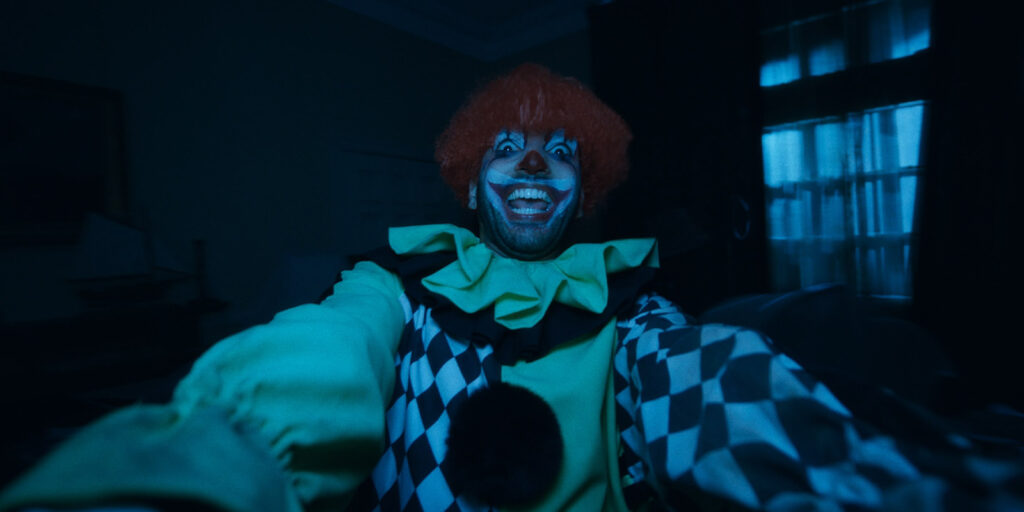
Some episodes are shot as a sitcom, some are shot as a horror, because that’s what the character’s state of mind is at that moment in the story. The multiple genres, motifs and in-camera techniques that play a part in the world of Juice are some of the things that make this TV show a bit of a wild ride.
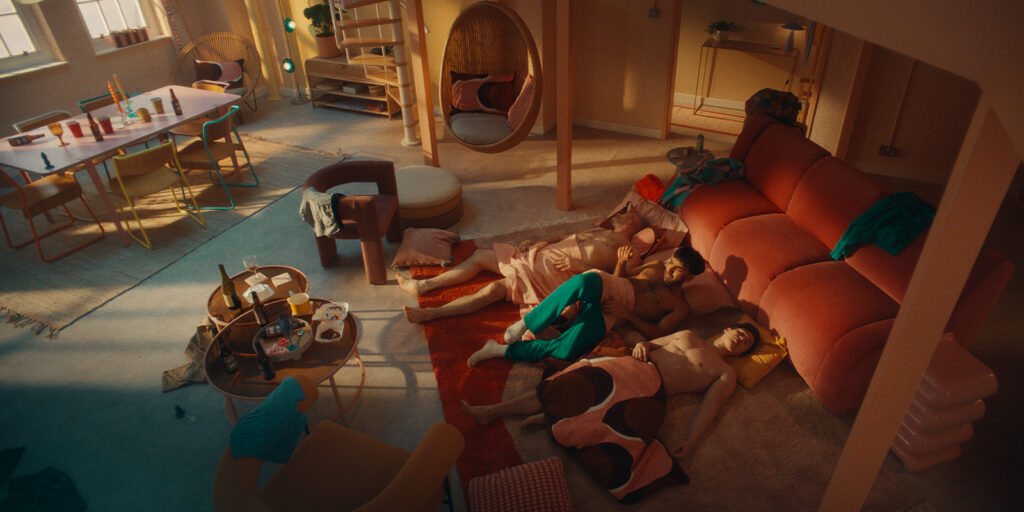
The shoot itself was short. Principal photography was seven weeks, and we had a very small budget. One of the hardest things at the beginning stages was to convince the BBC and VAL to be on board with our ideas. Together with Eros, we wanted the show to be shot on dolly and sliders and use a fair number of intricate camera rigs.
The camera had to be reactive and snappy and never use handheld unless it was called for, which arguably made life harder for us as we knew that would take more time than simply going handheld and getting the coverage that was needed. We had a lot of these things, where we made life harder for ourselves in order to be able to craft a look that felt different from what has already been done in the genre before.
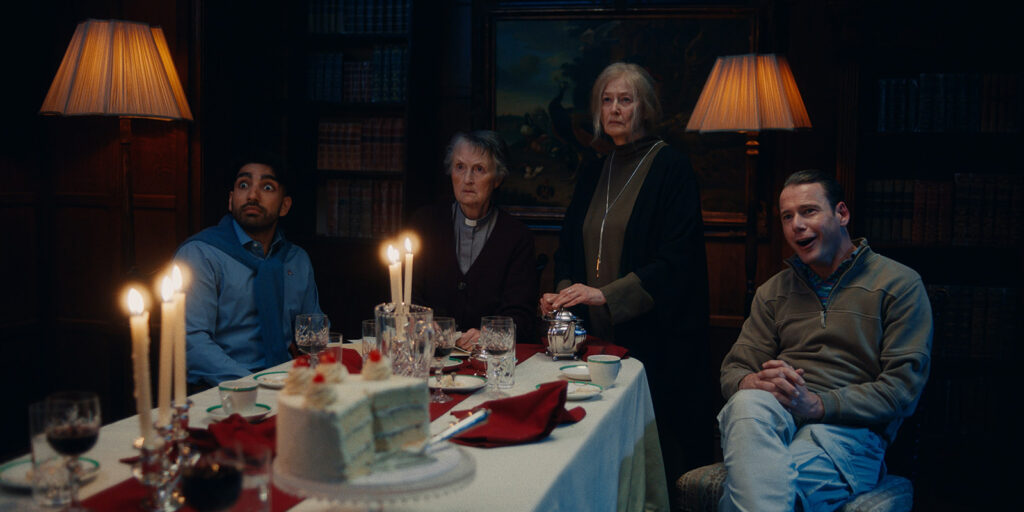
A great example of this is episode five, where we fully committed to a horror look, knowing that it would add layers and depth to the storytelling. In this episode, Jamma visits his love interest’s family in a manor in the countryside, inhabited by a very white, conservative household. He’s excited and scared at the same time, but it’s not until he’s there that he realises how terrifying this family really is.
We decided early on it should be shot as a horror. Light levels were dropped dramatically in comparison to the other episodes, and we swapped to an aspect ratio of 1.85:1. We shot this on location for a week, so we blacked out the entire place in order to be able to have full control of it inside. I was lucky to able to work with a longtime collaborator, Vianney Kernanet, an incredible gaffer who made this not only possible but also workable within our tight budget.
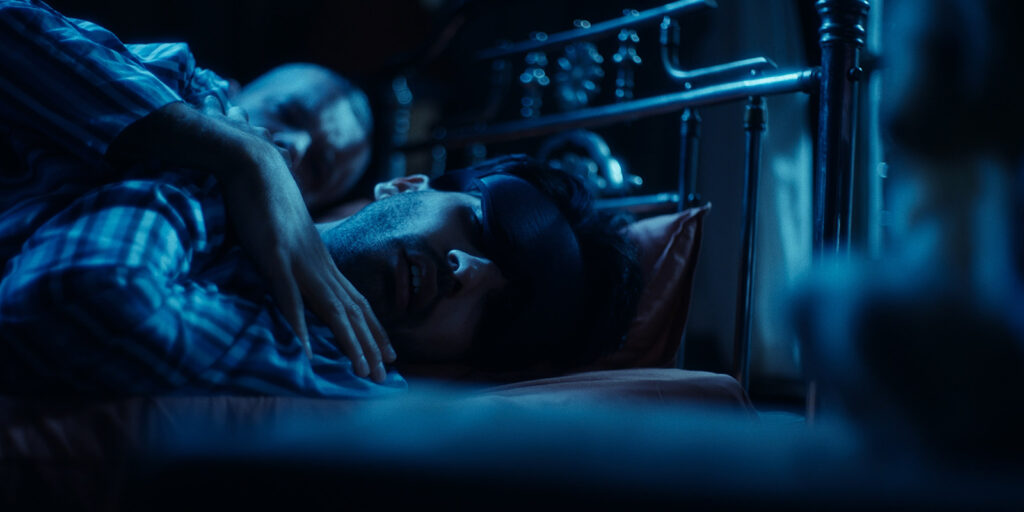
Probably the darkest moment in the story, and cinematography-wise, is the fight between Jamma and his dark bizarre doppelganger (played by him too). This is the only thing in the entire series we shot handheld as it’s a one-v-one fight in a very small room. There are various layers at play, to be able to have someone fight themselves on a low budget. We used a mix of techniques, including body doubles, to simulate the more active parts of the fight, and also things like VFX comps with locked off frames for when they were both on the screen at the same time. Since there is contact between them, we had to align them perfectly every time and do loads of VFX plates.
To make it even harder on myself I had an LED Nanlux Evoke 2400B outside a fake window we built inside the room itself (again, to have full control of the light), flashing throughout the entire fight sequence. So, together with my desk-op Oli, we built a sequence of lightning that would land on specific moments or dialogues; it had to be consistent throughout the entire scene.
When we swapped the actor to do the reverse shots, we knew the timings for those lighting cues would be landing on the same beats. You would think this is just a nice thing to have for added visual interest, a bit of lightning, but no. The lightning was working as our key light during the whole fight sequence – since our light levels were so low, the thunder would make the fight much more dramatic and chaotic. When the lightning flashed, it would be the only time we were able to distinguish them in the darkness, which elevates the scene, in my opinion, and makes you wonder who is who at that point. It’s the character’s inner struggle after all, manifested on screen as a fight between two sides of the same coin.
It was crucial to get it not only bright enough to light their faces during the fight but also being able to hit those precise story beats, while maintaining a coherent cut between the same actor dressed as both our hero and the antagonist.
It was an incredible team effort to pull off something like this on every episode, considering the time and resources we had, but at the same time these little challenges and ideas are what keeps us excited and what separate Juice S2 from other comedies.