
LIGHTING FOR BALANCE: FORGING A SUSTAINABLE CINEMATOGRAPHY PRACTICE
Jack Shelbourn, a cinematographer and University of Lincoln lecturer currently undertaking a practice-based PhD on sustainable approaches to cinematography, recently completed two linked studio experiments that expand the concept of New Naturalism into a controlled environment. Here, he explains how the work investigates how reflected-light systems and modern LED sources — specifically the Aputure 600D alongside Dedolight and Lightbridge tools — can reproduce the aesthetic qualities of natural light while cutting on-set energy use and carbon output.
I’ve spent most of my career doing more with less, often by choice, usually out of necessity. That constraint became a style, and that style became a research question: can a New-Naturalist approach to cinematography cut carbon without compromising craft? My work on Mind-Set (2022, Dir. Mikey Murray) led me from the street and the solstice into a studio experiment designed to quantify what many of us feel instinctively when working with natural and reflected light.
From set to study: Practice first, theory second
I’m a working cinematographer who teaches, not an academic parachuting in with prescriptions. My route into research was through the camera, through no- and micro-budget features where the luxury of gear trucks and generator farms was absent by default. Those constraints shaped a language: favour natural or available light; move handheld when it serves the moment; embrace backlight; work with the environment rather than overpower it. I learned to find balance between story, place, weather, crew, and time, and to treat that balance as a creative target.
That language wasn’t learned from a book. It was honed over four features and countless shorts, but two films were pivotal. How You Look At Me (2019, Dir. Gabriel Gonzalez) was shot almost entirely with natural light across East London and a crumbling French house whose wiring politely suggested we keep the electrics minimal. We leaned into windows, silhouettes, and mixed-colour interiors, the aesthetic outcome of a practical reality that became a deliberate choice.
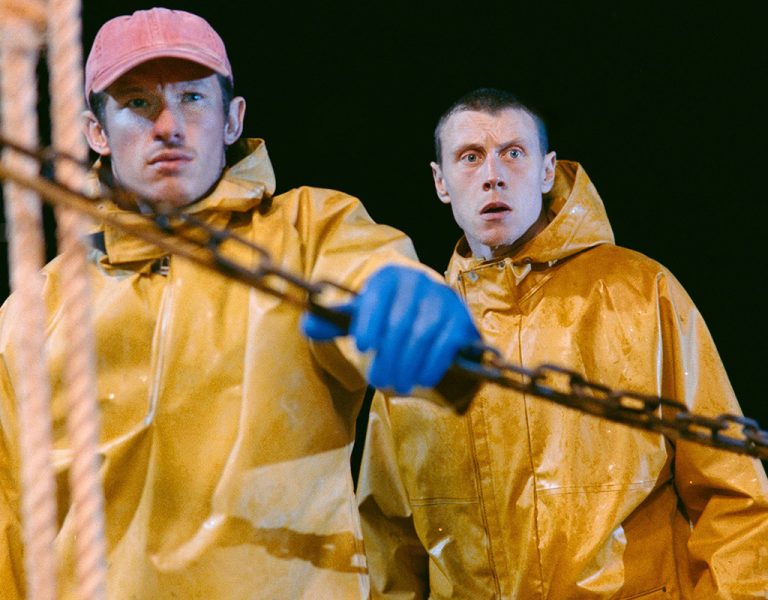
The second turning point was Mind-Set (2022, Dir. Mikey Murray), a University of Lincoln project made with staff, students, and graduates. We planned the schedule around the sun, including a dawn scene timed for the light to fill a bedroom at exactly the right angle. We assembled at 3:30 a.m., rolled around 5:00, and wrapped inside the sliver of time nature granted us. Mind-Set went on to win Best UK Feature at MANIFF 2022 and received a warm Guardian review, proof that a natural-light-forward approach can travel from idea to audience.
Why sustainability isn’t someone else’s department
The film industry’s climate footprint is well-documented, and the numbers are bracing. The BFI’s A Screen New Deal estimates that an average tentpole feature generates around 2,840 tonnes of CO₂e: roughly 51% transport, 34% mains electricity, and 15% diesel generators. Those aren’t abstract categories for cinematography, we move heavy camera and lighting packages, we draw power, and we often trigger the generators. If cinematography changes, those percentages can move.
At the same time, audiences and awards bodies have embraced work that privileges natural and available light. Think of the New Naturalism lineage, from Malick and Lubezki to Zhao and Richards, whose practices normalised a disciplined, natural-light-driven grammar at the highest level. My research asks whether that aesthetic can double as a sustainability strategy.
New naturalism, expanded
As written about by Benjamin B., New Naturalism, follows a working dogma: shoot by day; at night, use existing sources; favour backlight; move the camera with the bodies; embrace serendipity. I’ve adapted that list into creative restraints with an environmental spine: prefer natural or available light; if you must add a lamp, start with one and multiply it with reflectors; design schedules around the sky; reduce transport mass; eliminate generators wherever possible. It’s not anti-craft, it’s a different craft.
On Mind-Set, those choices were baked in from development to shoot: scheduling, crew size, kit list, location, and blocking. The result was not only a leaner carbon footprint but more space, literally and metaphorically, for actors and camera. Reflectors don’t need distro runs; a single head bounced three ways invites quieter sets and faster adjustments. The creative and sustainability upsides are aligned more often than people realise.
Experiment 1: One lamp, many lights
To move beyond intuition, I began practice-based experiments as part of my PhD. The first studio experiment asked: can I reproduce a conventional three-point portrait using a single powered source plus reflectors, and do it to the same exposure? Not a new technique, but one rarely analysed for environmental impact.
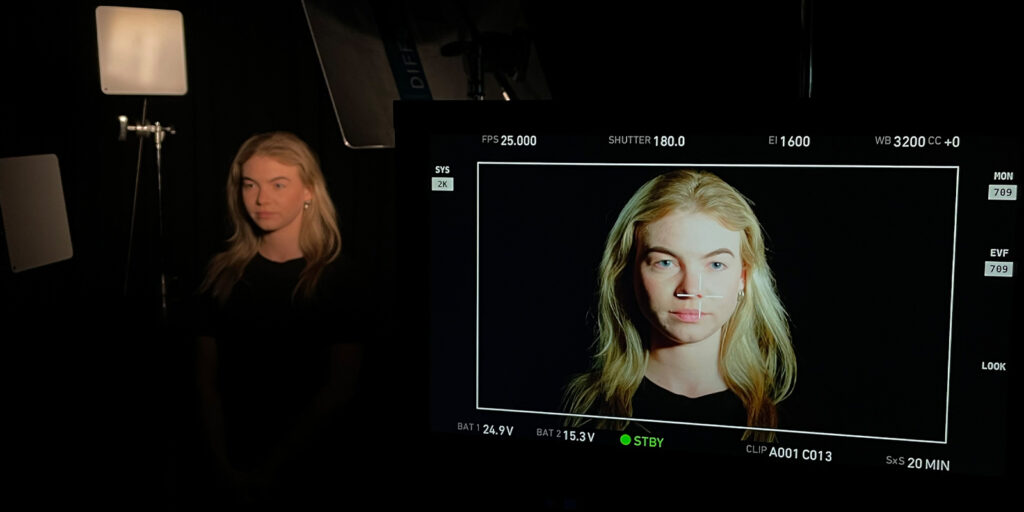
In matched portraits of three skin tones, I compared four set-ups: three 150W tungsten lamps, one tungsten with reflectors, three 40W LEDs, and one LED with reflectors. Exposure was matched using false colour for accuracy. The single-source reflector setups achieved comparable exposure and arguably a more organic fall-off on cheeks and hairlines.
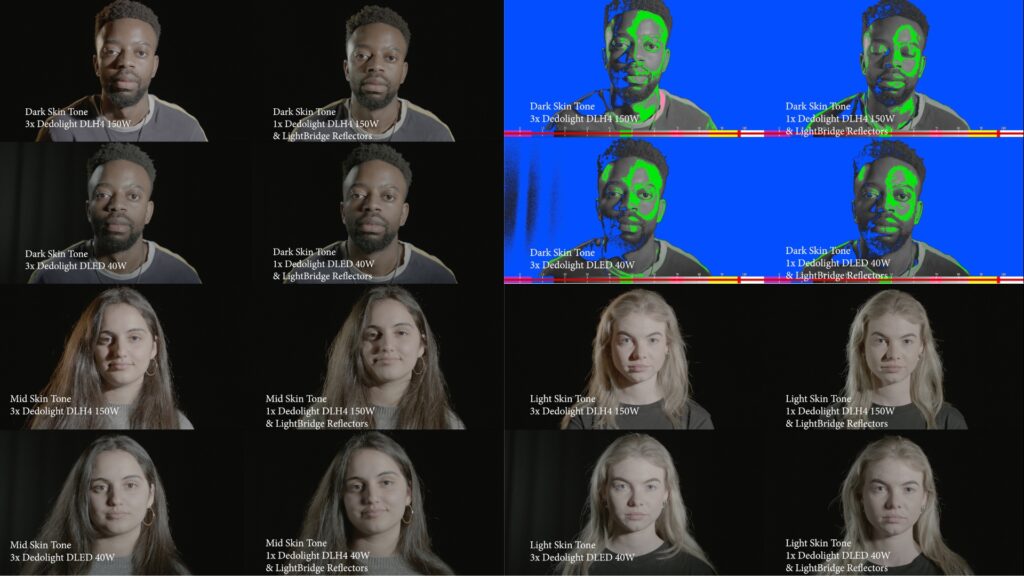
The reflected-light variants often looked “better”, less “fixture”, more like light bouncing naturally around a room. Swapping two lamps for reflectors cuts power, heat, cable runs, and van space. It also shortens rig and strike times—a quiet win crews feel immediately.
To the left of Figure 4 you can just about make out the difference reflector sources outside the window. All lit by the same light source. Reflected around the set to create the natural feel of sun light, but with the ability to highlight certain areas of the set, to best tell the story of the scene.
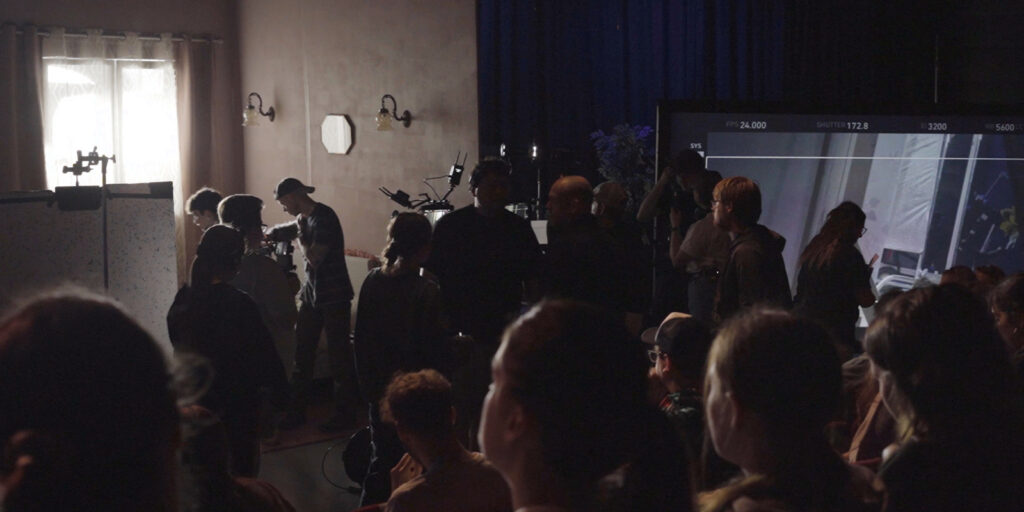
In a few scenes a door was open, revealing a corridor on the set. For these shots an additional 40w Dedo was used and reflected to light that area.
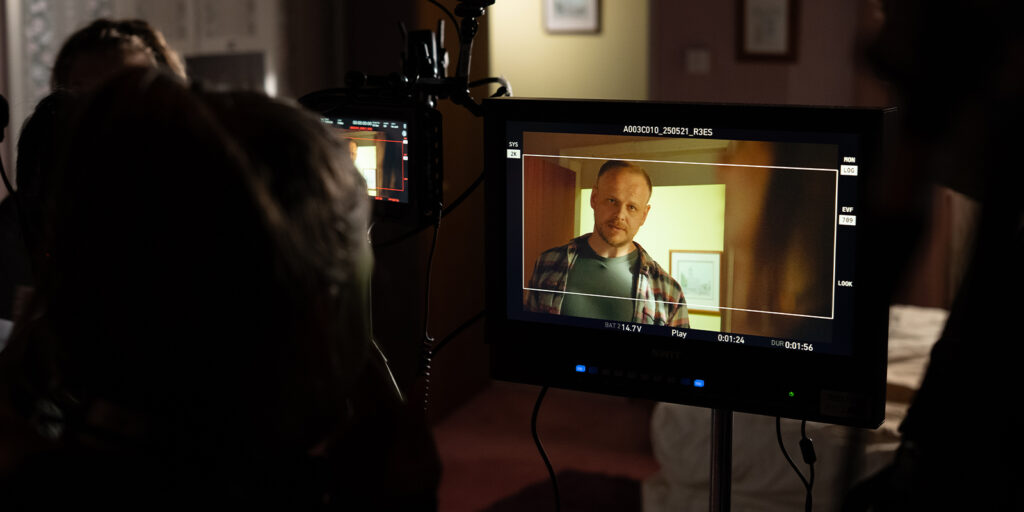
A note of caution: in a single-light studio scene shot on an older ARRI Alexa Plus 4:3 at an ISO of 3200, we observed elevated noise in the original negative, correctable but computationally intensive in post. The takeaway isn’t “add more lamps” but “mind the exposure triangle.” The energy you save on set can boomerang in render time if you’re not careful.
What changes on a real set
This approach nudges decisions upstream. Scheduling becomes a lighting tool. We treated dawn and late afternoon as fixtures on Mind-Set, not obstacles. The payoff was a look the film owns, and a footprint the film avoids.
The kit list shrinks, and the grip list gets smarter: a sturdy package of reflectors, flags, and stands plus one hero head covers surprising ground. Fewer stands and cables mean quieter sets, quicker resets, and calmer actors. First ADs often note the improved flow, slower prep, and faster days.
Transport and power use drop dramatically. When lighting is reflectors-first, productions rarely need a generator. Per the BFI breakdown, that cuts deep into the two biggest carbon contributors that cinematography can control.
Mind-Set wasn’t marketed as a sustainability film; it was simply made with sustainable habits at its core. We hired local, used university kit, and planned around natural light. The result won awards and audiences alike, proof that this approach works both ethically and cinematically.
Reflections and findings
Across both experiments, the reflector-based method achieved a measurable 70% reduction in energy use without perceptible loss in image quality. In controlled conditions, single-source reflector setups used about 0.176 kWh per hour versus 0.586 for traditional tungsten rigs, a 70% energy saving and similar visual results after grading.
A second studio drama, In from the Dark, extended these results under production pressure. Using an Aputure 600D Pro as a single key redistributed through CRLS reflectors, total lighting load for a five-minute scene was just 0.054 kWh. The reflected light created a cooler, quieter, and calmer workspace.
Post confirmed clean colour and manageable noise at EI 3200. The visual language held across skin tones, suggesting reflective design can enhance tonal equity while conserving power.
The conclusion is simple: sustainable cinematography isn’t a compromise, it’s an evolution. Light quality, not quantity, defines the image. Reflectors turn wattage into nuance. Sustainability becomes not a constraint but a form of creativity.
Final thoughts
In practice and teaching alike, the reflected-light method fosters collaboration with physics rather than resistance to it. Students respond to the calmer set and the challenge of building light paths instead of placing fixtures. Efficiency and expressivity are not opposites, they’re the same skill exercised differently.
The next step, Experiment 2: Natural Light (Spring 2026), will take these principles outdoors, followed by the feature In From the Dark (Dir. Mikey Murray) in Summer 2026. Every watt will be logged from set to post, building a full carbon map of cinematography in practice.
In the end, sustainability is not a limitation; it’s a lens. The reflected image, quiet and deliberate, reminds us that cinematography at its best has always been about making light travel further.