
THE ETHICAL SPECTACLE: GROUNDING EPIC ACTION WITH PRACTICAL EFFECTS
Jules O’Loughlin ASC ACS explains how modern constraints forced the crew to innovate for a key chariot race in Percy Jackson and the Olympians series two.
When we approached the epic chariot race sequence for the opening of Percy Jackson season two, we were faced with a singular challenge: delivering visceral, high-stakes action on a scale rivalling cinematic history; specifically, the legendary races in Ben-Hur, but doing so with child actors, live horses, dramatically reduced working hours, and the stringent involvement of the American Humane Society.
This set of modern production constraints didn’t limit our ambition; they became the precise driving force behind a crucial aesthetic decision. After a first season that relied heavily on the volume, for season two the producers and our team embraced a commitment to a fully grounded, practical feel to maximise authenticity. The shift was away from the digital safety net and towards the raw texture of a real-world location. The result was a demanding but immensely rewarding shoot that forced us to innovate, focusing our lens not just on spectacle, but on safety, efficiency, and the undeniable reality of sun, dust, and muscle.
The ghost of cinema past and the ethical mandate
In the conceiving of our sequence, the ghost of cinema history loomed large. The benchmark, of course, remains the 1925 silent epic Ben-Hur. The scale of that production is staggering, a testament to a bygone era of limitless ambition, with reports of up to 42 cameras capturing every possible angle.
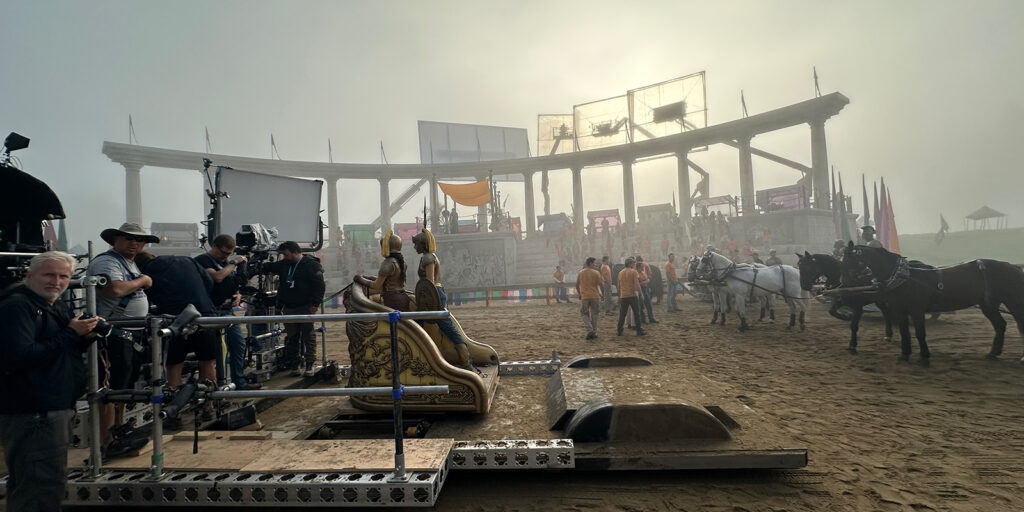
A shoot like the 1925 Ben-Hur simply would not and should not happen today. The most critical difference is the mandatory involvement of animal welfare oversight, signified by the American Humane Association’s “No animals were harmed” credit. This ethical mandate, combined with our creative decision to move away from the volume, became our aesthetic north star. The director, James Bobin, wanted the visceral feeling of the real sun, the dust kicked up by the horses, and the genuine energy of the live animals and young performers. The commitment was clear: If it’s an exterior, we shoot it on location.
The process trailer solution
This mandate meant a life-size chariot arena was built, and we couldn’t use traditional blue or green screen stage work for our most complex interactions, especially those requiring our principal actors to perform alongside stunt doubles at speed. We needed to capture the nuance of performance, the fear, the determination, the close-up exchange of glances, while the chariots were seemingly jockeying for position.
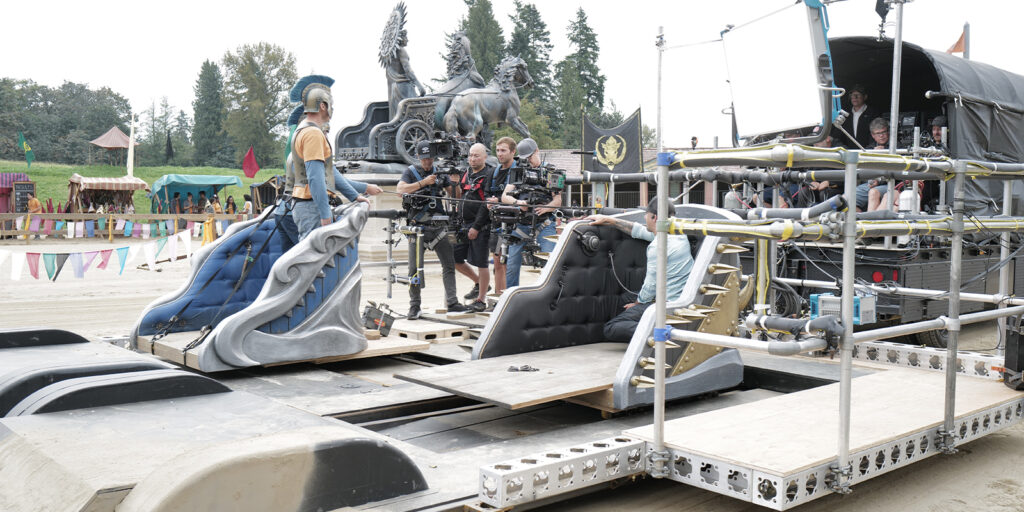
Our solution was a radical piece of mobile staging: a custom-designed process trailer system hauled by a powerful truck. Since we could not risk our young actors driving the chariots at high speed, we constructed two separate trailers, each meticulously dressed with a chariot.
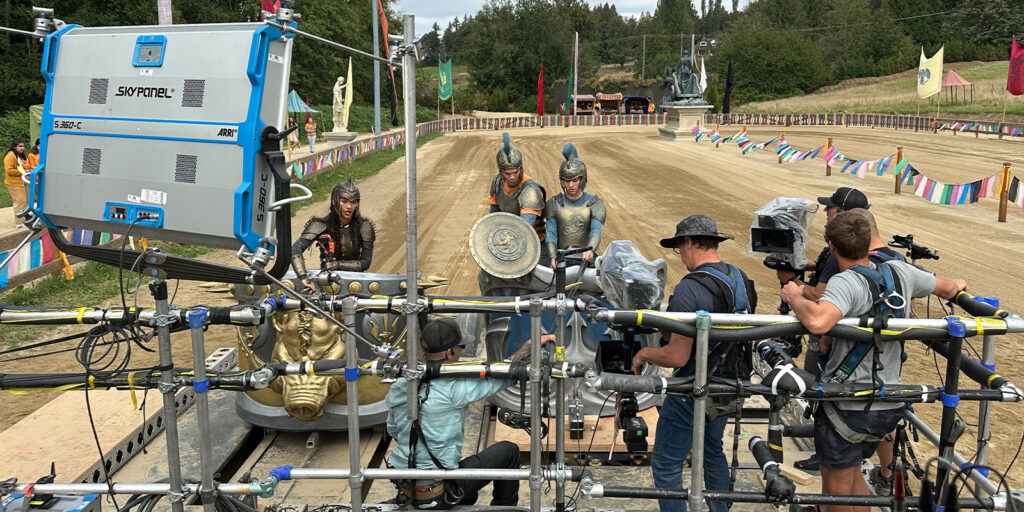
Cameras could be positioned on the process trailer in close proximity to our cast. We chose Steadicam to give us freedom of movement and the ability for the operators to react in the moment but with enough stabilisation to reduce the high frequency vibration of a trailer running across a sandy track.
We could haul a single chariot when needed but there were specific action beats that required two chariots to come together so that our characters could ‘lock swords’ while racing. In this configuration the two trailers could be combined. The key innovation was how the chariots moved on this larger process trailer: with the use of a pully system and track, one chariot was rigged to move north/south, and the other east/west, allowing us to dynamically shift the chariots’ relative positions in real-time. This meant that on location, we could create the illusion of closing in, pulling ahead, or being boxed in, all while capturing the actors’ close-up performances with a clean, authentic, live background.
Translating constraints into speed
With the limitations of working hours, safety, and a practical location, we had to abandon the 42-camera approach for precision cinematography. Every camera set-up became highly specific and highly choreographed, focused on maximising the emotional impact of a limited number of safe passes. Instead of trying to cover every angle with brute force, we concentrated on making every shot feel fast, utilising specific technical approaches.
Shutter and frame rate manipulation
To intensify the sense of frenetic, high-speed danger, we utilised reduced shutter angles, a technique perfected in films like Saving Private Ryan and Gladiator. By using a 90-degree or even a 45-degree shutter, we introduced a stutter movement effect to the horses’ legs, the wheels, and the background, increasing the perceived velocity and agitation of the frame. In addition to this, we would at times undercrank to 20 or 21fps to give the sense of greater speed.
Close proximity and dirty frames
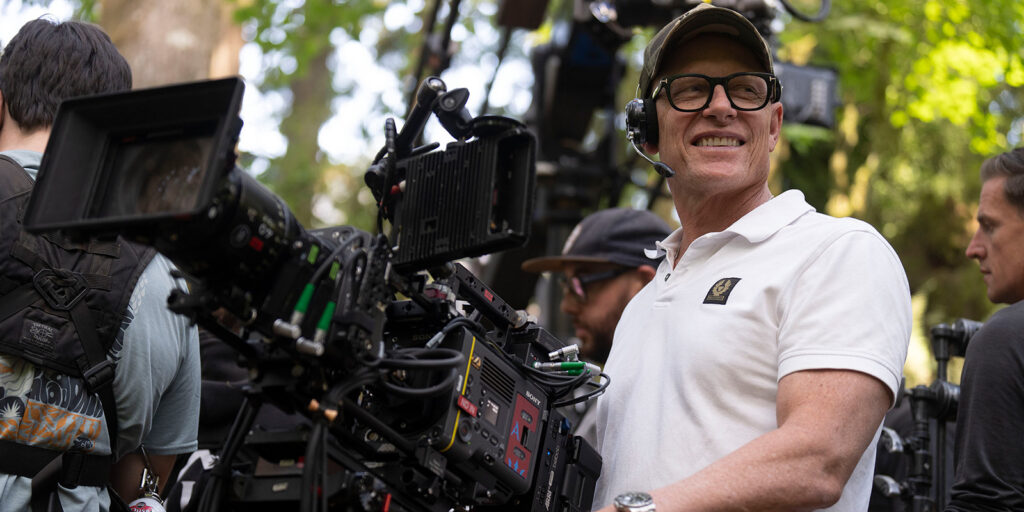
Our camera was frequently low and close to the action. We used specialised remote heads and stabilising rigs on high-speed Arm Cars, moving on a custom-built road on the periphery of the track. This allowed the camera to track with the chariots while flying past foreground elements, spectators, track fencing, flag poles, which streak by the lens, significantly boosting the illusion of speed. We further “dirtied the frame” by using telephoto lenses from the sidelines to compress the action, heightening the feeling of a chaotic bottleneck, and using fullers earth and mortars to explode dust and dirt into the lens during near-crashes.
Agitating the stabilised camera
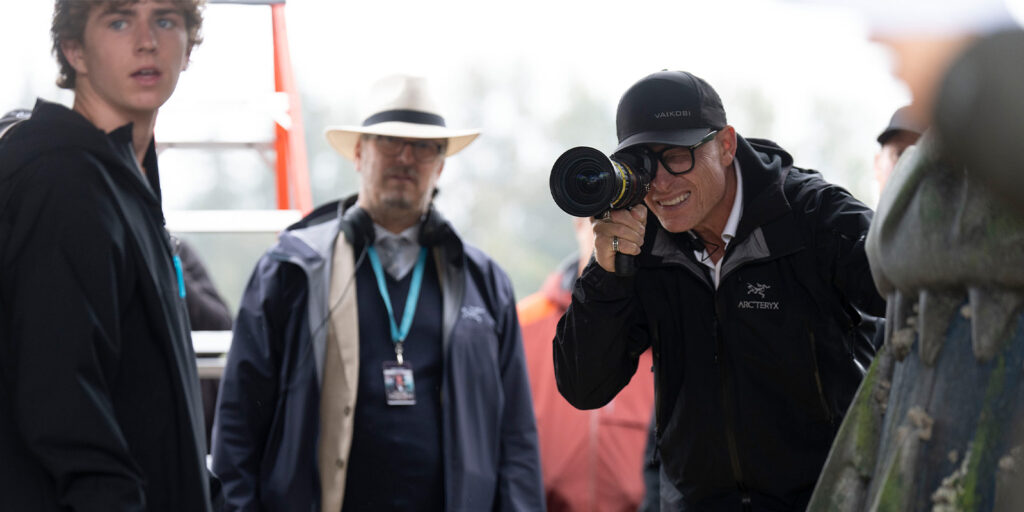
The inherent roughness of the practical environment was a gift. Instead of seeking perfectly smooth shots, we intentionally reduced the stabilisation on our remote heads to increase the feeling of physical agitation. This slight camera shake put the viewer inside the chaotic energy of the race. For certain passes, we even used systems like the Ronin 4D, wielded by a stunt rider on a horse, allowing us to get incredibly intimate, dynamic shots moving from wheel to driver in a single, fluid take.
This precision methodology, where we treated the environment as a collaborator and used technical constraints to dictate our aesthetic choices, allowed us to be highly efficient. We traded the vast coverage of the past for a more focused, practical methodology, proving that contemporary spectacle can still be epic, grounded, and ethical. This is not merely a budgetary or technical choice, but a necessary evolution in cinematic storytelling, capturing a real, grounded, and honest sense of awe for a new generation.
This Masterclass is dedicated to the memory of our friend and colleague Danny Virtue (1949–2025), who did all the horse work for Percy Jackson S2.