
LENSING SUBURBIA
The ‘Burbs DP Jonathan Furmanski reveals how he helped to remake a classic movie for a modern TV audience.
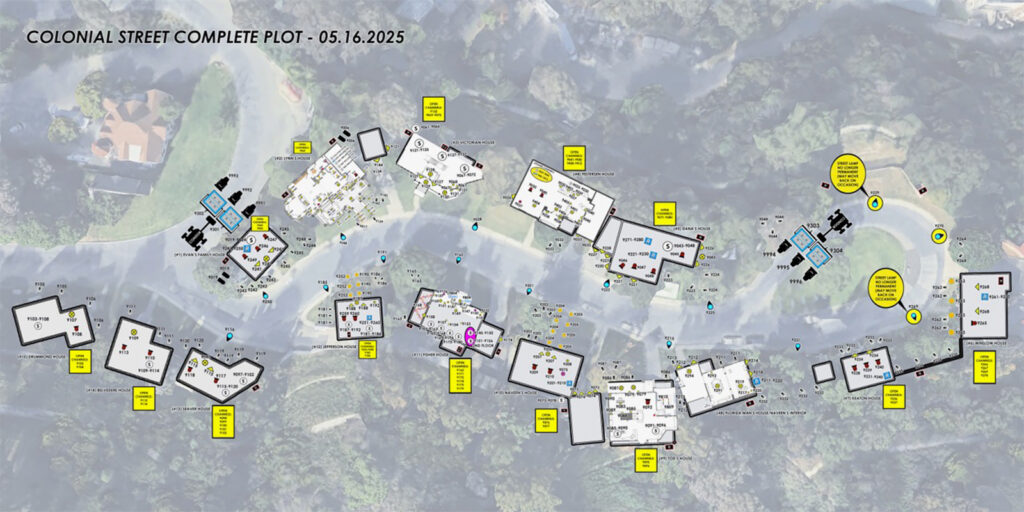
Over the years I’ve been lucky enough to work on all kinds of projects at all kinds of locations, including studio soundstages, but I’d never tackled a studio-based show before The ‘Burbs, a streaming reboot of the classic 1989 film. We were based out of Universal Studios, shooting on the same backlot cul-de-sac where director Joe Dante and star Tom Hanks filmed the original, with stages and offices just a golf cart ride away—and the Jaws and Psycho exhibits on either side of us!
It was an inspiring place to work, but when I first signed on to the show I was worried. How would I find creative inspiration working on one small street and two large soundstages for 80-ish days? My previous show was entirely location-based, and most days had a company move — which has its own challenges, of course. Again, I was fortunate: Even though we were almost always in the same locations — we had one day outside the studio per episode — showrunner Celeste Hughey and the writers provided a story that refused to sit still. The scripts were so full of humour and unexpected turns that everything stayed fresh as we moved through the shoot.
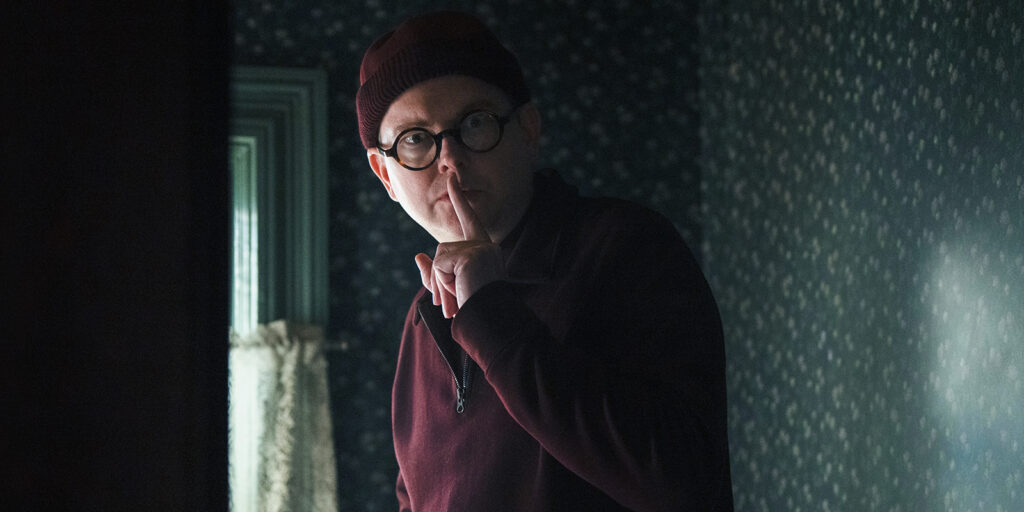
The show loosely follows the original film’s story: Keke Palmer stars as Samira Fisher, a new mother recently relocated to her husband’s childhood home on a small, postcard-perfect cul-de-sac in the hamlet of Hinkley Hills. As Samira is quickly welcomed into the community by her warm but odd neighbours, she’s captivated by a creepy, derelict house across the street — the Victorian. Soon enough, a mysterious and unfriendly couple moves into the Victorian, and it slowly becomes apparent that everyone on Ashfield Place might have something to hide.
Blending genres
In prep we discussed many themes and influences: neighbourliness, voyeurism, suburban ennui, creeping paranoia, and all the inherent tension (and comedy) between. The key to the photography was finding that balance between naturalistic and colourful, so it felt like our story could take place almost anywhere, and something more theatrical and brooding, creating space for the eerier scenes. And of course leaving as much room as possible for silly and looser, more improvised moments.
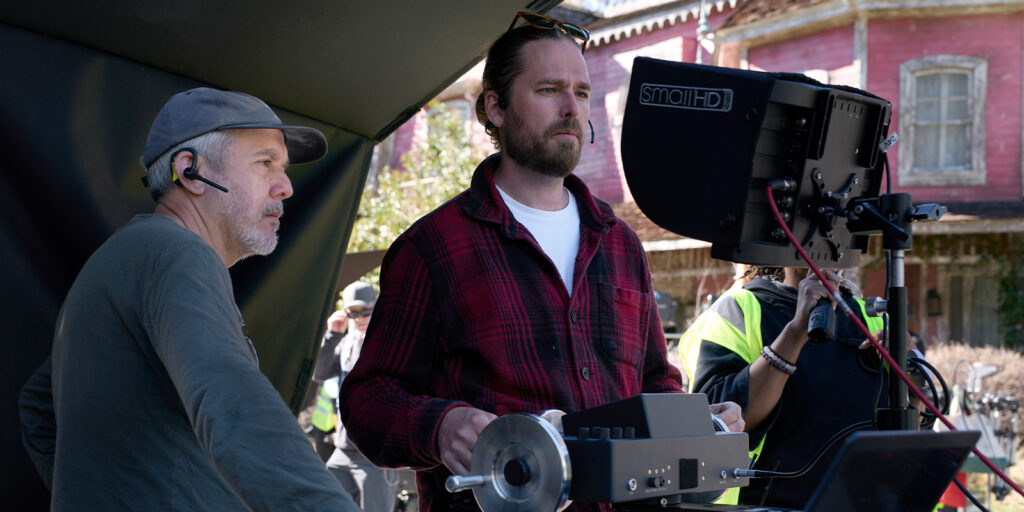
With all this in mind, I chose the ARRI Alexa Mini LF paired with beautiful, slightly detuned Panaspeed lenses, recording in ARRIRAW with a 2.39:1 aspect ratio. This rich, expansive canvas captured every detail and nuance, bridging the gap between bright, wide-angle exteriors and moody, more intimate interiors like the Victorian house.
A nice example comes from the pilot episode, directed by Nzingha Stewart, where Samira and some of her neighbors visit the Victorian home for the first time. It intercuts between backlot and stage work, and highlights the transition from the sun-soaked cul-de-sac to the creepier and more mysterious Victorian interior. We talked a lot in prep about moving the camera; this scene was perfect for Steadicam shots that floated through rooms with the actors, paired with smaller slider and dolly moves — the camera stalking and prowling around the house in a slow, observational, and fun way.
The sequence starts, establishing core themes of spite and voyeurism through a simple beat: Samira watches from her living room, snacking on popcorn, as her neighbour Agnes (Danielle Kennedy) leads her dog to use another neighbour’s front yard as a bathroom. The shots of Agnes were filmed on the street while shots of Samira (interior and exterior) were captured on stage. We had to combine shots like this throughout the season because the backlot houses weren’t much more than facades with limited depth — far less than our fully realised sets had. It’s a testament to our meticulous production design and set decorating departments that everything had enough overlap, enabling seamless continuity between locations.
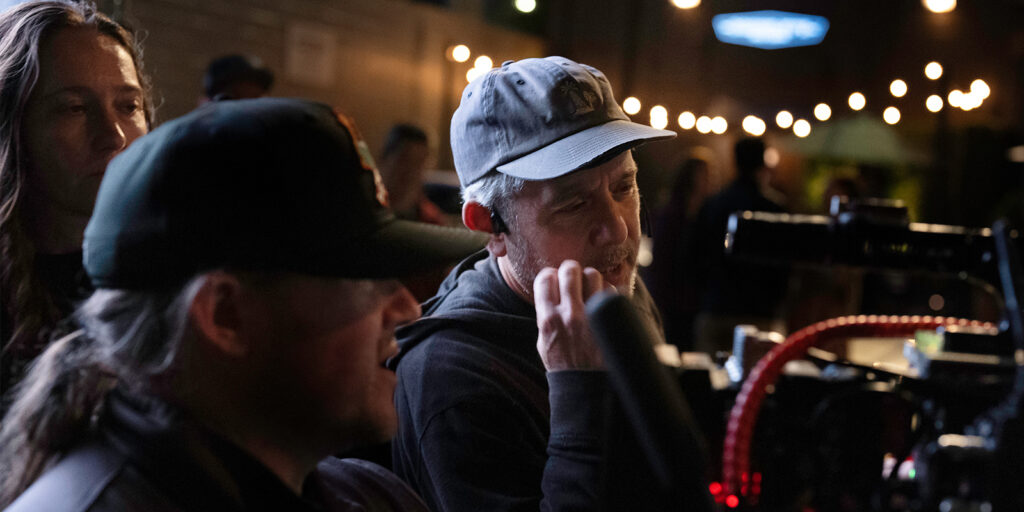
Lighting on the backlot was simple, with only an 18K HMI edge on Samira that tied her to the sunlit background. On the stage we used 10K and 12K tungsten fresnels to mimic the direct, hard sun, with rings of Quantum Studio LED spacelights for a broad, soft, bluer skylight. Most sets had hard ceilings, which provided better framing options but necessitated a window-driven lighting strategy — a welcome limitation that allowed light to bounce through the sets in a more naturalistic way. When necessary, gaffer Jeff Chin and his team used a collection of small, battery-powered, remote-controllable LED fixtures on all the sets, making it quick and easy to rig and control units where needed.
We also took advantage of digital backings on The ‘Burbs, using two 12×10’ screens and one 12×20’ screen from Lightning LED in Los Angeles. Key grip Ben Benesh and rigging key Alpheus Underhill designed and built large rolling gantries to push the screens around the sets and raise or lower them as needed; we also had tracks on chain motors outside our second floor sets to get the screens even higher. I’d used digital backings before and loved the flexibility and interactivity they provide, but on The ‘Burbs it was more than just a cool and powerful new tool; the story is all about people watching each other, so this technology meant we could have someone mowing their lawn outside the window, or I could reposition a plate to get a certain perspective, or see a police car on the street and get lighting interactivity with its flashers — all with complete control over brightness, contrast, sizing, etc. Plus, the costs were offset by eliminating traditional printed backings, physical yard construction, and the massive lighting rigs those setups require. Admittedly, they’re sometimes tricky to light around and moving screens between sets was a process, but ultimately it was a real benefit to the photography.
Back in the scene, Samira answers a knock at the door, revealing another neighbour, Dana (Paula Pell), who points out an open house sign in front of the Victorian. A plan is quickly hatched, Samira says a quick goodbye to her husband — played by a very convincingly asleep Jack Whitehall — and she’s out the door.
We cut to Samira, Dana, and neighbour Lynn (Julia Duffy) on the Victorian front porch. They slowly, trepidatiously enter the home, revealing a dark, decayed and stagnant interior. A vestibule was added to both the backlot house and stage set as a visual bridge, so we could see people entering and exiting either location and not worry about seeing off the set. Still, lighting continuity took some figuring out, and it didn’t help that we shot the interiors first — there was a limit to how much we could light interiors on the backlot, or exteriors on the stages — but colourist Laura Jans-Fazio cleverly smoothed any inconsistencies.
Classic prep
In prep we talked a lot about the Victorian interior and how to differentiate it from the other neighborhood home interiors. I started thinking about it like Miss Havisham’s estate from Charles Dickens’ classic, Great Expectations: musty, dusty, and trapped in time. It was the only interior location where we used atmosphere; we also deliberately overexposed the windows, creating a sense of isolation that separated the Victorian’s stagnant history from the sun-drenched street outside. The digital backings were here, too, but in a much subtler way; interior lighting was moodier, though we attacked each room individually, so the library is appropriately bright but the dining room darker and a spiral staircase towards the back of the house is lit by a single shaft of hard light from an ETC Series 3 Lustre lamp.
Set decorator Rachael Ferrara filled the Victorian rooms with all kinds of colourful, unusual, sometimes bizarre practical fixtures that looked amazing on camera. We then added accent lights for some of the artwork and furniture — small, focusable, low-wattage lamps — and rigged Astera tubes on the ceilings of bigger rooms that could be removed quickly if seen on camera. Everything was at low levels to keep the contrast and mood but still see all the amazing detail in the furnishings and finishes. Production designer Susie Mancini and the art department made each room distinct and filled with colour and texture; we could point the camera in any direction and have something great to look at.
On the second floor of the Victorian, Samira sees her neighbour Tod (Mark Proksch) taking pictures of a bathroom while weirdly perched on a toilet, then continues down a long hallway — dramatically lit by a T12 fresnel through a stained-glass window — to a child’s bedroom at the far end. There, in the back of a closet, she sees “Alison” scrawled on a wall, a name that will haunt Samira and the first clue to unravel a much larger mystery. A small sconce in the room suddenly pops and she runs in fear, downstairs and out of the house. Some curiosity is satisfied, but more questions remain.
Ultimately, for me The ‘Burbs was a reminder that sometimes what at first feels like a limitation can actually spark more creativity. Thanks to the tight collaboration between camera, lighting, production design, and every other department, we were able to turn a familiar backlot into a vibrant landscape of suburban paranoia that felt fresh every single day — helping scenes like this highlight the show’s central tension, where the bright facade of the cul-de-sac is constantly at odds with the darker mysteries hidden just behind closed doors.