
BRINGING HISTORY TO LIFE
A Life’s Worth is a six-part drama inspired by the first Swedish UN battalion in Bosnia in 1993. Four young soldiers face their first mission in a brutal conflict where peacekeeping solely isn’t enough. Their commander, Andreasson, struggles between intervention and duty. What follows is a gripping story of war, morality, and the bonds of friendship, love, and trust.
When director and close friend since film school Ahmed Abdullahi reached out to me regarding a war story, I became quite intrigued. As a human being, the project immediately felt urgent — a reality-based story holding a responsibility to portray the people who were really there.
From the different perspectives, I was taken away by the story itself as well as by the importance of engraving this particular narrative material with both dignity and presence. To find the right visual language, the director, producer, one of the scriptwriters, production designer and I travelled to Bosnia, where the former events took place; the light, terrain and stillness of the place shaped our aesthetic.
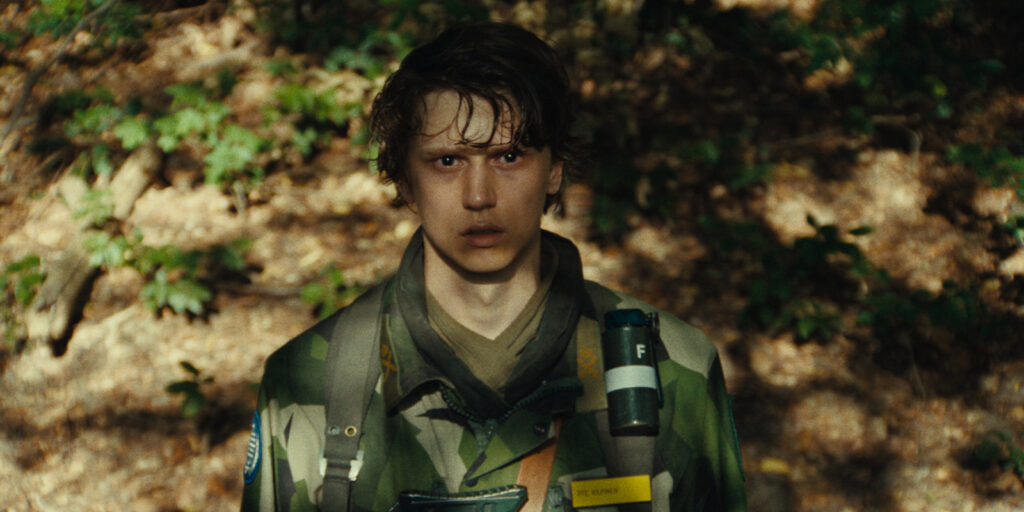
Achieving authenticity
We studied old photographs taken by UN soldiers and watched old documentaries from the war to capture authentic movement patterns, body language and everyday details. These references influenced the majority of the main elements, from the feeling and colour palette to camera movements and lighting — an attempt to let the image carry both the weight of history and the small human moments that make the consequences of war tangible. It was also important that the camera would feel like being a part of the unseen group members, which later on turned out to be a perspective employed quite often.
The visual appearance itself became very naturalistic and relatively “simple” in a way. I wanted to avoid mannerisms and spoon-feeding the audience. To try to be as honest as possible to the story. This applied to everything from the portraits of the Swedish UN soldiers to the local population. It was crucial that the gaze would never place the audience as a distant witness.
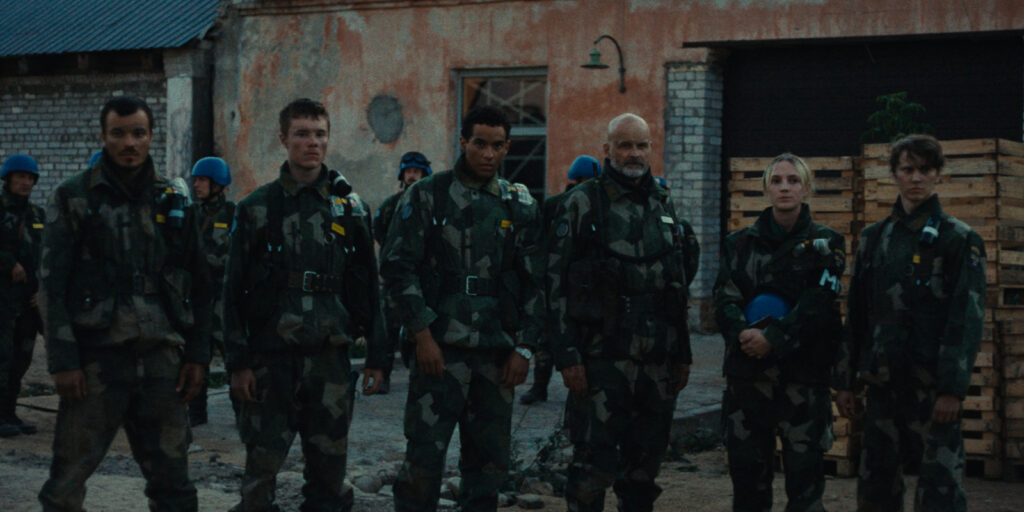
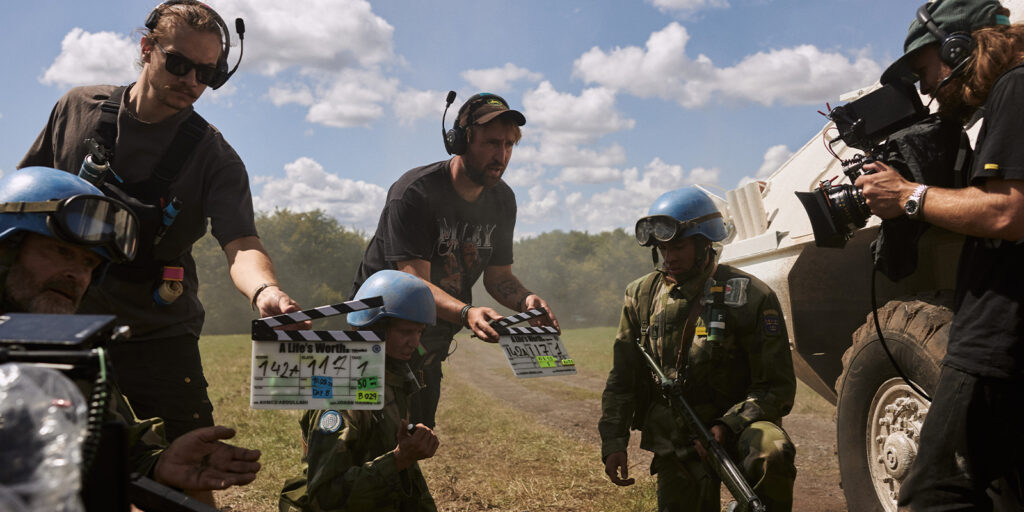
The ARRI Alexa 35 was relatively new to me, but I immediately felt that it would be a perfect tool for this project. 1st AC Niclas Löwstedt exploited the camera’s lightness and built it very compact so I could operate it from anywhere. Together with our choice of optics — Cooke S2 and a Canon K35 25–120mm zoom — it allowed me to stay close to the actors and follow their movements. The combination gave a warm tone that suited the sweaty, intimate look we aimed for.
The main set-up was mostly filmed with two cameras, and I had the luxury of having a fantastic operator, Audrius Zelenius, with me, who really captured the story and was responsive to what we were trying to tell with the camera. When we used a single camera, Audrius often went off to capture nature shots we wanted. We had a saying: “Find the beauty within sadness.”
Creative confidence
In close collaboration with colourist Martin Steinberg, we created a set LUT based on lens tests shot with the actors in their actual wardrobe. We built in grain and halation for the dailies. I wanted everyone to see images that felt as close to the final look as possible, so decisions on set could be made with that confidence.
Episode 3 was the most technically complicated. The scene takes place mainly in one location but is told from three simultaneous perspectives: soldiers holding people in an old school, our Swedish UN soldiers arriving with the SISU (Tanks) and a family held in an apartment next door. All three perspectives communicate continuously. We shot the main part on location in Slovakia, but INT scenes in the SISU were shot in a studio in Lithuania and the INT apartment was also shot in Lithuania (with POV´s filmed in Slovakia). There was a lot of logistics and continuity to keep track of, but we solved it — something I’m very proud of.
I had an incredibly rewarding creative collaboration with the production design team; much thought went into selecting practicals to build into the sets and achieving the right colours, textures and patina.
For Camp Valhalla we used traditional lighting, installing sodium-vapour lamps around the camp to keep the ground clear and give actors freedom of movement — a philosophy I often aim for. For larger night scenes in the forest, we pursued a “submarine” feeling, surrounding darkness with only the light from the SISU tanks, and added practicals. For some scenes I added some big soft boxes above the set and went with the same colour as from the lights from the tanks to kind of make it blend in better, not noticing the “ambient” light.
I’m beyond grateful when Ahmed asked me to come on board for A Life’s Worth. The project became like a child to me — an opportunity to help tell a part of a story from over 30 years ago, set in one of the most brutal wars in Europe since WWII. Especially with the current political climate the world is facing nowadays.