
HUNTING FOR SUCCESS
Following up 2022’s Prey, a critically-acclaimed sci-fi flick that reignited the Predator franchise, was no easy task – but by crafting a fresh experience with Predator: Badlands, DP Jeff Cutter and director Dan Trachtenberg have done so with aplomb. We find out how.
From the moment Predator: Badlands gets under way, it’s clear that the audience is buckling up for a wild ride. Opening with a bone-crunching battle between lead character Dek (Dimitrius Schuster-Koloamatangi) – the titular Predator – and his brother, Kwei (Stefan Grube), Jeff Cutter’s cinematography drops you right into the brutality of this extraterrestrial world. Unsurprisingly, the DP admits that getting that opening salvo right was crucial for setting the tone of the film.
“It was very important to say, ‘Okay this is the world,’” he agrees. “We really wanted to hammer home the visceral, in-your-face action – you want people to almost feel the hits and have the action reverberate through the screen.”
However, like Kwei’s assault on Dek, that initial sequence threw up its fair share of challenges, with Cutter having to capture intense stunt choreography on a blue-screened stage. “It’s a strange experience working with blue screen, at least for me,” he muses. “The cave was a set that was extended with blue screen. You have elements in the foreground and midground, and then you have the actors standing on, basically, dirt, and then there’s a big blue screen wrapping around it.
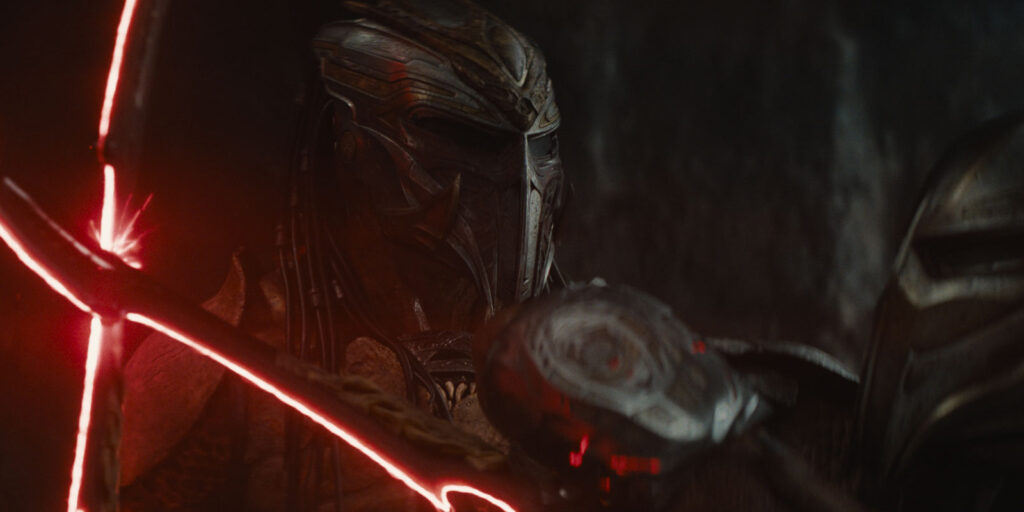
“I find that quite difficult because the way you shoot something changes based on the whole shot. As an example, if I’m setting up a shot of an actor and they’re semi-silhouetted against the sky, it looks a certain way in-camera, but then that same image of an actor semi-silhouetted against the blue screen makes you question, ‘Do I know what I’m looking at?’ There’s this strange transition that happens, I find. So the cave was quite difficult because it was this combination of set and visual effects beyond that.”
Trusting your tribe
Despite these challenges, Cutter puts together one of the film’s most memorable sequences, and some of cinema’s most exciting action beats in recent years, right from the off – with a combination of his extensive action experience and dedicated team helping to overcome any obstacles.
“So much of it falls on the VFX supervisor and their work in post,” Cutter reveals. “Our VFX supervisor, Olivier Dumont, did an incredible job of integrating environments. A lot of that fine-tuning comes in post. When you get into post, and Olivier starts bringing in the backgrounds, there will be plenty of interesting conversations. Olivier would occasionally call me and say, ‘This comp isn’t quite working, why do you think this doesn’t feel right?’ It just becomes about the ratios of the background against the foreground, assessing whether the background should be brighter, or whether you need to bring the characters forward to take up more of the frame. You just have to play around. Essentially, it all becomes about balance – that was really the dance that we did. It’s a real collaborative effort.”
Landing on the ‘Death Planet’
While blue screen may have been used at the start of the film, however, large parts of Badlands takes place on location, with Cutter and his team scouting several spots in New Zealand to craft the ‘Death Planet’ – where Dek and his cyborg companion Thia (Elle Fanning) must take down a seemingly invincible foe to prove Dek’s value to his clan.
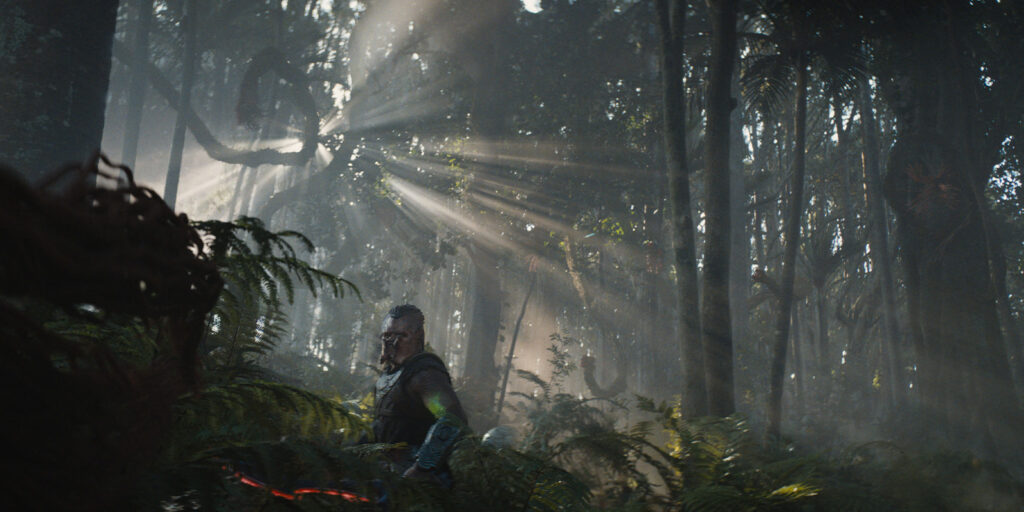
Cutter explains, “We scouted a bunch of places. We scouted Iceland, which was incredible, but ended up being too expensive, because they don’t really have the infrastructure. We scouted Australia, but we didn’t really like that terrain.
“I had always been interested in New Zealand because those opening sequences in Alien: Covenant had such a great extraterrestrial quality to the landscapes. What we didn’t want was a completely fake, abstract landscape. You want audiences to feel like they’re on another planet and you want it to feel extraterrestrial, but at the same time you need to make it not feel so out of people’s scope of imagination that they can’t connect with it at all.
“So New Zealand was great. It had these environments that we’re used to, like forests and rocky environments and so on, but they’re all jumbled together all the time. It had these great terrains that combine things that we know but in ways that we’re not familiar with. And I think that was what really lent it this extraterrestrial quality.”
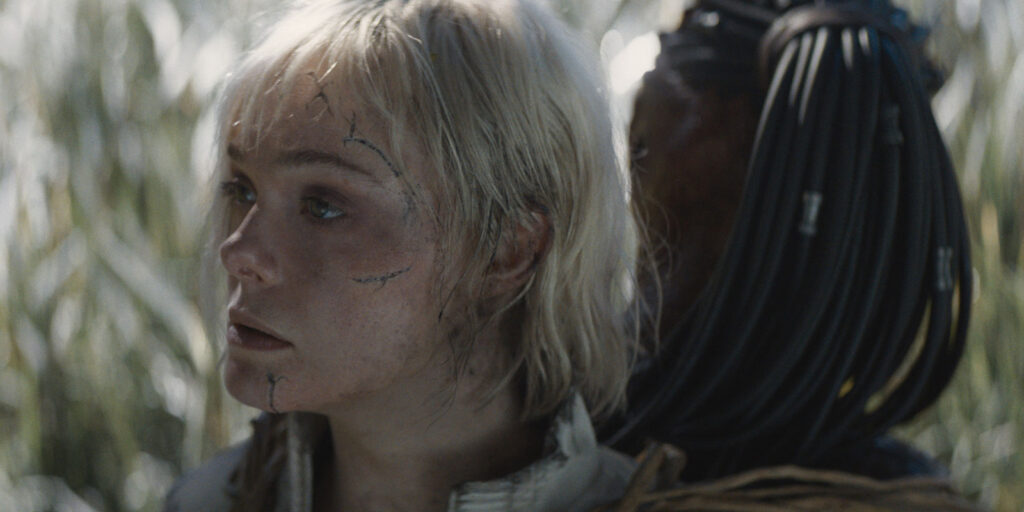
Cutter continues, “Some of those places are really difficult to access, but you just have to make the most of what you can get. You say, ‘Okay, instead of getting 20 shots, we’re only going to get 14 shots,’ because it takes so long to get in and out. But the value of those shots increases; everything feels like a million-dollar shot, versus going somewhere that might be easier to access but doesn’t offer the same visuals. It’s about quality versus quantity.”
From Prey to Predator
Badlands’ expansion of Predator lore and use of unique locations runs in a similar vein to 2022’s Prey, which Cutter also shot for Trachtenberg. Yet both had very different premises and methods of distribution. Instead of following a Predator, Prey centres on a Comanche Nation warrior as she fights to save her tribe from one, with the film always destined for a streaming-only release on Disney+. Badlands, however, focuses on what would traditionally be the antagonist, and had a magnificent cinema run, becoming the highest-grossing Predator movie of all time.
Did these differing factors change Cutter’s approach to the visuals? “I don’t think so,” he muses. “When we were doing Prey, even though we did know from the get-go that it was streaming, we still very much wanted a widescreen aspect ratio, we wanted to shoot anamorphic, we still wanted to treat it in the same way. Those aspects of it didn’t really change. I think for both Prey and Badlands, we wanted that really cinematic feel.”
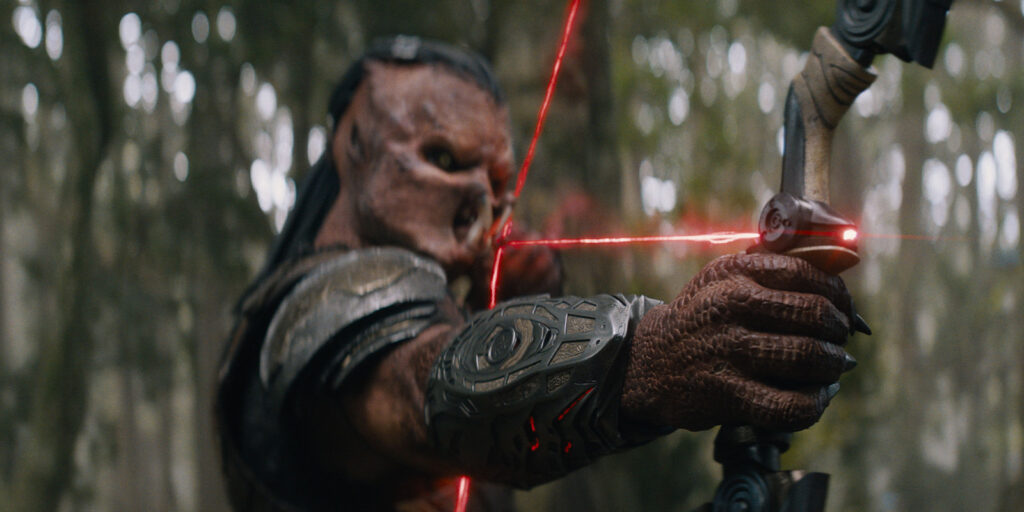
In fact, Cutter even used the same camera for Badlands as he did for Prey, the ARRI Alexa Mini LF – “I really like the larger sensor of the LF,” he explains – though the lens set-up was tweaked to give even more drama to the action.
“We ended up testing a bunch of lenses,” explains Cutter. “[Trachtenberg and I] had done a couple of commercials together and used the Xelmus Apollo anamorphic lenses and we really liked them. They had a lot of character.
“We both grew up with those amazing action movies in the ‘80s. John McTiernan was always a big influence, we both felt there was a real muscular quality to his filmmaking, in that he has these rack focuses that bring dramatic weight to the action, with a lot of breathing and flares throughout his work. We like the breathing and the curvature and the flares that the Apollos provided. I only used the Cooke Anamorphic/i lenses, the same lenses used on Prey, probably four or five times, when sometimes the flares were just so much that you felt like it was a mistake.”
The set-up may have been tweaked slightly from Prey, but one thing remained true: that the team-up between Cutter and Trachtenberg remains one of the most exciting on the sci-fi scene. Cutter credits their success to a shared love for experimentation on set, with the pair willing to rip up the plan – for which Trachtenberg does “a lot of previs” – if a shot doesn’t feel right.
“We both have a willingness to just try things,” Cutter says. “Sometimes we frustrate camera operators and dolly grips and focus pullers because it’ll be, ‘Oh, okay, now let’s try this. Now delay the push in and don’t rack until you get to the end of the dolly move and then whip pan over to this character,’ you know. We’ll just try multiple versions of things, if something’s not right. Obviously, if it feels right on the first go, it’s not experimentation just for fun. But Dan always really wants to find a very precise moment, and if we’re not feeling it, we need to adapt and try something different.”
It’s safe to say the duo’s experimentation is paying off – and long may it continue.