

British Cinematographer partnered with the Production Designers Collective in the run-up to International Production Design Week, the global festival celebrating the craft of the art department in film and television.
A year after winning the Golden Lion for best film at the Venice Film Festival, production designer and PDC co-founder Inbal Weinberg sat down with cinematographer Edu Grau ASC AEC to reflect on how they shaped Pedro Almodóvar’s latest feature, The Room Next Door.
Prior to working on The Room Next Door, what was your connection to Pedro Almodóvar’s films?
EG: I’m Spanish, so all my life Pedro’s films have played as a backdrop in my living room. Making a movie with him was a dream, and a special opportunity for a cinematographer, or for any film lover.
IW: Same for me. I first encountered Pedro’s films as a teenager, and they really opened up these paths that I didn’t think could exist for storytelling.
Once you stepped in as collaborators, and stopped being just viewers of his films, was there anything that you noticed about his cinematic language that you hadn’t noticed before?
IW: I rewatched his films for inspiration while in Spain, and for the first time I noticed the repetition of design elements. Pieces of furniture, fabrics, the way colour palettes connect, even tablescapes. There are so many visual patterns that, funnily enough, I never noticed as a viewer. It was mesmerising.
EG: That’s also what we like about his movies. We find them familiar, they feel like home. It’s a very thin line between being repetitive and being genuine to his own taste.
Were you then able to use any references besides his own filmography?
IW: Early on I understood that on this film I would often be referencing the filmmaker’s own work. So instead of doing an inspiration wall of diverse references as I usually do, I printed around 50 images from Pedro’s films. I was inspired by Edu, who had spent time analyzing Pedro’s films looking for visual patterns.
EG: The same thing that applies to production design applies to visual language. Pedro likes the light, the colours, the contrast a certain way. It’s a very patterned world. So I didn’t want to talk to Pedro about other filmmakers, I just wanted to talk about his own filmography. For instance, for deciding the aspect ratio, I noticed there were three periods throughout his filmography: one was 35mm spherical, 35mm anamorphic and the most recent one was digital. I realised that the movies that we really love visually were those shot on anamorphic. When he mentioned he wanted to approach this project differently, I suggested going back to the period of All About My Mother or Talk to Her, the beginning of the 2000s.
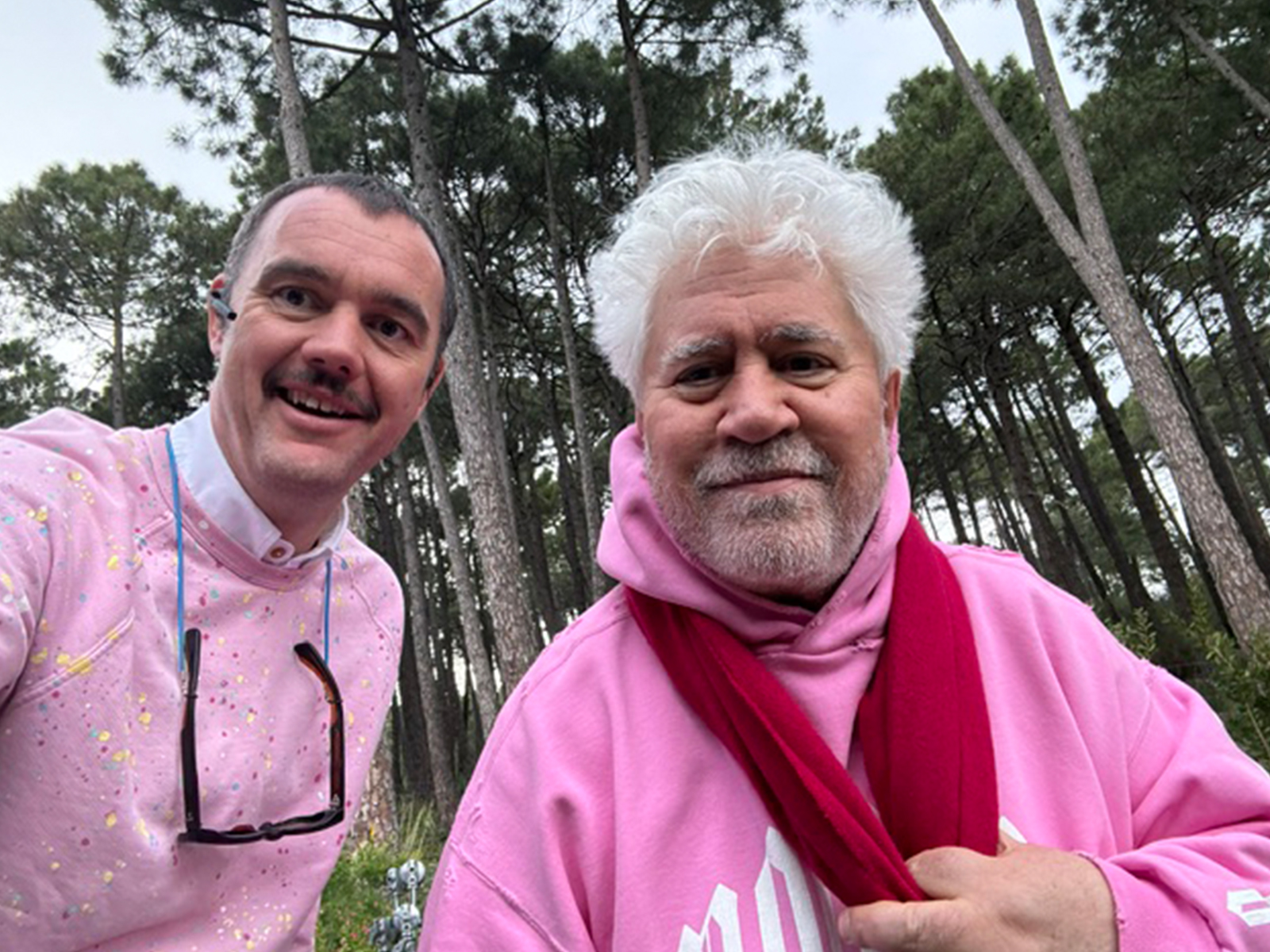
This also marked the first time that the two of you worked together. What was the collaboration process like between your departments?
IW: It was an interesting early process because my prep time was longer than I had ever had for any other project.
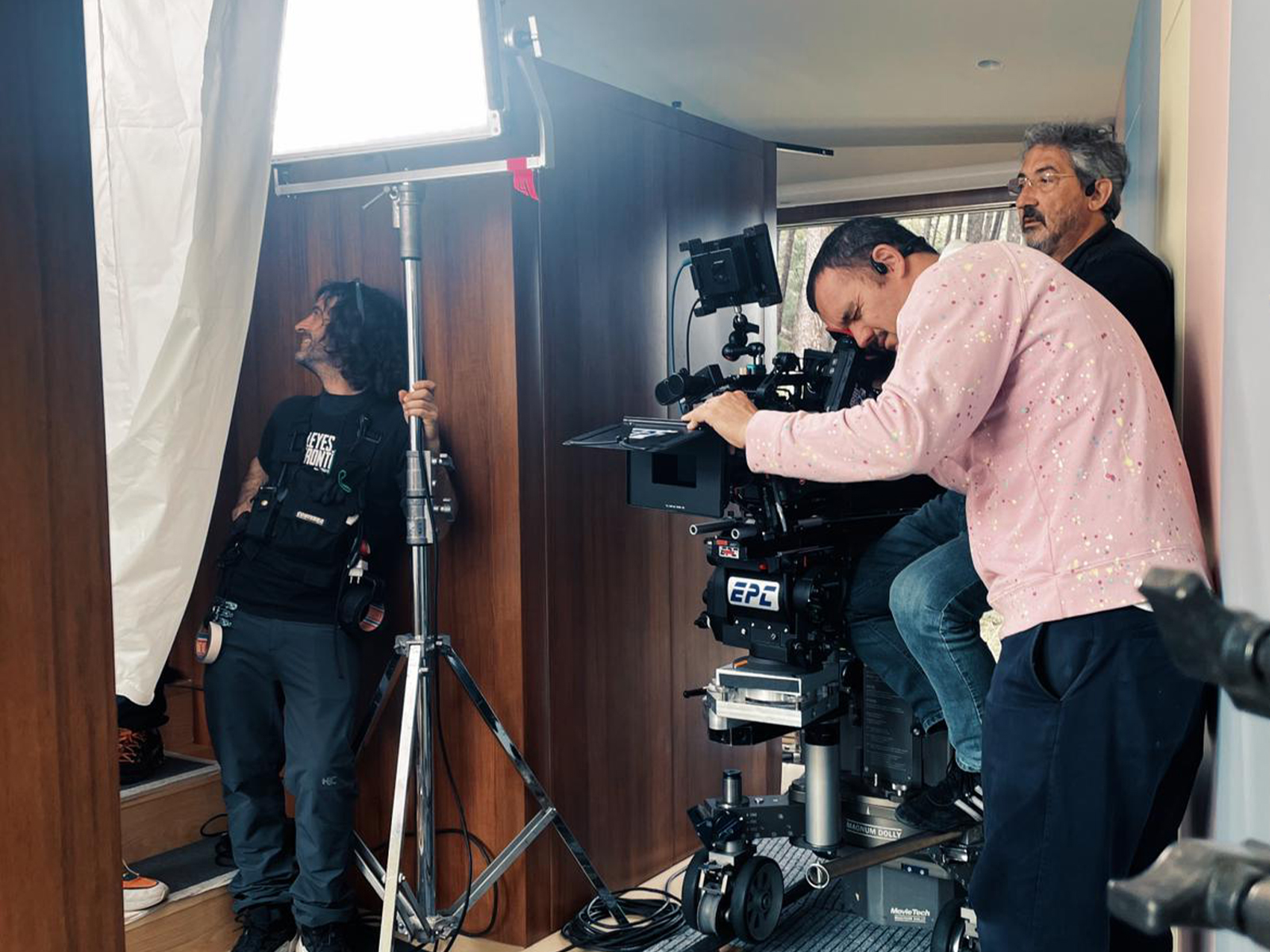
EG: Mine was the shortest! I was very jealous of the quality time that Inbal spent with Pedro. That’s how he works, he wants to spend a lot of time with the production designer, the costume designer… Even makeup gets more time than I do. I barely had three and a half weeks of prep.
IW: I chatted with Edu often during my prep in Spain to let him know how things were evolving, but also to ask him for advice. It was really helpful because Edu is a kind of bridge person–he understands the US American system, and he’s worked in Spain, although we were both newcomers when it came to working with Pedro’s production company, El Deseo.
EG: The concept of team is very present at El Deseo. When making a decision, there’s a political dynamic which involves convincing Pedro’s usual collaborators.
IW: Edu and I worked very collaboratively to diplomatically express new ideas to Pedro and the team, and subtly push in certain directions. For example, with VFX.
EG: That’s a good point. For the hospital room and Martha’s apartment, the original plan was to put a blue screen outside, but we were keen on having the result in our hands, rather than leaving it for post-production. What we liked about Pedro’s movies in the past is the backdrops, which are kind of theatrical and fake. It’s actually part of Pedro’s style, whereas the green screen loses all this soul, this personality of Pedro. Inbal and I realized that together in an early conversation, so we decided to push for backdrops.
How easy was it to convince him of this approach?
IW: It was like pushing a boulder up a hill because El Deseo had moved on from backdrops, and were now in the current world of digital. Backdrops are also very expensive, and a big responsibility on the cinematographer to light, and on the art department to facilitate. In the end, Pedro was very open to the conversation. He also realised that he could embrace the tone of 1950s melodrama movies, with their super noticeable backdrops. When we showed up on set, he was like “point the camera at the backdrop!”–the number one thing not to do [laughs].
EG: There’s a backdrop during the first 20 minutes of the film! At the end of the day, we tried to do the right thing by aiming to be more Pedro-like, and embrace his essence.
There were certainly new elements to his cinema, such as the English language or the actors, but decisions like the backdrops made viewers feel a sense of familiarity.
EG: Exactly! There was another incredible day, when we were doing camera tests, and he was constantly talking about not wanting the backdrop to be washed out. I was trying to push him to make the backdrop brighter in order for it to look more realistic. At one point I told him, “Pedro, I’ll start the light from zero, I’ll increase it, and you’ll tell me when you like the intensity.” We did the test, and at 52, he said, “Stop! I like it here.” Then we did the same thing, but we started from 100, lowered it down, and when he yelled “stop!”, we were at 53. It was incredible, and that proves that when he says he likes something, he means it.
Another element that characterises his films is the use of colour. How was the approach to this subject compared to working with other directors?
EG: I couldn’t add much of it with the lighting. He likes white light. He likes his green to be green or his red to be red to the point that if you retouch a colour too much, he will say, “This is not my sofa, this has a different colour.”
IW: I was concerned that the usual bright Pedro palette was going to clash with the style of New York City, because it is gritty, grey, and has a lot of stone and red brick. I managed to move the needle slightly to a more muted palette, but with some of the colours, even after getting Pedro’s approval and having done tests, we ended up repainting.
EG: He’s someone who sees something and reacts to it. He trusts his intuition. That’s why we sometimes need to repaint, change the costume, relight the whole scene.
IW: On one hand, it’s very difficult for the crew to deal with these last-minute changes. But on the other hand, I think it’s brave of him. Other filmmakers would perhaps be hesitant to say something at such a late stage. It is probably how every filmmaker would want to work, but they’re not lucky enough to have that luxury.
EG: He designed this long pre-production schedule for that reason. He wants to see the actors on the location, with the script, and then make changes, do the blocking, then make more changes. And he’s like, “Oh, you know what? The colour of the wall doesn’t fit the scene. Let’s change the colour.”
What was your reaction once you watched the finished film?
EG: I was lucky enough to see it in the grading room, but nothing compared to the experience of watching it all together with an audience at the Venice Film Festival. Suddenly all the memories of small dramas disappeared because, at the end of the day, you have done a piece of work that you’re proud of and that you’ll keep in your heart for the rest of your life. It made me think of all the things that took me there, and question what might come next.
IW: I totally agree. On a more conceptual level, the film taught me a refreshing lesson about how to think less rationally about people’s worlds when I design a movie. I realised that my concern about connecting Pedro’s world with New York realism was unfounded. In the aftermath, I’ve been trying to be more surreal with the design process, in order to get to an interesting place. Pedro doesn’t have to try, it comes naturally to him.
International Production Design Week will take place in several cities around the world from 17-26 October. The PDC will reveal the programme in early October.