GRIPPING TALES
DPs, operators and grips collaborate to produce camerawork that propels the story, be it observational or immersive, dreamlike or down-to-earth. Here are some of their tales.
Maja Jensen recently completed her Level 3 Grip Certificate, making her the UK’s first fully qualified female key grip. Discussing her process, she says she is usually hired quite late. “The script has already been broken down… and then they’ve been told, ‘You can have three days with a crane,’ and then they must choose which three days… It’s always a discussion with the DP, isn’t it? Because they might think, ‘Oh, we’ll use a 30ft Technocrane here,’ but the 30ft doesn’t have 30ft of travel; we might need a 50 to get the 30ft of travel. So, it’s a conversation, and sometimes a bit of a compromise, on both sides.”
Her advice to DPs collaborating with grips is simple: listen. “If there’s anything that you’re not quite sure about, ask. We like talking about our own work. We’re all geeks and nerds about our equipment and our jobs.” She adds, “We’ve usually done it before. And if I haven’t done a certain thing before, then I have colleagues who have, so I ask them. We bring in the specialist crew when needed… to achieve the vision that the DP has.”
Jensen recalls a Royal Enfield motorbike commercial for which the filmmakers wanted to achieve a “floaty” look using a track and jib arm. The team had only a single day to get 25 set-ups, and Jensen was immediately concerned that moving the tracks would take a lot of time and people. She persuaded the production to go for a telescopic crane instead. “I had to say, ‘Yes, it’s expensive, but we’re not going to need as much crew, because the base doesn’t move… and you’re going to save a lot of time, and therefore you’re also going to save a lot of money in overtime.’”
Jensen was one of two key grips on Ish, a feature about two boys affected by a racially profiled stop-and-search. Director Imran Perretta and DP Jermaine Edwards developed a visual language which differentiated the film’s three environments: the forest, the city and inside homes. Edwards explains that the first was shot entirely handheld to generate a sense of “freedom – go anywhere, do anything.” The last was “stable, like a rock” and so employed classically composed shots, either static, or on a jib or slider. The city exteriors acted as a bridge between those two styles. “We wanted it to feel a bit more free and a bit more refined than handheld,” Edwards explains, “but also to keep that uneasiness – because the boys aren’t at home, and they’re quite young – and to have this ‘edge’.” The solution was to shoot handheld on a dolly, which “introduced imperfections”.
A fourth style for Ish comes into play when the boys ride their bikes; Edwards shot from an electric tracking vehicle with a simple spring-based vibration isolator to dampen lateral movement. “The tracking vehicle would sway and meander with the boys on the bike, and that gave us a really smooth transition from the forest to the inner city,” he says.
Seeing a specialist
Denson Baker ACS NZCS needed a whole other level of stability for No Way Off. “About 90% of the project is set on a bus and probably 50% of that time the bus is moving,” he says. Although the production did shoot on a real travelling bus, certain scenes were to be simulated in Studio Ulster’s LED volume instead; Baker had just completed photography of the background plates when we spoke. The low light levels – for night plates – and the bumpy country roads were the key problems. “Although we want to have a lot of movement in our shots, we’ve built a vibration rig for our bus. We’d rather our bus was doing the movement than our plates… If they didn’t sync up, if there was some movement in the plates that didn’t match what we’re doing here, it’s just not going to look right.”
Baker turned to specialists Brownian Motion and their ReActive Array Stabiliser made in collaboration with Motion Impossible. Compatible with all cinema cameras up to a combined payload of 65kg, the rig was designed to stabilise a cluster off cameras on a flat plane, in six degrees of freedom, as opposed to the traditional nodal point stabilisation. This also enables the ability to stabilise vertical motion on the the Z-axis without dampeners and springs. “It’s got sensors that detect the movement, and then the actuators compensate so that within fractions of a second it’s reacting to the movement of the vehicle and stabilising the shot,” Baker explains. “So we’ve ended up with some absolutely perfect-looking plates.”
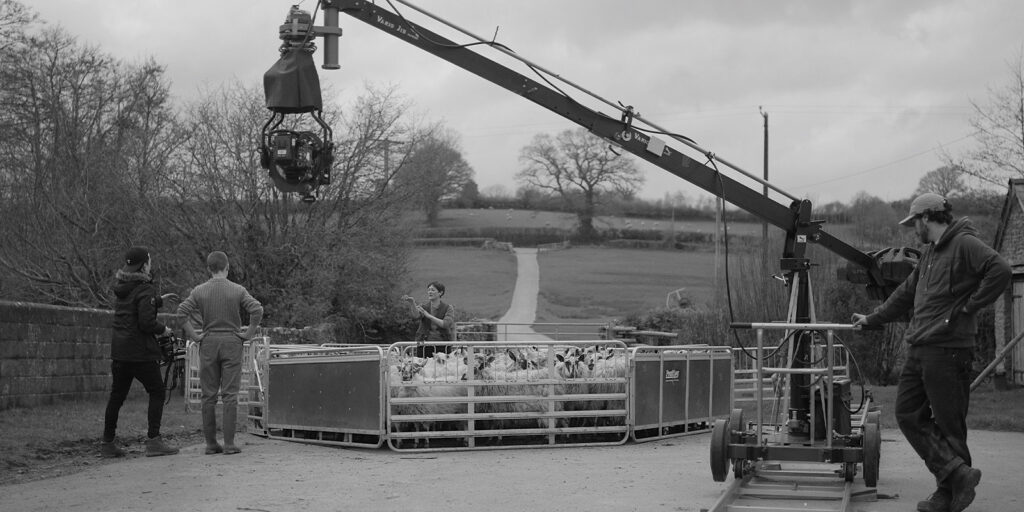
DP Linda Wu wanted very little camera movement for the horror short Flock (for which she scooped Best Cinematography in a Short Film (BSC Club) in the BSC Short Film Competition), about an elderly shepherd who falls under suspicion when several sheep disappear. “We were really lucky to have Pat Gillespie as our key grip,” she says, “and Pat did Adolescence as well, so he’s an incredibly talented grip.” Wu describes the film’s camera style as “very locked-off, still, and composed… quite an observational camera, especially in the barn, getting it into places where you could really see what was happening, and feel the isolation our character was going through… Pat came with us on our tech reccies, and I was able to say to him all the dream places where I would like to put a camera, and he just went, ‘Yeah, great, we can make that happen,’ and it was brilliant.”
On a recent shoot for the charity Missing People, Wu worked with key grip Phill Heale. Dirty framing was central to the look, and by keeping the dolly loose, Heale was able to make subtle movements to maintain that look. “Phill always had a gut instinct,” says Wu. “That kind of camera and grip working together just meant that the shot was always dynamic, and there was always something interesting in the foreground.”
Human movement
Rupert Peddle is a camera operator and associate ACO member with extensive Steadicam experience. “Steadicam’s obviously a very loose form of camera movement, which is both a help and a hindrance sometimes,” he reflects. “You can go anywhere, and sometimes that’s great, because if you’re trying to convey the more human aspect of it, you’re trying to get the audience into the shot. It feels a lot more… immersive, I would say, when compared to something like a dolly or a crane.”
Discussing what he brings to a set, Peddle offers: “As I’m used to being so intrinsically connected with the camera, you move intuitively through the space, and you react to the cast and the timings and all that kind of stuff.” He says his Steadicam experience makes it easier for him to visualise and optimise three-dimensional moves. “When you’re planning the shot, you can maybe look at the blocking and think, ‘Okay, so it’d be nice to be able to link these two sections together, and then turn it into a oner,’ for example.”
When electronic gimbals were introduced, some foresaw the death of Steadicam, but Peddle believes that a Steadicam’s more human movement is the key to its continued popularity. “When you’re moving through three-dimensional space as a human, all your degrees of freedom are linked together, so your rotational movements and your translational movements are all linked together intrinsically, and with a Steadicam that’s the same.”
Peddle mentions a thriller called Breathe Deep which he recently shot at sea. Whereas a dolly would have locked the camera movement to the boat, and a gimbal – the filmmakers’ first choice – would have locked it to the horizon, causing the foreground to rock about wildly, with Steadicam “you merge those two movements together into something that feels quite natural.”
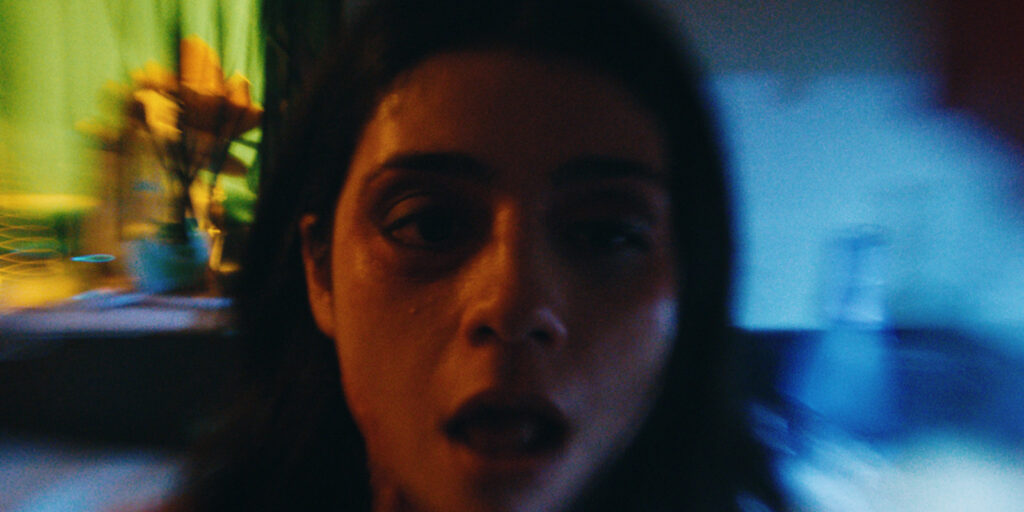
Not all body-worn rigs are stabilised, of course. When the lead character in short film A Matter of Minutes goes into anaphylactic shock, her experience is visualised with a SnorriCam-like rig supplied by Feral Equipment. “We wanted the audience to feel trapped with her, hyper-aware, disorientated, and isolated,” says DP Helena González, “while partygoers visually obstruct her path but emotionally ignore her distress.” A stripped-down Alexa Mini build with a 24mm Panavision Portrait was mounted on the rig. The production could not afford a grip and González notes that this put significant pressure on the camera crew. “We tested the rig first with a stand-in to confirm the visual effect, then did a dedicated test day with Emily Renée, our lead actor. This was essential not only to see how she physically tolerated the weight, but also to refine the blocking… We had to carefully rehearse with supporting actors so that it felt like Ava was being blocked and suffocated, no one collided with the camera, and the chaos still felt organic and believable.”
González worked with grip Thomas Treveil on the short film Last Night, which involves the lead character contemplating suicide on the ledge of a building. The film was entirely handheld and made use of a BLCKBRD Mantis stabiliser with an Easyrig; to maintain the visual language, Treveil suggested attaching the Mantis directly to a scaffold rig overhanging the ledge. To operate, González wore a safety harness like the actor’s, allowing her to lean safely over the edge. “I really needed to practice confronting my vertigo, ha ha!” The DP reflects: “Time is the biggest factor in any stunt-adjacent setup. Safety cannot be rushed. You definitely don’t want to rush it when it’s about risking your own life. The biggest takeaway was: collaborate early with grip, stunt and rigging departments.”
Floating flexibility
When Rainer Lipski shot an episode of the venerable German crime procedural Tatort, his first long-form European project for 18 years, he knew that he needed to be fast and flexible. “I definitely didn’t want to be the ‘Hollywood guy’ who slows everyone down,” Lipski says. He opted to hire a Cinetica NU.TRON, a jointed mechanical arm designed to let the camera move weightlessly in all directions. “Things like quick inserts, overheads, push-ins, even using it as a slider — all of that became easy. We did a few top shots in the offices that normally would have needed serious rigging just to avoid seeing the base.”
Lipski went on to use the NU.TRON on the supernatural feature, Sigil. “Most of the film takes place on and around a single bed, so mobility and fluidity were key. I knew the NU.TRON would give me that weightless, floating feel – I could shoot underslung, move in tight spaces, and still keep that smooth, almost dreamlike motion we wanted, all without slowing things down or adding setup time.” The DP highlights a particular shot captured in the NU.TRON’s underslung mode with a Lambda 10 nodal head, all mounted on a Panther Buddy dolly base. “We created this sweeping shot that followed a water trail – basically the trace of a body dragged across the floor – on a 14mm Master Prime, just inches above the ground. Then we boomed up, circled the bed, and ended in a wide overhead while continuing to push in. It all happened in a tight space with just our core setup – no extra gear, no lost time, and completely on budget.”
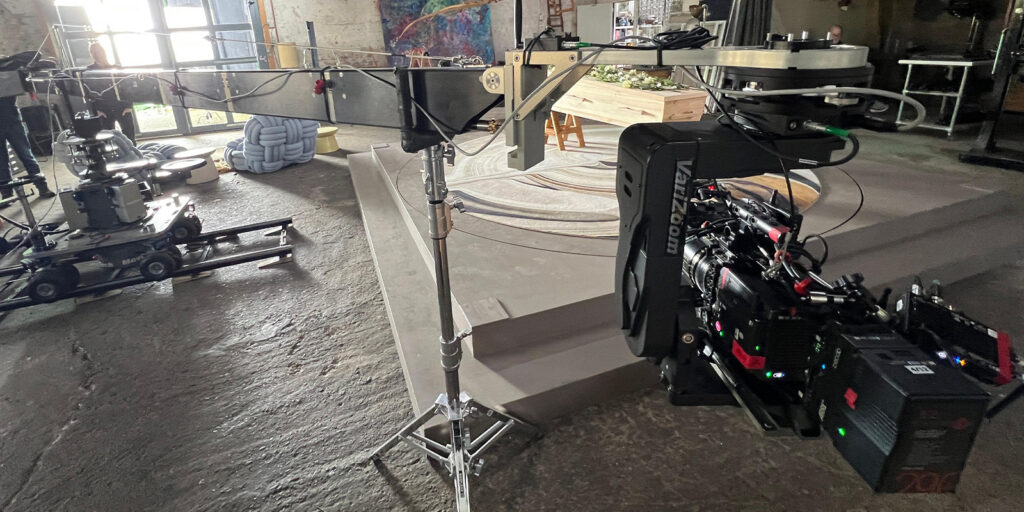
Kees Van Oostrum ASC sought a similar flexibility 25 years ago, which led him to develop the Aerocrane. “I wanted to work with a jib arm, which gave me the flexibility to move the camera at will, not having to deal with track and all that stuff,” he recounts. “I tried every jib arm in the world and I wasn’t happy, and I ended up building an arm as a prototype.” Sir Roger Deakins CBE ASC BSC saw the prototype and requested one for himself. “Roger started to develop it more as his tool to use with remote heads, and he’s used it on every movie.”
Van Oostrum loves the freedom which the jib gives him to respond spontaneously to changes in the blocking. “Sometimes you do the first take and the actor does a certain thing and you want to be just a little bit lower – I can even do that during the shot, unnoticeably.” He highlights Gettysburg’s Battle of Little Round Top, a literal uphill battle. “My concept was to do counter-movement on the whole piece, so not going with it but always going against it, to make it uncomfortable. I used long cranes, I used uphill dollies, but I also used the jib arm to always move.”
Key grip Mitch Lillian, a frequent Deakins collaborator, is a big fan of the Aerocrane. Another of his favourite tools is CableCam, a system of travelling the camera on overhead wires. Horror prequel Crystal Lake made extensive use of it in forest scenes, where cables were run from trees or telehandlers. Lillian notes that the dip in the middle of the cable creates a natural feathering of the camera movement: it accelerates towards the centre of the line, then slows down towards the end as the cable rises. Sometimes a grip would run with the camera. Other times the pull line would be run to a dolly for the “familiarity” of pushing it.
On West Side Story the CableCam movements were computerised. Spielberg called Lillian the night before they were due to shoot a fight scene between the Sharks and the Jets. “I want to do a spiral,” Lillian recalls the director saying, “as if it was a funnel, wide on the top, and spiral around them, and land on a close-up.” Lillian explains that a complex move like this is achieved with four motors, one in each corner of the overhead rig. “Usually, you can do anything you want within about 70% of that square.” J. Patrick Daily programmed the move, which was “frame-by-frame repeatable.”
Lillian’s advice for DPs, like Maja Jensen’s, is to listen. “You don’t learn from talking,” he says. “If you’re a younger cameraperson and have an older grip that may have had more experience, or a different experience, or a variety of experience, listen. Just keep an open ear. Not necessarily obey but hear what they have to say.”