
LA STORY
Crime 101 relies on practical lighting, real streets, compact Sony Venice rigs and remote vehicle cameras to capture high-speed, in-camera thrills safely.
Director Bart Layton and cinematographer Erik A Wilson BSC return to the muscular grammar of 1970s American crime cinema, crafting a thriller that privileges texture, perspective and physical production over digital artifice all shot in LA and California — and it wasn’t easy.
Adapted from Don Winslow’s novella, the Crime 101 film unfolds across Los Angeles with a deliberate commitment to authenticity — real streets, real speed, real night.
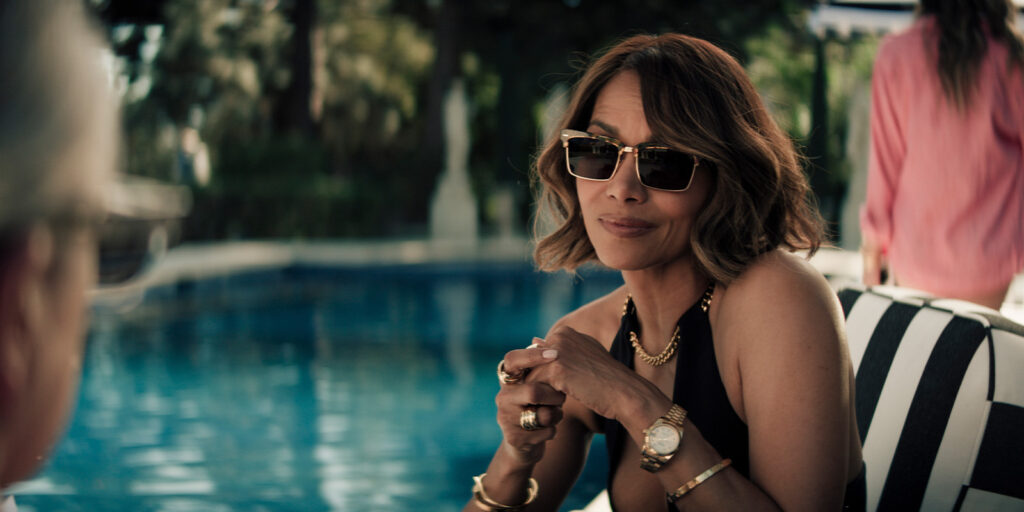
Mike Davis (Chris Hemsworth), a skilled jewel thief, has been eluding law enforcement with a series of daring heists along the 101 freeway. When he targets his most ambitious score yet, his path crosses with insurance broker Sharon Colvin (Halle Berry). Detective Lou Lubesnick (Mark Ruffalo), convinced he’s deciphered the thief’s methods, is determined to stop him before the next job.
“The manuscriptcame to me during that brutal lockdown winter — about five years ago,” director Bart Layton (American Animals) recalls. “I remember it vividly. Reading it felt like a real ray of sunshine because of the setting. About two-thirds of the way through, I was thinking, this is really good — I hope it sticks the landing. When I finished the last few pages, I immediately emailed my agent, who had sent it over. There ended up being a bit of a bidding war, and I just thought, I have to do this.
“I’d always felt that if I were going to make a bigger, more Hollywood-style film, it would be in the vein of the movies we grew up loving — films that felt like proper ‘movie movies’, but were still intelligent and elevated. Suspenseful, thrilling, but classic in their construction. I thought this could be one of those. And maybe it could even help bring people back to the cinema with something that feels both traditional and fresh.”
An inverted skyline opens the film, turning the City of Angels literally on its head and establishing a visual language built on moral disorientation and shifting point of view.
“It’s about the familiar made unfamiliar,” says Layton. “LA is a place where your moral compass can turn upside down. Rather than a traditional establishing shot, we wanted something slightly disorientating — something that forces you to look differently. We initially layered in city noise — adverts selling wellness tech and self-improvement — but in the end the meditation voice alone felt stronger. It captures that ethereal LA wellness culture before we descend into the real city.”
Erik A Wilson BSC (Paddington in Peru), a frequent Barton collaborator – the duo worked on The Imposter together – handled the film’s visual storytelling.
“I brought along my small RED Komodo – with a little anamorphic lens attached – as we scouted locations,” he says. “We’d huddle around the monitor and test different settings and LUTs. By chance, one of the looks we tried wasn’t technically ‘correct’, but we both reacted to it — that’s nice, that’s great. And that ended up becoming the foundation of our look. We realised many of the locations worked beautifully at night with minimal lighting. The film relies heavily on practical lighting rather than large lighting setups.”
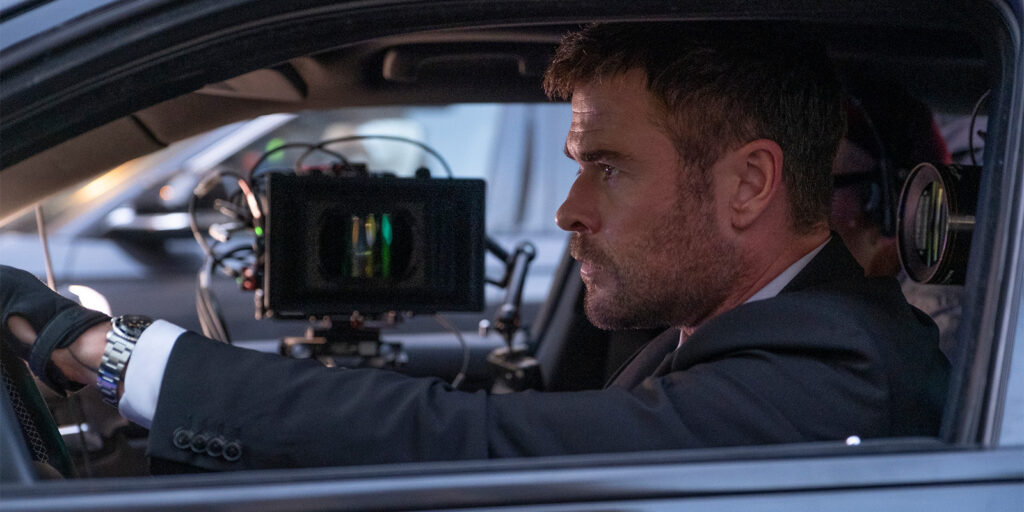
For the actual shoot, he opted for the Sony Venice. “So much of the film takes place in cars, so we needed a camera that could be made compact. Everything was real driving — no blue screen, no LED volumes, no green screen. We were shooting on real roads at real speed. The Venice allowed us to stay small and flexible, especially inside vehicles.”
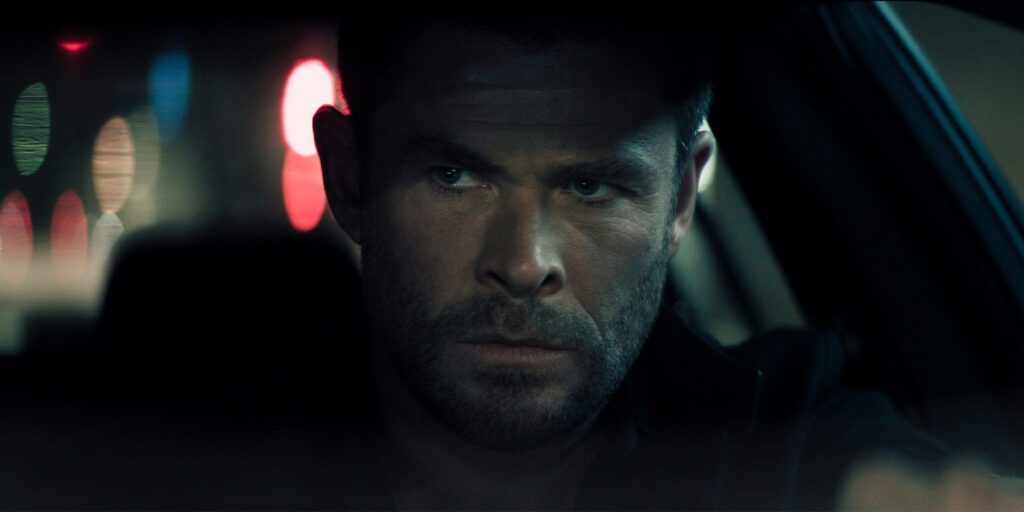
Fans of car chases are in for arguably the most memorable sequences in this film. Behind the wheel, Mike tears through night-time streets, chasing Barry Keoghan’s motorcycle in a high-octane pursuit.
Indeed, the high-speed chases — captured practically on locked-down freeways — reject volume stages and blue screen in favour of controlled chaos. Using a remote mimic rig mounted inside vehicles, Wilson could operate handheld from a separate tracking van while the actors drove at speed, preserving immediacy without sacrificing safety. The result is action that feels observed rather than constructed — kinetic yet grounded.
What’s more, Hemsworth did a lot of the driving himself. “He’s genuinely very good,” Layton adds.
The need for speed
Wilson shot anamorphic on the Sony Venice, embracing wide frames and intimate close focus inside moving vehicles.
“We shot anamorphic,” he says. “It felt right — this is a ‘movie movie’ and not a documentary. But because we were shooting in cars, we needed close focus and speed, so older anamorphics weren’t suitable. We worked with Panavision’s T Series lenses. They’re fantastic — excellent close focus. We even had a couple of custom modifications for even closer work inside vehicles. They were fast, compact enough for cars and gave us everything we needed.”
Wilson also shot some material on the RED Komodo and a few scouting shots even made it into the final cut.
To capture the action from above, helicopter pilot Fred North and DP Dylan Goss oversaw the film’s aerial sequences.
“A core shot for Crime 101 that we had to solve required a full 360-degree roll on axis,” Goss explains. “For the most part, aerial platforms over the years haven’t been designed for this. Bart wanted a long slow move that landed in a specific way. The few full-rotation shots I have done prior were accomplished a post-production effect – and for various reasons we all agreed early on that we wanted the move to be organic and in-camera. We had to execute that in a small shooting window, which was both a challenge and also exciting, to be doing something new.”
Wilson adds: “When flying over people, and especially the general public, the restrictions are very strict, so drones can’t be used over, say, the LA freeway. And the speed you have to fly, and the distances makes that much better with a helicopter.”
The ‘70s look
At its core, Crime 101 stages a disciplined duel between a professional jewel thief and the detective convinced the robberies follow a strict code. That emphasis on code and perspective extends beyond the narrative into the filmmaking itself, shaping lens choice, framing and camera placement. In an industry increasingly defined by virtual workflows, Layton and Wilson make a persuasive case for physical cinema — one where Los Angeles breathes, flickers and looms as a living presence rather than a digital backdrop.
You’d be forgiven for assuming the film was backed by serious money, given its polished aesthetic — yet Layton insists, “we’re a relatively low-budget film, despite how it looks” on the big screen.
Shooting in LA is incredibly expensive — that’s where the money goes. “There was talk of shooting in Sydney for tax breaks, but for me LA was non-negotiable. It had to be LA. It’s integral to the story,” he says.
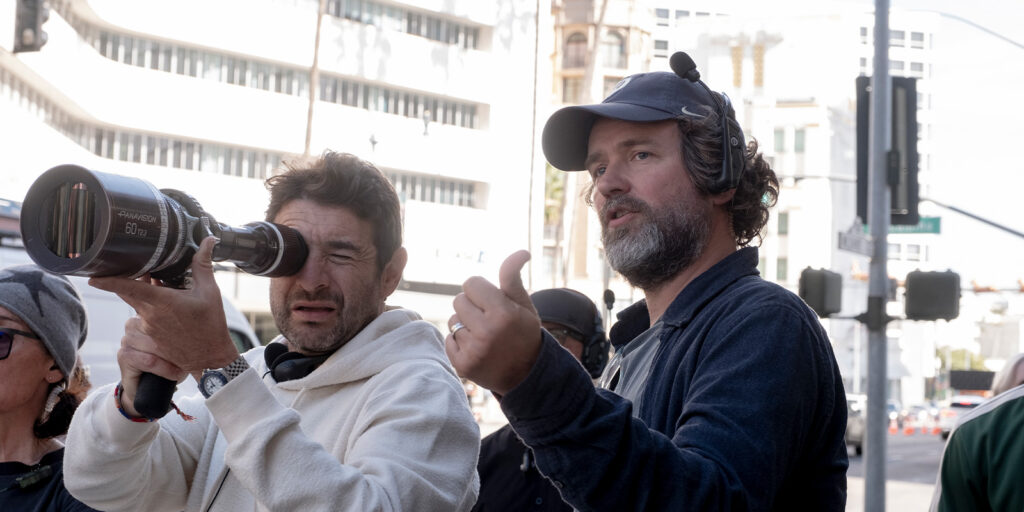
“Coming from documentary filmmaking, visual effects aren’t my natural comfort zone. We researched volume work and blue screen car sequences extensively. While there are good examples — especially at night — we never found something convincing enough for what we wanted. I felt that if I wasn’t convinced, the audience wouldn’t be either.
“Scouting through the actual aspect ratio lens was transformative. You might stand in front of a stunning downtown building, but once framed correctly, you’re only seeing a small portion of it. That completely changes your choice of location.
“We referenced a lot of 1970s cinema — films like The Killing of a Chinese Bookie — natural light at night, grounded realism. A major touchstone was a book called The Atmosphere of Crime, a photo essay by Gordon Parks shot in Harlem in the late 1950s. The colour, the halation around lights, the texture — that became central to our visual language.”
Car scenes in LA weren’t the only major challenges, in fact the biggest was reserved for the opening sequence at dawn.
“We needed that very specific LA look — silhouettes of palm trees against a lit pre-dawn sky,” Wilson says. “But we were facing north, with no mountains. So we had about a 20-minute window where it looked right. And we had a naked Chris Hemsworth on a glass balcony, waiting for the light to drop into exactly the right place. We managed it, but it wasn’t easy.”
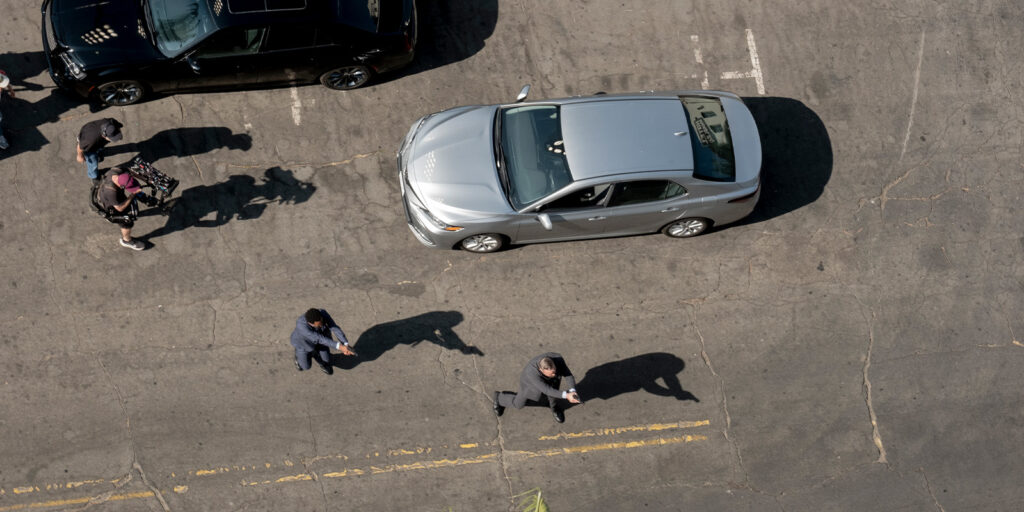
Lighting was kept minimal, relying heavily on the Californian sun.
“Astera tubes inside cars for subtle highlights and Nanlux units for punchier daylight scenes,” Wilson says. “But largely practical lighting. That was the philosophy.”
The cost
LA is Hollywood’s backyard, but like many big cities, exceeding 20mph is near-impossible thanks to traffic and laws. The production had to shut down swaths of the city. “And I mean everything,’ Layton explains—not just streets, but buildings. “You can’t risk someone walking their dog into an 80mph stunt at 2am. We locked down multiple blocks; sometimes whole apartment buildings were relocated to hotels overnight. That’s why filming in LA costs a fortune.'”
The idea was “to achieve the energy of something like Friedkin’s To Live and Die in LA” — but safely. “We used technology that allowed Erik to operate remotely,” says Layton. “He sat in a separate van with a monitor, operating a Phantom camera”. Inside the hero car was a robotic head that mimicked his handheld movements in real time.
“It was essentially a mimic rig — like a remote Libra head mounted on a slider,” adds Wilson. “I’d operate handheld in the van and the right next to Chris would replicate those movements precisely. That way, you get authentic handheld energy at real speed — safely.”
Keeping energy high
The film was finished using a DFD workflow, printed to film and scanned back digitally to achieve the desired look.
Cinelab’s DFD involved transferring digitally captured footage onto Kodak 250D film stock and then processing and scanning back to digital. The process adds real film grain and texture to the digital image giving it an authentic film look.
“That gives you real film grain, halation, colour shifts — not just a plug-in emulation,” Wilson says. “Some wider shots remained digital with emulation, but much of it went through the film process.” Layton adds: “We wanted that ‘70s grittiness and earthiness. Grounded. Never too glossy.”
Editor Jacob Schulsinger explains how he was editing content while filming was taking place,assembling scenes without detailed instructions. “There’s a lot of intention in how it’s shot, so that naturally guides you,” he says. “I start with performance — that’s always the foundation. Once you find the best performances, you build structure around them. After that, you refine rhythm, structure and emphasis with the director.”
Despite Layton and Wilson being sticklers for prep, there can never be enough — having seen how tricky Crime 101 was to make.
“What we will take from this is more prep is needed for every job,” Wilson says. “Prep is everything. It’s the antidote to doubt. We plan obsessively, but we also make sure that every day has something we’re excited to shoot. That keeps energy high. Point of view was crucial. Where does the camera go? Whose story are we in at a given time? That dictated everything.”
At the very least, Crime 101 pays homage to those high-octane gems like Bullit (1968), the original Steve McQueen classic. And fittingly, Mike drives a Mustang in Crime 101. Layton knew they’d nailed it when a journalist said to him, “Thanks for bringing it back.”