
COLLECTIVE BODY
Four filmmakers and a cinematographer demonstrated the power of a collective collaboration with the release of Where You Find Me which revolves around two women supporting each other as they fight for the right to their own bodies.
Upon writing parts of the script for Where You Find Me individually, Julia Goldsby, Willi Andrick, Juan Bermúdez, Anna Schröder and Isis Rampf began to patch their narrative contributions together and hired Eli Börnicke to be their cinematographer to assist them in developing a cohesive visual language.
“Since it was a collective effort, the themes of the film had to be of a collective quality,” explains Juan Bermúdez, producer, director and writer. “After the first round of brainstorming, we still didn’t know how to intertwine the different stories we had but knew what the main topics would be such as bodily autonomy.”
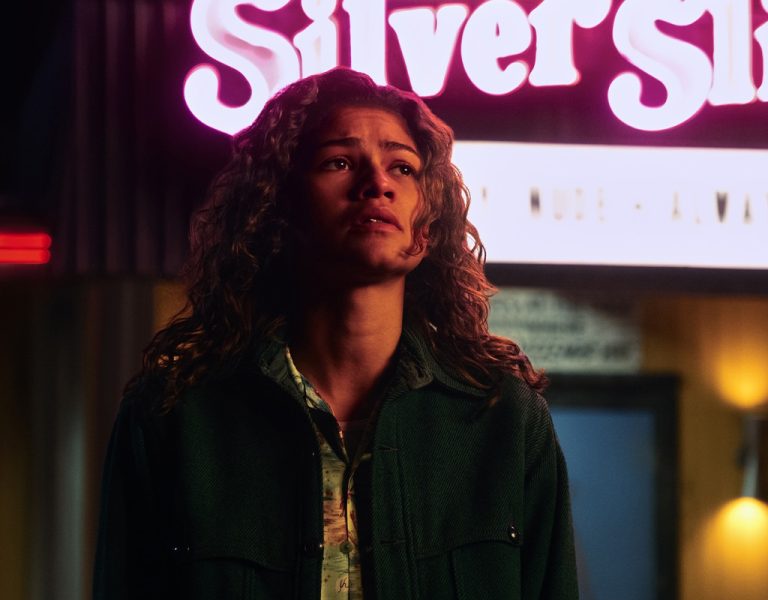
The story focuses on a doctor (Isabella Krieger) considering having an abortion and a nightclub bartender (Thea Ehre) facing a prison sentence for exposing her breasts in public and having an intimate relationship with one another.
Preproduction was five to six months and 22 days were spent on principal photography with a crew of 30 to 40 people in Berlin. Among the key contributors were Sebastian Trübner (gaffer), Sally Shamas (colourist) and Katharina Susec (DIT).
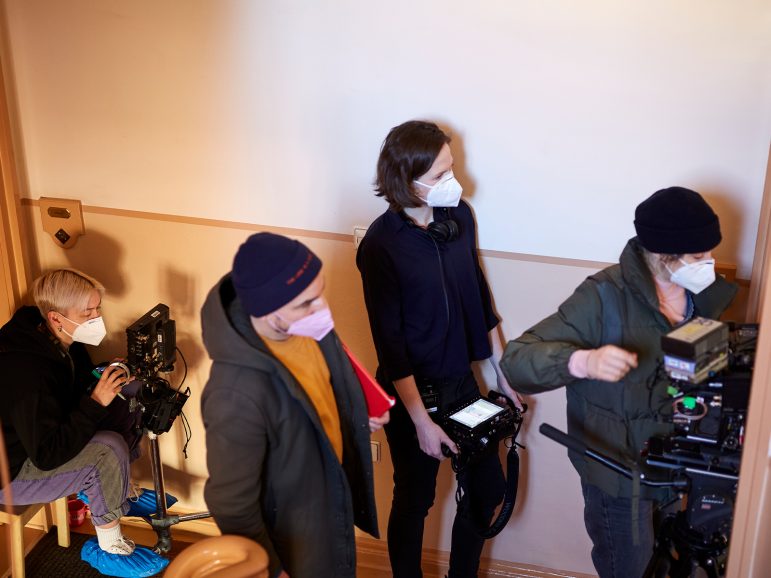
“The four directors had different ideas and references but also various interpretations of the scenes,” notes Eli Börnicke. “Sometimes it was a more comedic or metaphorical approach. We thought about the different levels and these discussions enriched the film. Director duos were established onset.
“Juan and I did the opening and the ending while Anna and Willi did the middle section,” reveals Isis Rampf, producer, director and writer. “This was partly determined by locations and characters. We tried to make it easier for the whole team that for a longer period time they had one voice to follow. We also tried not to discuss onset, but rather in the evening beforehand or afterwards. It was great that we worked with Eli for so long on the visual content, so we were clear as to what we were doing. It was good to work as collective because we had to switch one location three days before shooting and I was off duty at the time so I could visit and look at the new flat.”
Magical realism
The ambition was to achieve a magical realism to the imagery. “I wanted to have an extremely subjective version of a moment within the natural language of the film that is close to the body and shows a glimpse of the intimate space between the characters,” says Börnicke.
“I like to work with ARRI cameras because you have so much flexibility in the colour grading and they try to come close to original film stock so it’s pleasant to the eye regarding the film conventions that we are used to. We were going to do a lot of handheld and the ARRI Alexa Mini is a light and good camera. Also, we liked the characteristics of Zeiss High-Speed T2 lenses which are more vintage and not hyper sharp. They fall into this more pleasant soft look and are used for 16mm cameras, so we lost a little bit of the sensor size, but we liked it anyway. We worked a lot with the Alura Zoom which created a nice dynamic when placed on a dolly.”
The aspect ratio is 1.66:1 with the footage captured ProRes at 3.2K. “Because we wanted to be close with the characters and body, and feel it,” states Rampf. “We decided to go with this narrower format in the end.”
Various lighting schemes and colour palettes were used to differentiate the nightclub scenes that took place in the same room. “We mostly used LEDs and SkyPanels but there was one scene where we used a projector to give a laser party feeling,” remarks Börnicke.
“Lighting the buildings was a challenge because due to the budget we didn’t have apartments with access to the first floor, so we had to light from inside. Normally I prefer lighting outside through a window because you can create a more natural situation. There we used HMIs and LEDs as well.”
Some old fashion trickery was utilised when a pregnant Beatrice slides underneath the bathwater and the face of a baby surfaces. “There were actually going to be way more babies in the bathtub, but we decided that was too much,” laughs Rampf. “It was one of the more emotional scenes. As Beatrice was going down, she had a baby doll in her hands and let it float up. Water was a theme through the film so that’s why we decided on the bathtub scene with the baby.”
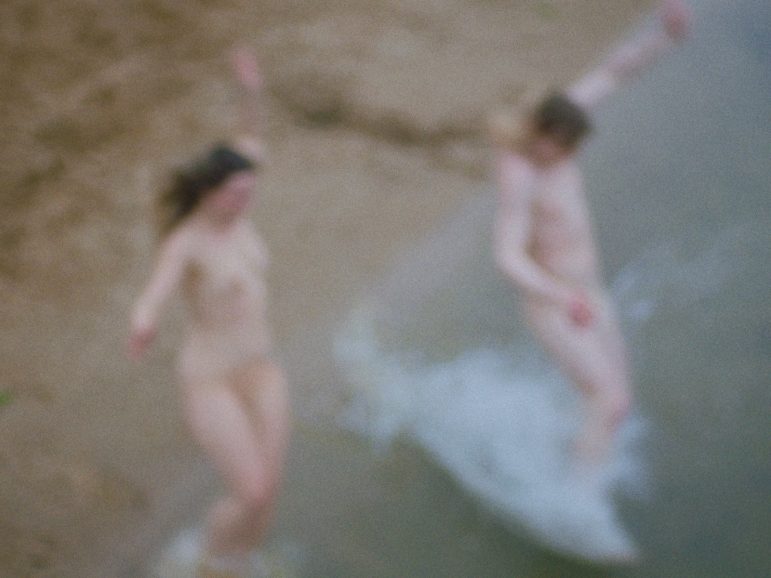
A Lensbaby was responsible for the opening shot where two out-of-focus naked women stand in the middle of a lake. “Going into the edit suite, we did not know that Where You Find Me was going to begin with a lens distorted shot,” admits Bermúdez. “But at the end of the day when we put it there, we understood that this helps to set the tone for film.”
The surrealist imagery was driven by the need to be sensitive and respectful to the subject matter. “The challenge was that this film is about society’s relationship with naked female body,” explains Börnicke. “Our actress is a trans woman so we had to consider that a trans body cannot be read like other bodies. There is more of a voyeuristic curiosity. We found creative solutions, like the Lensbaby.”
The most complex shot took place in the forest. “We had to find the right spot because the forest was close to the city and there had to be a connection to nature,” states Börnicke. “We had to carry a lot of stuff into the forest to make this uneven ground suitable to balance the tracks of the dolly. It was too cold to be naked for the two actresses, so we had to be fast. It was a big challenge to move around when the two actresses were looking at each other at the right moment. We were racing against time and then carrying everything back in the dark to the van, but the shot was worth it!”