
FEELING A MOMENT
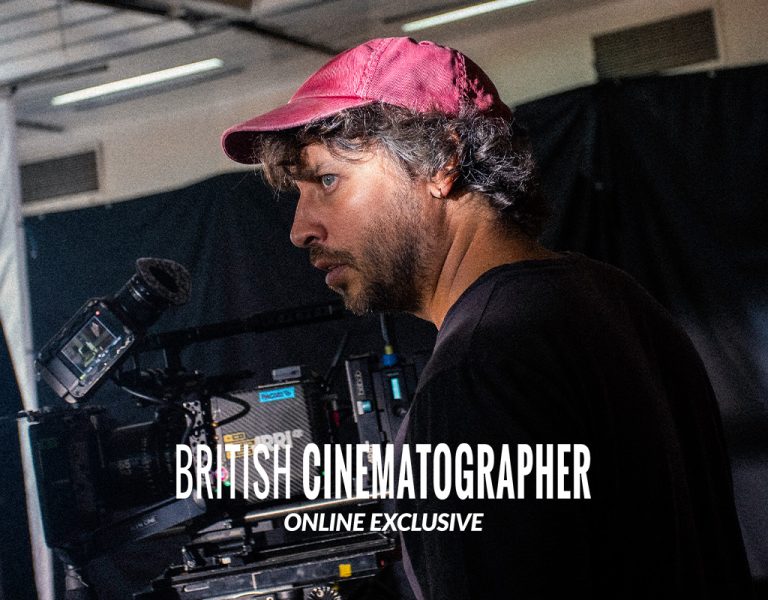
Timely tale A House of Dynamite is lensed in an authentic, intimate and honest way by Barry Ackroyd BSC, capturing the increasing threat and tension as the story is revealed from multiple perspectives.
Viewing filmmaking as an “opportunity to explore worlds few people know anything about”, director Kathryn Bigelow’s cinematic storytelling process always begins with her curiosity being sparked. “It’s a journalistic approach to filmmaking, where the distinction between entertainment and information is fused and fluid,” she says.
Barry Ackroyd BSC, who teamed up with Bigelow on The Hurt Locker, Detroit and their latest gripping and timely project A House of Dynamite, views the process in the same way. “Kathryn doesn’t choose films because it’s convenient,” he says. “She does it because she’s passionate about it. Likewise, I’m passionate about working with Kathryn and the stories she tells.”
Bigelow was compelled to make The Hurt Locker — which saw her become the first woman to win a Best Director Academy Award — because “in Iraq, nobody ever spoke about the methodology of the insurgency, and no photos were being released, so we didn’t know what was going on. I thought that was information that people need to know”.
The director made A House of Dynamite because she was “curious, not to offer prescriptions or policy solutions. I want audiences to leave theatres thinking, ‘Okay, what do we do now?’ It leaves the answer to that question in their hands. They get to carry the ball forward”.
Rather than relying on explosions or gimmicks to build intensity, the tense political thriller relies on skilful camerawork to authentically capture the nervous energy of characters. Exploring themes that are equally terrifying and timely, the film — written by journalist-turned-screenwriter Noah Oppenheim — considers what might happen if a single, unattributed missile was launched at the United States, focusing on the race to determine who is responsible and how to respond.
Bigelow highlights that “multiple nations possess enough nuclear weapons to end civilisation within minutes. And yet, there’s a kind of collective numbness — a quiet normalisation of the unthinkable. How can we call this ‘defence’ when the inevitable outcome is total destruction?
“I wanted to make a film that confronts this paradox — to explore the madness of a world that lives under the constant shadow of annihilation, yet rarely speaks of it.”
Ackroyd’s visceral, documentary-informed style, complete with kinetic camerawork and handheld intimacy was well suited to building tension and capturing the story unfolding in real time, revisited from three different perspectives.
“I have a style, and it is not unique, but people recognise it’s a signature style, and something I’ve worked on because I love that way of filming,” he says. “I would find other methods of filming difficult and I’ve turned down films because I know they need someone who is good at slick camera moves and will use lots of equipment. It’s not for me. I want to feel, I want it to be intimate, story-focused and not beautiful for the sake of it.”
Portraying perspectives
“We just hit it off when we first met,” Ackroyd recalls, reminiscing about his first collaboration with Bigelow, The Hurt Locker (2008) which is set during the Iraq War and examines the dangerous role of elite soldiers disarming bombs in the heat of combat. “Our instincts overlapped completely. When making The Hurt Locker, I suggested we should shoot Super 16 on Aaron cameras which we did. We went to the right location, and as close to the subjects as we could. That was exactly what she wanted and that film was massively successful.”
When they made Detroit (2017) — a harrowing, fact-based drama centred around the Algiers Motel incident, set during the 1967 Detroit riots in which rogue police officers respond to a complaint — they continued to adopt an immersive, immediate, emotionally raw approach to tell the dark story. “We see the world in the same way; through emotion and the physical motion of finding the content of the story; that’s where we coincide.”
The format of A House of Dynamite’s script — 20 minutes of real time, replayed three times from different viewpoints — stood out to Ackroyd as unique and presented the challenge of how to portray the ways in which power is viewed and how people with different levels of authority might react in such a situation.
The filmmakers adopted a flexible cinematographic approach, creating a visual rhythm that became the beating heart of the film as the camera almost became a character in the room. When Ackroyd began his career, he often favoured a single-camera approach, but through years of working with Bigelow, he has come to embrace a multi-camera setup to achieve authentic storytelling, still deploying his trademark use of organic handheld.
“When we started The Hurt Locker, I was much more into a single-camera perspective,” he explains. “But Kathryn wanted more and more cameras, so now, if we don’t have three cameras on set, no matter how small the location, I feel we’re letting the story down. We want to see multiple perspectives of the event, and that’s how I now look at the world.”
Ackroyd believes cinematography is about discovery. For A House of Dynamite, Ackroyd shot A cam and collaborated with two operators with whom he had not worked in that capacity before: Katherine Castro, who had previously worked with him as a focus puller, and Gregor Tavenner, an operator Ackroyd had only met over Zoom before shooting began.
“I ask them: watch, listen, understand and follow what’s in front of the camera. It wasn’t about trying to reinvent or reposition it according to the script,” Ackroyd says, highlighting that the operators became indispensable. “The tension comes into the camera itself. Sometimes you miss something by a fraction of a second — but that’s the moment that feels most real.
“If you start to feel looser with the shots, moving a little more, missing things slightly, that’s when it becomes intense. It goes back to my documentary days. You walk into a room you’ve never been in before, with a camera on your shoulder and there are strangers there, but that’s all you need to tell the story. You find the story, find the motion, reflect what’s in front of you through the lens.”
The concept of A, B or C camera does not work for Ackroyd: “I need to treat each camera with equal importance as each camera, angle and frame could be in the finished film. It’s about using all the footage and everyone’s skills for the best use in the film. It’s all there.”
At the centre of the conflict
Most of A House of Dynamite unfolds in confined interiors. While previous Bigelow productions Ackroyd worked on were mainly location-based, this film demanded extensive studio builds at three large stages in New Jersey which were transformed into replicas of White House bunkers, military control centres and observation outposts.
During the prep and research stages, and using Bigelow’s influence, some key crew were given access to the real White House basement, forming an essential basis for production designer Jeremy Hindle to accurately recreate those spaces on set and for the crew to reproduce the lighting.
Although excited to venture into new territory, some sets presented challenges. “Because we built the whole set — ceilings, floors, windows, glass — everything reflected back into the room,” he explains. “Wherever you put a camera or light, you’d see reflections. So we used available light more than I would have liked. The available light wasn’t beautiful, but cinematography isn’t always about beauty. It’s about telling the story.”
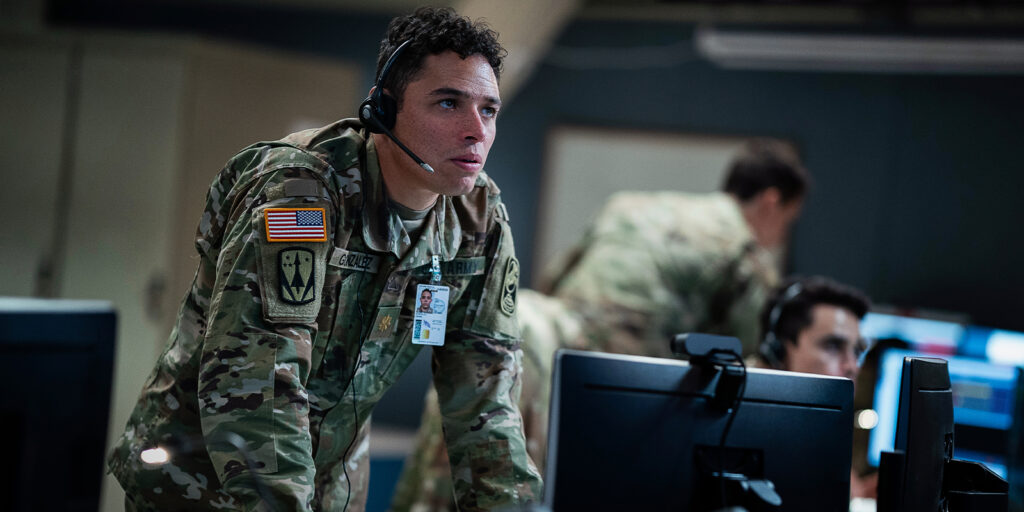
This approach resulted in interiors that felt realistic and oppressive and were lit often using harsh institutional downlighting many expect from government facilities. When choosing the best way to capture the first site to detect the threat of the nuclear attack, the Fort Greely outpost in Alaska, the filmmakers wanted the camera to convey the nervousness of the youthful military personnel. “They’re young, they’re trained, but they’ve never experienced this before,” says Ackroyd. “So you gather that nervousness and it goes through the lens. That’s where the energy came from, the way they respond.”
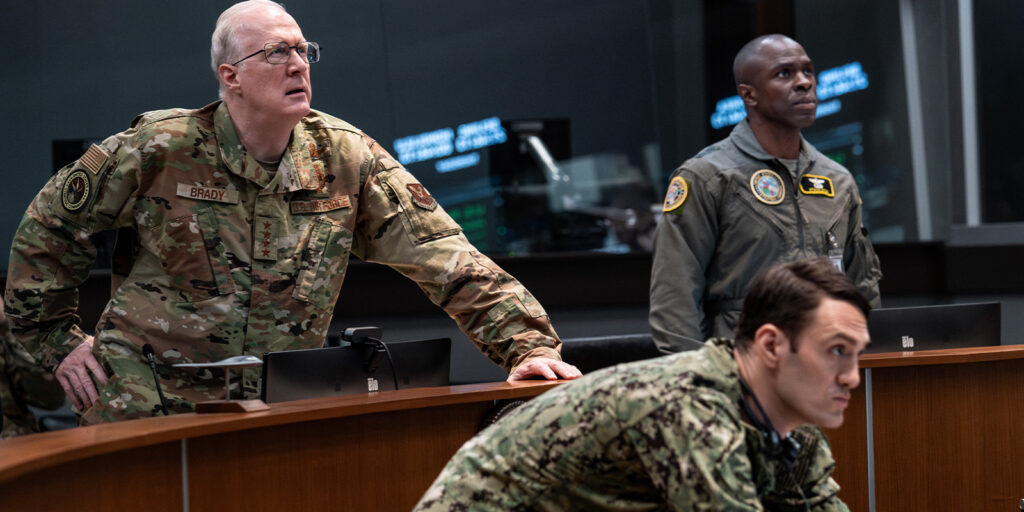
In contrast to this, the STRATCOM Strategic Command control room was shot in a way that would reflect calm authority. “Those guys are older, more experienced and with a ‘We’ve seen it all before,’ attitude,” adds Ackroyd. “You follow that rhythm and the camera isn’t frantic there.”
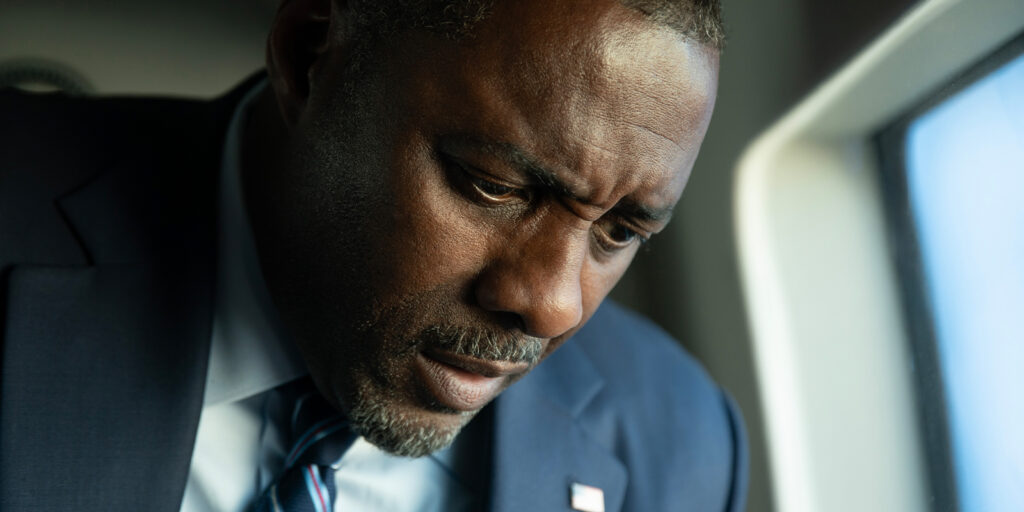
Later sequences of the President (played by Idris Elba), who is whisked away from a joyous public gathering and into the confined space of the Beast — the vehicle the President travels in — and then a helicopter, were captured in a different way to set each setting, perspective and chapter of the story apart. Here the camerawork becomes claustrophobic as more details are revealed and the anxiety and pressure surrounding the situation increases.
“You follow the rhythm the story gives you,” Ackroyd says. “You need to be alert to everything and your surroundings, but also intently aware of what’s through the lens. I look through the camera eyepiece as I feel if you separate yourself from the subjects by looking at a screen, you’ve lost touch.”
Realistic reactions
Rather than opting for flashy gadgets, Ackroyd prefers a more practical approach to selecting equipment, and one that is grounded in the story’s requirements. For A House of Dynamite, he chose the ARRI Alexa 35, paired with Angénieux Optimo zooms and Cooke S4/i primes. To achieve naturalism, filtration remained simple, mainly using Tiffen 1/4 and 1/8 Glimmerglass.
“I need a good zoom. The versatile 24–290mm Optimo was my go-to; I just love that lens. We also used the 15-40mm, 28-76mm and 45-120mm,” he says. “It gives me the flexibility I need and was welcomed by the other camera operators. Gregor loves handheld, and he’s excellent at it — somewhere between Steadicam and handheld, but controlled, human.”
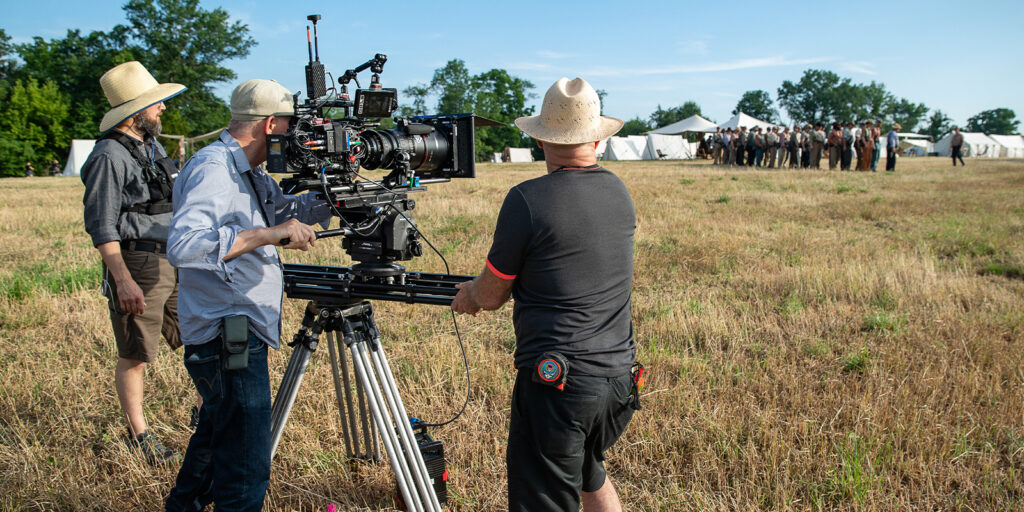
Ackroyd views handheld as an extension of perspective and has finessed his technique throughout his career to immerse audiences in events as they unfold, making it feel like they are watching a documentary more than a drama. “It becomes a point where the mood or atmosphere transitions,” he explains. “Traveling with people, pushing through corridors, turning corners or being in a place where the energy has to be unique to hand holding, where you follow detail in spontaneously.”
There’s a moment in A House of Dynamite where a character gets out of their chair unexpectedly. Tradition would be to anticipate it, but Ackroyd did not. “Kathryn even said, ‘Weren’t you a bit late on that shot?’ And I replied, ‘No, I did that intentionally because if I had anticipated it, it wouldn’t have felt real.’”
The cinematographer also uses sliders on a dolly, on a tripod or on the floor, allowing him to move two or three feet. “It’s like swaying, if you were hand holding, but I can use that long lens and keep my eye to the camera, hug the camera, be part of it, and then it’s like observation which is the way to create this atmosphere.”
Ackroyd learnt valuable lessons from his time working with director Ken Loach which have stayed with him on every project: “His concept of the world and filmmaking was that you don’t make shots that lose the humanity. You don’t frame something that makes somebody feel diminished; there needs to be a dignity to every shot. That’s what Ken embedded in me: there’s dignity in everything you do and even when there are evil people in the story, you don’t want to caricature them.”
For Ackroyd, the key to successful filmmaking is making the audience believe. “And from the response A House of Dynamite has received, we know it was effective and seemed to affect the audience,” he says. “That’s how you tell if we picked the right lenses, chose the right shots, so that editor Kirk Baxter can order them in the best way.”
Ugly beauty
Ackroyd’s longtime collaborator, gaffer Andy Day, was essential in navigating the studio builds. Every light fixture was rewired to run through dimmers by rigging electrician Paul Bordonaro, allowing for subtle dimming and colour adjustment.
“Prelighting was crucial because once it’s lit, it was lit and that’s what Kathryn likes so it doesn’t interfere with the flow of shooting,” Ackroyd says. “The lighting needed to feel authentic which was more important than being revolutionary. It wasn’t about making the most beautiful image, but the most appropriate image.”
Sometimes, the resulting images are what Ackroyd refers to as “ugly beautiful” — a term he embraces which a journalist once used to describe The Hurt Locker. “Some shots are beautiful, and some are ugly beautiful. I like that because there’s a lot of ugly beauty as well as regular beauty,” he says.

Also essential in achieving that honesty of imagery were collaborators including first ACs Olly Driscoll, Cory Stambler, Nolan Ball, and first assistant director Simon Warnock. “The first AD is often underrated but they play a crucial role,” Ackroyd notes. “Simon was on it every day, with so many actors, locations and constant changes; he nailed it.”
Helicopter Film Services’ team – aerial DP Jeremy Braben Assoc. BSC, aerial tech Sam Thurston, and helicopter pilot Jon Bjornsson – were responsible for capturing aerial sequences with ARRI cameras and Shotover Systems.
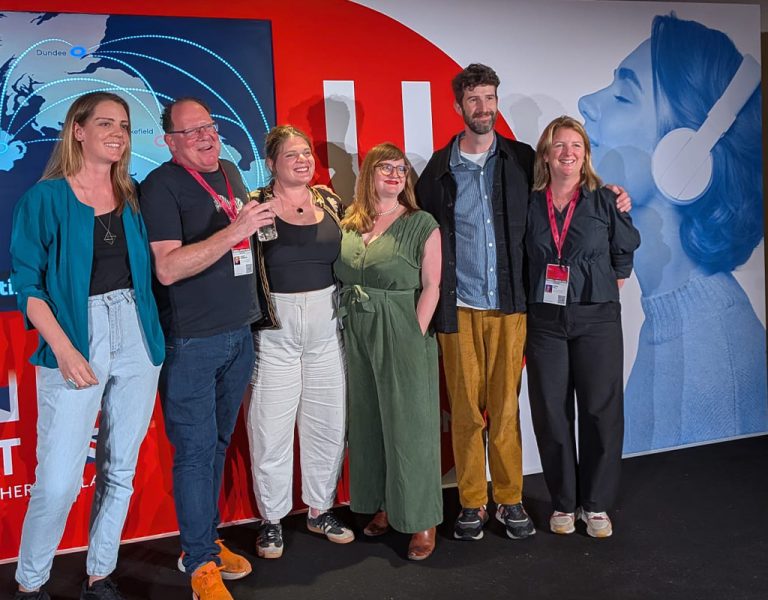
Tight-knit collaboration and dedication is what makes Bigelow’s sets stand out. “Kathryn loves what everyone does,” says Ackroyd. “At Venice Film Festival, where this film premiered, when we were sat in the front row during the press event — me, the editor, the composer — Kathryn said, ‘These are the people I want to work with, this is my A-team.’ That was a nice feeling.”
Company 3’s Stephen Nakamura adopted a subtle approach to the grade that aligned with the realism at the heart of the story, focusing on balancing tones rather than dramatically reinventing the image. “It wasn’t about strong colours,” Ackroyd adds. “It was about naturalism, balance of skin tones, bringing down lights that were too bright. The goal was always for it to feel real.”
An explosive situation
Although predominantly shot on New Jersey stages, exteriors for Fort Greely outpost were captured in Iceland and safari sequences were filmed in Kenya, reflecting Bigelow’s personal commitment to wildlife and conservation. The film which took 50 days of shooting stretched from May to November 2024, with breaks to accommodate the realities of shooting during a US presidential election year.
A House of Dynamite taught Ackroyd about prepping and when to take more control. “When the stages were being built I should have jumped in more and said, ‘This kind of lighting could present me with some obstacles,’” he reflects. “Sometimes you look at a set and think, ‘This is incredible because it’s an exact replica.’ But maybe it should have been made a little more filmic so we could use light to alter things. I lost a bit of control there, but in the end, the audience doesn’t walk out thinking about the lights, they walk out with the story and that’s at the heart of good cinematography and filmmaking.”
As Ackroyd highlights, the reason Bigelow leaves quite long gaps between projects is because she only pursues films she has a passion for. The film’s powerful title — implying we live in a house of dynamite that could explode at any time — is a metaphor for the world and current political climate, says Ackroyd: “It’s a dangerous place to be living. Why have we done that to ourselves? It’s a question that lingers with the audience.”
Despite his undeniable success in telling captivating cinematic stories, Ackroyd admits he still questions whether he “got a shot right”: “I still feel a little unsure about myself at times. But people keep coming back. If I can run around with a camera, I’ll keep filming because when I’m behind the camera, I feel energised.
“When you watch a film for the first time in a cinema with an audience, there’s always something you think that could be better, but that wasn’t really the case when watching this. We didn’t need reshoots, and we didn’t need a second unit, so everything we did was what we wanted to shoot. I think it’s great filmmaking. It’s unusual and has a very important message.”