
Ryan J. Smith explains how he and his team worked on location to bring Arthur’s Empire to life.
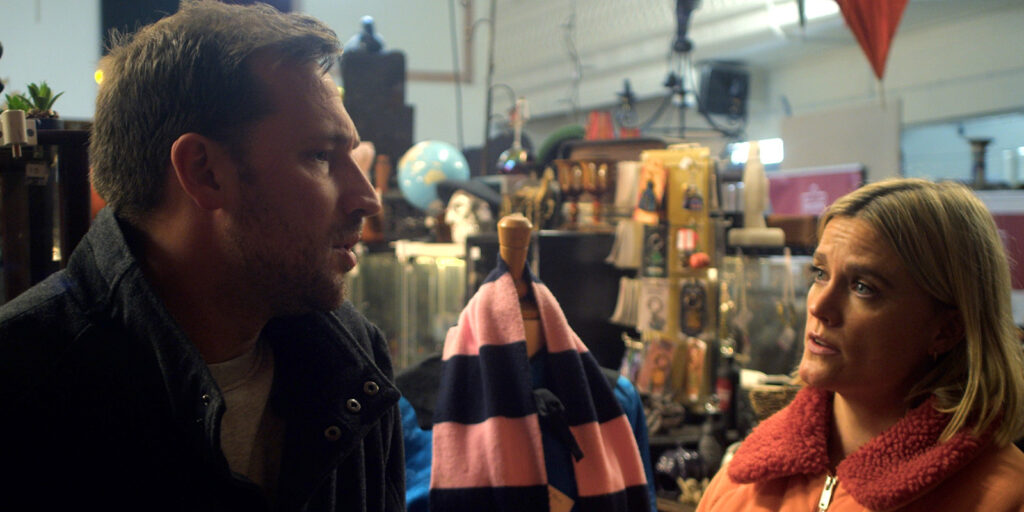
Arthur’s Empire largely takes place in “The Empire Antiques”, a fictional trinkets hall inspired by The Regent – a real-life location in Blackpool, where the production also shot the movie. We wrote the entire film around the real-world location, and being allowed to shoot there was a great privilege. Independent films live and die by their locations and production value.
The drama-comedy film follows a burnt-out magazine writer who’s tasked with covering the final days of a Grade-II listed antiques hall on the coast, under the watch of its Falklands veteran owner, Arthur.
We went into Arthur’s Empire with two mantras: “keep it fun” and “this should feel like a movie that was found by the bins at Ealing Studios”. We were doing everything you’re fundamentally told not to do when making a movie in today’s market as an independent filmmaker — over-exposing, drawing out shots and using our grip equipment in very locked-off ways. The resulting film is something that feels very old-school visually and tonally, despite having an enormous amount of hidden visual effects work and a 4K delivery.
Making tracks
We often had 20 feet of tracks running through the place, which doesn’t sound hair-raising until you realise one wrong footstep can cause a loose shelf in another room to fall down. This was often a major concern when staging action sequences, as we have multiple shootouts across the movie as well as physical comedy such as pratfalls and face plants. It’s a very, very old building with multiple levels and narrow corridors, something you couldn’t possibly replicate on-stage. The physical limitations of the space also meant we weren’t swinging booms, we were shotgunning and lav-ing the whole thing. There were many times crew members would get lost from one setup to the next – trying to navigate the building, it often felt like shooting in The Overlook. As always, it was worth the headache.
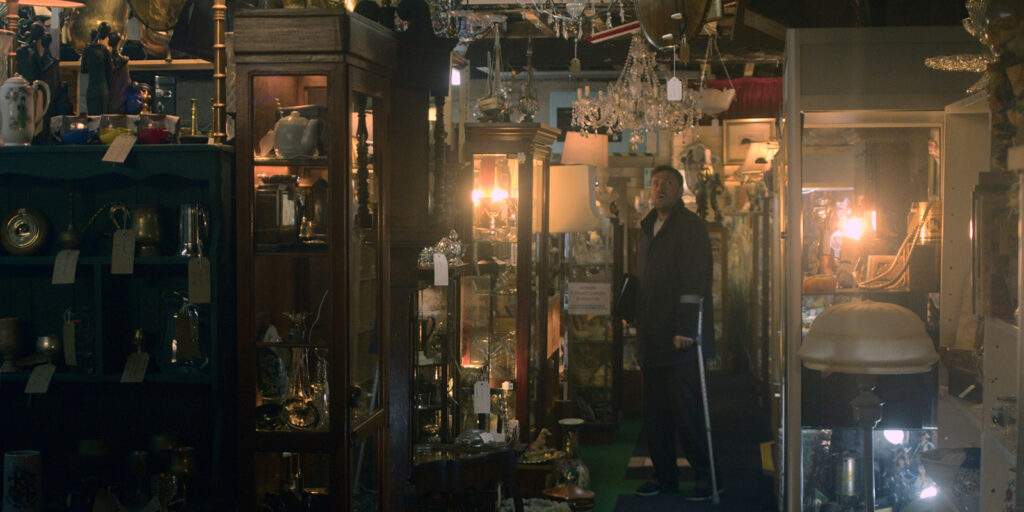
Key grip Callum Sanderson speaks about shooting in the Grade-II listed antiques hall: “Watching a modern cinema-grade camera move through the location on tracks was surreal. There’s no handheld in the movie as we wanted to preserve a vintage feel that would match the production design. It’s a bold choice for a film of this scale, it’s very confident visually.”
In terms of lighting, there was physically no other choice than going with practicals. We had the same problem on my previous movie Kid — no space for film lights. Luckily, we’re in a location which is constantly flooded with dozens of practicals, so we were really lucky. Anytime we can use practicals to give us weird shadows and depth as well as looking pretty is a good day.
The production opted to shoot on the BlackMagic Pocket Cinema 4K Camera in order to keep the production footprint small, whilst retaining projection and streaming standard quality.
The cast features British talent Jake Waring (Tip Toe, Kid), Grahame Edwards (The Dark Knight), and Elizabeth Hope (Emmerdale), alongside emerging talent Charlotte Dalton (Kid) and Rhiann Millington (Kid). The soundtrack blends original score by composer Alisdair Pickering with contributions from indie band Good Health Good Wealth, giving the film a distinct contemporary edge.