EVOLVING THE LOOK FOR SEASON 2
DP Phil Wood explains how the visual language of ITV drama After the Flood evolved from series one to series two.
Returning to After the Flood for a second series presented an unusual challenge: the visual identity of the show was already established, but the story had moved on, and we needed the visuals to reflect that shift. As the sole cinematographer across both series, my aim was not to reinvent the show’s look, but to allow it to evolve — to feel elevated from the first series as a natural progression. I deliberately selected a new camera and lens package for series 2 to better handle the scale of the environments and the challenges of fire and smoke, while keeping the immersive quality of the first series intact.
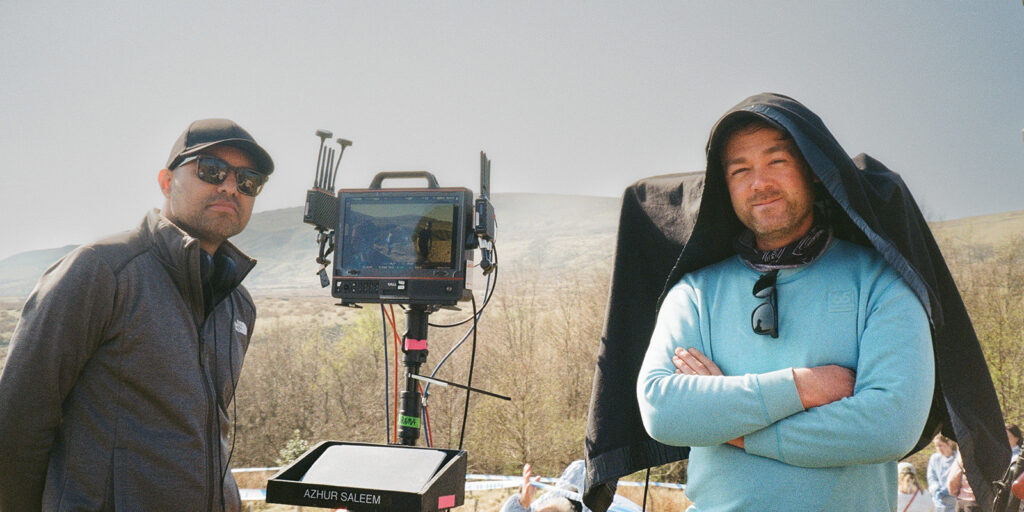
I collaborated again with Azhur Saleem, making this our third series working together. We first met on Doctor Who, and over time we’ve built a shared way of working with very similar visual instincts. That familiarity brought a real ease on set — decisions could be made quickly and instinctively, which was invaluable on a show of this scale. For the final block of series two, I also worked closely with director Tom McKay, whose perspective brought fresh ideas to the series’ climax.
“Every decision — camera, lens, or lighting — was driven by story and environment, not spectacle.”
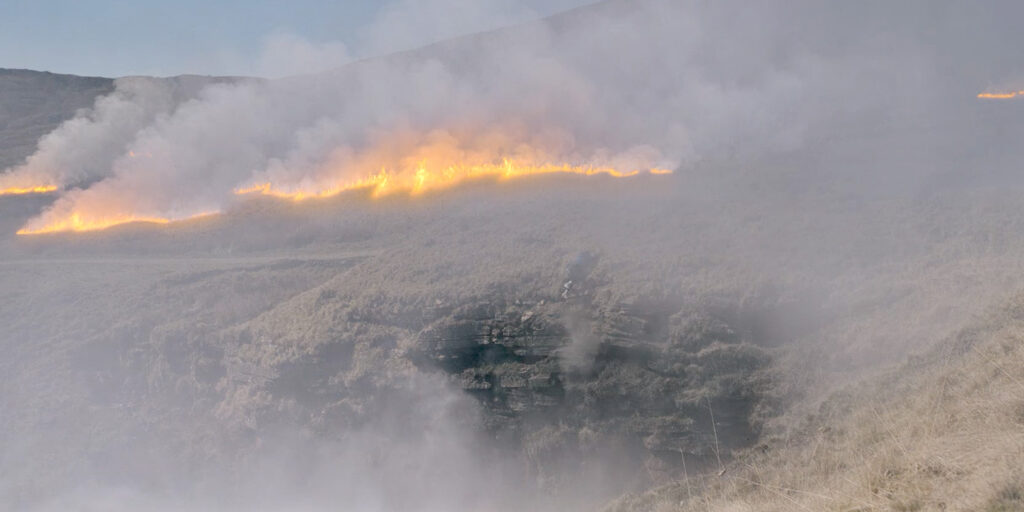
Series two shifts away from the immediacy of the flood and towards a different kind of threat. The focus moves to wildfire — scorched ground, drifting smoke, extreme heat, and very limited visibility. Unlike the flood, which arrived as a single defining event, wildfire creeps, spreads, and obscures. That uncertainty fed directly into how we shot the series.
Visually, the show stepped up in scale and ambition. Set pieces became more complex, locations more exposed, and logistics more demanding. Some sequences were designed to feel cinematic in scope, but always grounded in real locations and real conditions. The challenge wasn’t just staging that scale, but photographing it in a way that still felt immediate and physical.
One sequence really sums this up.
The moorland fire sequence
The sequence appears at the end of episode one during a moorland wildfire and was one of the most demanding scenes across both series. Shot in exposed terrain with heavy smoke, shifting weather, and limited visibility, it follows Jo Marshall (Sophie Rundle) as she investigates a voice in the smoke after search-and-rescue teams are forced to withdraw. A brief lift in the smoke reveals a woman near a concealed cliff edge; she slips, and Jo scrambles down to reach her, leaving both suspended above a gorge with fire below until rescue teams arrive on ropes. From a cinematography perspective, the challenge was staying close to the actors while still allowing the scale and risk of the environment to register — balancing intimacy with scale under constant safety and visibility constraints.
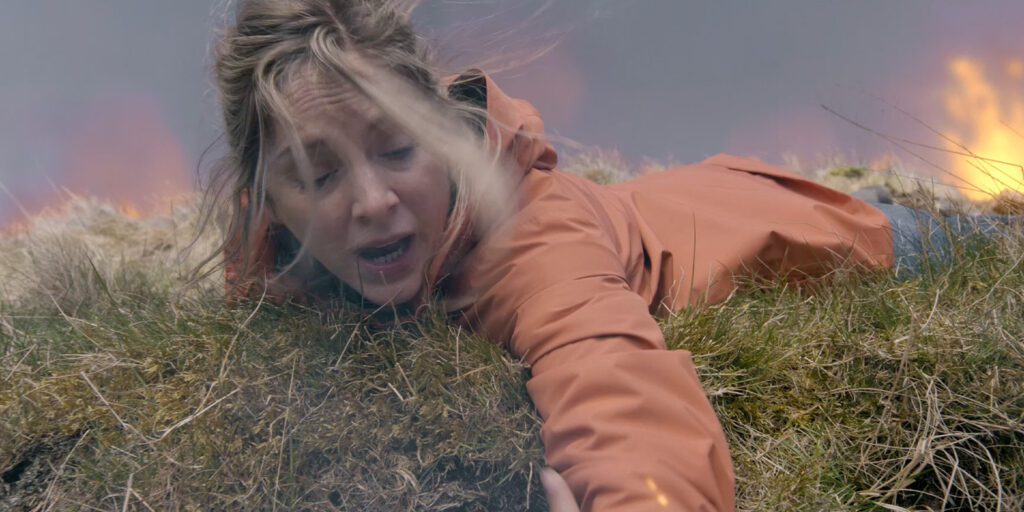
“The challenge was capturing real risk in a way that felt immediate and believable.”
Location, scale and planning
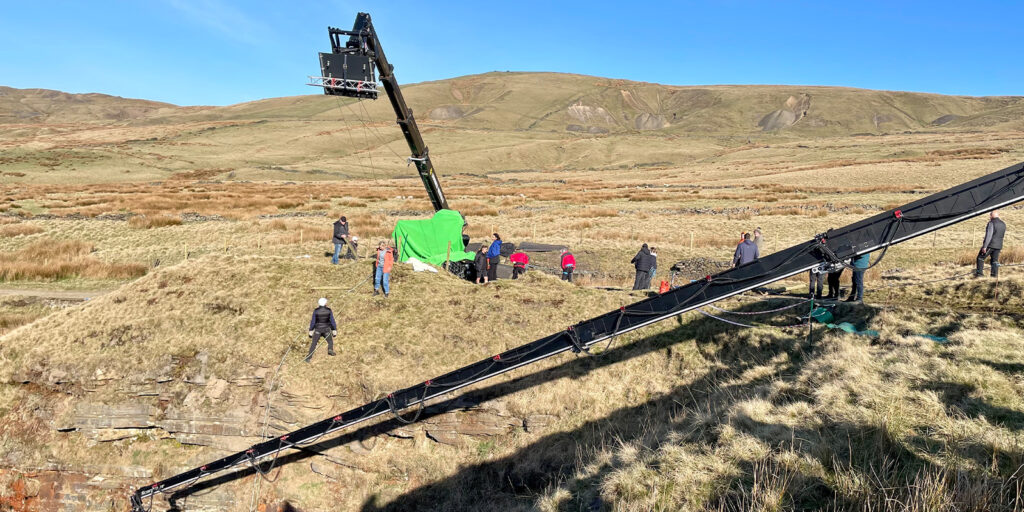
To sell the sense of risk, the location had to do the heavy lifting. We shot on the edge of the moors above Rochdale, in an elevated, isolated area where you immediately felt how unforgiving it was.
Access was limited to a narrow, uneven cobbled track across the moors, which created major logistical challenges for every department. Weather at that altitude is unpredictable — wind and rain can arrive quickly, even on clear days — so flexibility was essential.
We spent a long time prepping. Storyboards, technical recces, and safety planning were done in close collaboration between myself, Az and Steven Granger, the production designer. Getting camera, design, and locations aligned early meant the fire elements and terrain were shaped around what was achievable, rather than forcing solutions later.
We shot in late spring to maximise daylight hours, which gave us more flexibility, though the environment still dictated much of the pace.
Camera coverage and movement
To cover the sequence safely and efficiently, we used three camera teams working simultaneously.
Our primary angles came from the A-camera mounted on a Scorpio 78ft Technocrane on an e-Scorpion L base with a Libra head, which allowed us to move out over the gorge and back into close proximity with the performers. The crane was carefully programmed to maintain smooth arcs despite the uneven ground. Our key grip, Chris Hughes, was instrumental in helping select the correct crane configuration for the location and terrain.
On the crane, A-camera predominantly used the ARRI LW Zoom 30–80mm, chosen for maximum flexibility — allowing me to reframe or push in during shots without resetting. At points, we also used the ARRI LW Zoom 15.5–45mm when we needed to exaggerate scale or stay wider while still moving dynamically.
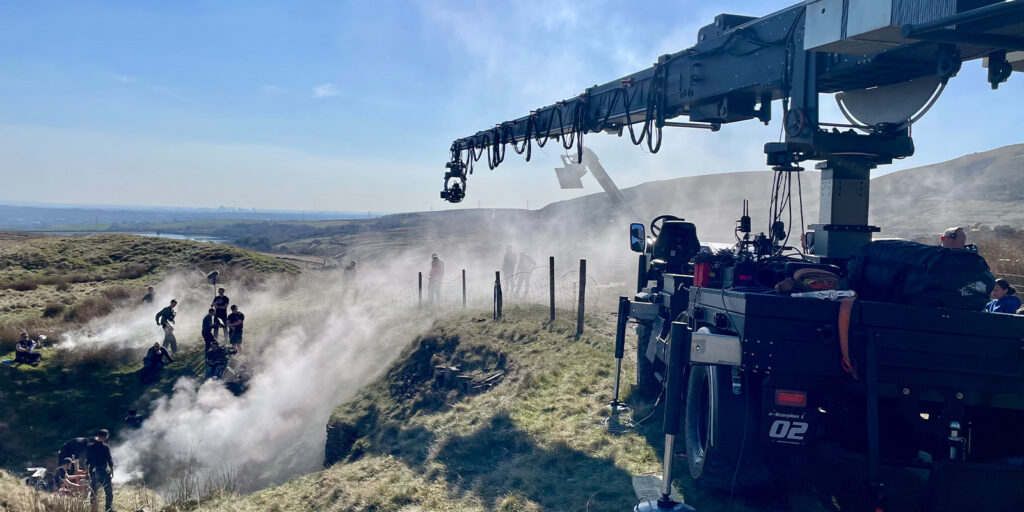
A second camera team was positioned low at the base of the cliff using an ARRI Alura Zoom 45–250mm, allowing us to compress distance and safely cover key moments from below. A third camera worked cliff-side, low to the ground and close to the stunts, keeping us physically connected to the performers during the most dangerous moments.
Alongside the main cliff, we also used a lower “cheat” cliff to safely capture close-ups. This allowed actors and stunts to perform without exposure, while still matching the real cliff visually. Blue-screen plates were shot from the main location at matching focal lengths and angles, then composited beneath the cheat cliff, to preserve scale and perspective.
“The cheat cliff let us get right into the performances without compromising safety or scale.”
Camera strategy and lens selection
For series two, I chose the ARRI Alexa 35, trusting its colour science and dynamic range to handle extreme fire highlights while retaining texture in smoke, skin, and landscape. It gave us enough headroom to hold intense flame detail while keeping faces and atmosphere under control.
I paired the camera with the wonderful ARRI Master Primes. With so many bright sources in frame — not just in this sequence but throughout the series — I didn’t want flares to become distracting. The Master Primes gave me exactly the right level of flare control, keeping contrast intact without feeling overly clinical. Their minimal distortion, sharpness, and clarity were particularly important in these environments, helping the image hold together through smoke, fire, and extreme contrast.
They also offered huge flexibility across the set. We had everything from the 12mm right up to the 135mm, though I often found myself working in the 35–50mm range, frequently gravitating toward the 35mm for our hero close-ups. That focal length gave me intimacy while still holding enough of the environment to keep the threat present.
After extensive testing — including shooting open flame during prep — the Master Primes consistently held more detail in highlight roll-off than other lenses we tested. Their clarity suited the harsh conditions, while still offering a pleasing focus fall-off and natural skin tones.
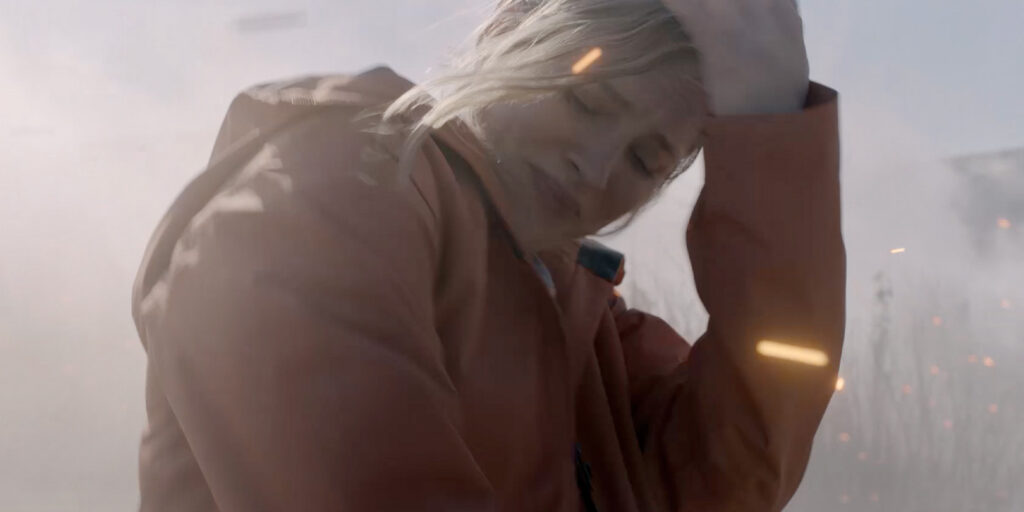
I predominantly shot this sequence with a deeper depth of field, generally between T5.6 and T8, to hold scale within close-ups and keep the environment present. Wider shots often pushed to T8–T11 to maintain layers of smoke, cliff edges, and fire. On tighter moments, I occasionally opened to T2.8–T4, just enough separation without losing context.
“Smoke, heat, and limited visibility forced us to rethink placement, movement, and lens choice on every shot.”
Lighting in extreme conditions
Lighting was just as difficult as shooting it. My gaffer, Jon Best, and I focused on creating the sense of an inferno beneath the performers. We used Sumomax LED panels to simulate flame colour, warmth, and flicker. They were IP-rated, low-power, and practical to run from generators carried up onto the moor.
The units were DMX-controlled, allowing us to fine-tune flicker and intensity to match real fire movement. We worked hard to maintain a consistent overcast feel by tracking the sun with frames and using negative fill to reduce ambient daylight. It was often more about taking light away than adding it, letting the fire read naturally without overpowering faces.
Reflections on collaboration
What really struck me on this sequence was how much coordination it took to make it work. The smoke, fire, weather, and terrain meant every department had to be completely in sync. From stunts and safety teams to lighting, camera, VFX, and production design, it only worked because everyone trusted each other and stuck to the plan.
As a cinematographer, moments like this aren’t about flashy choices. They’re about preparation, collaboration, and staying calm under pressure — and when it comes together, you can achieve something that genuinely feels physical and real.