Scope is a historical thriller short film which stars Antonia Thomas (The Good Doctor, Still Up) and Samantha Spiro (Sex Education, Still Up). Shot by Rick Joaquim SASC (RJ), and written and directed by Emma Moffat (EM), the film was produced by Samantha Locock (SL) and Kristina Pringle, with Amy Dowd, Elisabeth Hopper, Victoria Emslie (VE), and Zbigniew Siwek on board as executive producers. Scope premiered at the Oscar-qualifying San Jose International Short Film Festival in October and won Best Thriller at BAFTA-qualifying Aesthetica Short Film Festival. The film follows Antonia’s obsession with circles leading to her meeting with her therapist and unlocking the deeper meaning of the obsession.
Was the idea always to include circles at the centre of each frame?
RJ: Yes – our talented director Emma had this vision in mind right from the very beginning, and it was one of the key things that sold me on coming aboard the project as the DP. I loved not only the idea itself but also the challenge that came with trying to execute something so precise and ambitious. It’s the kind of concept that immediately sparks your imagination and makes you want to figure out how to pull it off.
Emma is not only creative but also highly technical. That combination meant our conversations were never abstract – they were grounded in practical thinking about how to actually achieve the look and we could connect easily. We were able to use the tech recce as a genuine working session, mapping out how each sequence might function, exploring where potential issues could arise, and discussing in detail how camera, lighting, and design choices could all support the vision.
It also gave us the chance to dive deep with the art department and dressing, which was a huge part of making this idea work. We wanted to get the absolute most out of what the locations could give us, and at the same time plan ahead for the inevitable challenges that come with a project of this scale and detail.
EM: Absolutely. I could see the cogs whirring in Rick’s head when we first chatted about the circles. It’s an unconventional idea and it provided us with lots of challenges, but we also enjoyed the opportunity to explore together how to use the circle motif in different ways to translate Antonia’s experience. We used match cuts in the montage to make them stand out more, and the circles change size across the rest of the film to let the actors’ performances breathe.
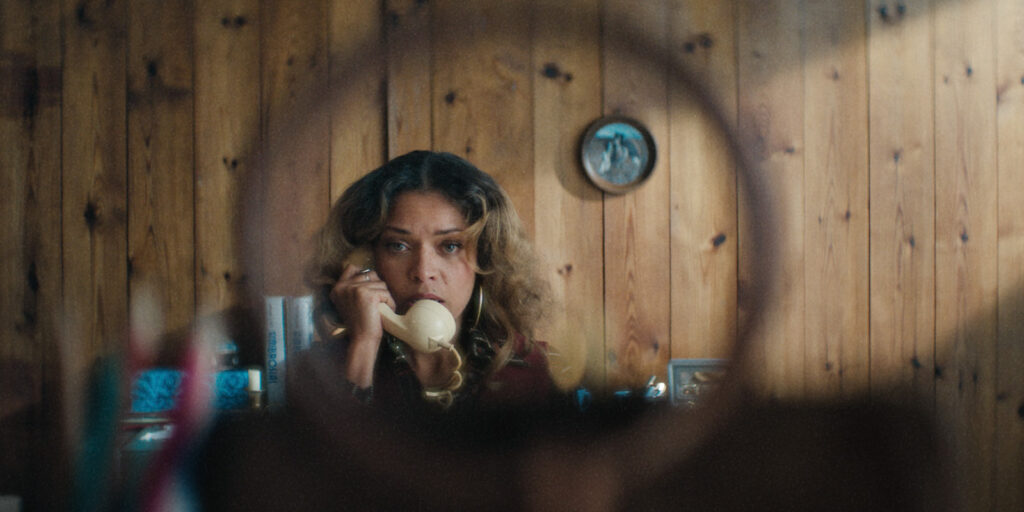
It was a risk going for such a specific composition throughout the film, so I storyboarded every shot; Rick and I were then able to work out how it would fit together and how it would feel overall. I also discussed the storyboards with our incredible editor, Laura Jennings, to get her take on how the circles could work in the cut, which was really invaluable. Rick and I were armed with our tests, storyboards and great advice going into the shoot and were able to be as efficient as we could.
How did you develop the visual language of the film, and what was behind the decision to put a circle in the centre of every frame?
EM: Typically, OCD is represented on film with characters repeatedly carrying out different actions i.e. washing hands, counting things, checking and re-checking if the iron is off etc. Although this is true for some people with OCD, I feel it leaves out the oppressive feeling behind it, and the experience of Pure OCD, which is more thought-based. I set out to make a film which shows the experience of someone suffering from a version of OCD, but wrapping it up in a genre film with its own 1970s Cold War thriller storyline rather than being an ‘issue’ film per se. I want audiences to be intrigued by the plot and the world of the story, with OCD being something they experience metaphorically as a result of the meticulous framing and the easter eggs. By choosing to have circles in the centre of every shot, not just ones from Antonia’s point of view, I am asking the audience if they are part of the same scheme she is wrapped up in, and to encourage a sense of empathy for OCD. I hope people enjoy watching the film a few times to notice different details and layers…
Rick, tell us about the equipment you used?
RJ: Emma and myself are huge vintage and anamorphic lens fans – so we knew from the start this would be something we both wanted to utilise on this. We tested a few options and settled on shooting on the ARRI Alexa 35, which is one of my favourite cameras to work with at the moment, and paired it with the Hawk V-Lite Vintage ’74’s lenses, which I absolutely adore and would love to use again on future projects. A big thank you to Mike Henery and the team at Sunbelt Rentals for all their support and for providing such fantastic equipment.
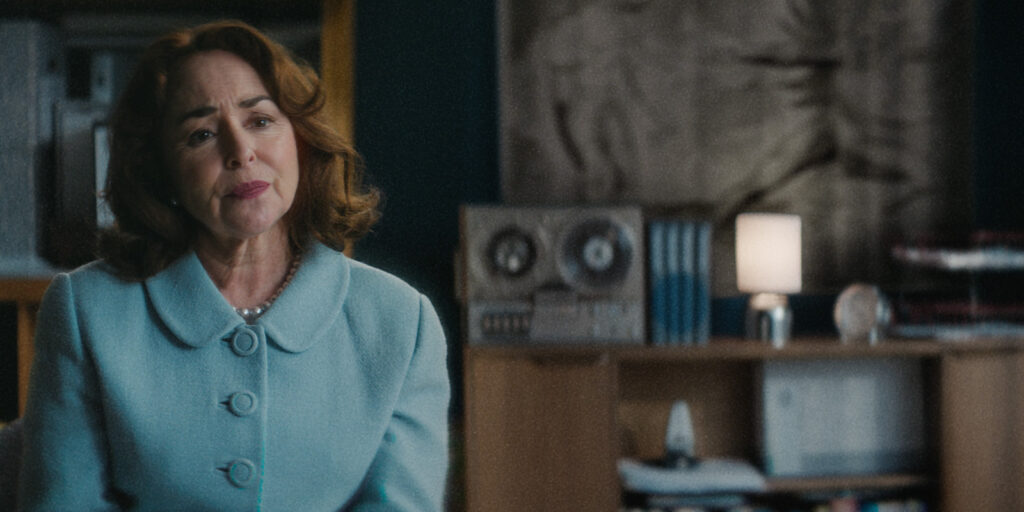
EM: The Hawk V-Lite Vintage ‘74’s were really gorgeous lenses. We were so lucky to use them, and the team at Sunbelt were so supportive and really went above and beyond for us. I was set from the beginning to use anamorphic lenses; Rick and I are both anamorphic enthusiasts, and I was particularly keen on them for Scope as the oval bokeh shape draws more attention to the central circle as well as providing a nifty optical trick right at the end of the film…
Which sequence/shot are you most proud of?
RJ: One of my personal favourite sequences is the hypnotising scene. We came up with a really fun trick where we rigged the camera to the pocket watch that’s hypnotising our lead, Antonia. I think it works beautifully in the edit, creating this slightly surreal perspective that really pulls you into her experience. As much as I love VFX, I also really love getting things right in camera. It was an experiment on set but ended up becoming one of the most striking moments in the film personally. But to be fair, I’m honestly proud of the whole piece – every single frame has a circle in the middle of it somewhere, which was a creative challenge in itself, but it’s those little details and visual motifs that I think give the project its unique feel.
EM: The hypnosis shot is one of my favourites too! We chose to shoot this in camera and enhance the shot in VFX afterwards rather than shoot two plates. Our VFX compositor, Shane Meehan, did such a spectacular job creating seamless VFX across this film; I think people will be surprised that any VFX is in it!
One of my favourite shots was a close-up on Antonia at the turning point of the film, for which we invented a set out of very lo-fi elements, which we had planned beforehand using craft equipment I picked up from an art shop, some clever lighting, some VFX magic, and a handheld fan. The shot looks like we had a massive budget and a whole other location but is actually some nifty tricks and a bit of crafty handmade elements. Rick and I had a lot of fun planning that shot and I think we pulled it off!
Technically what was the trickiest part of making Scope?
RJ: What made this piece so fascinating was also what made it so technically demanding. Placing a circle dead in the centre of every frame meant we had to be much more intentional with our compositions, constantly looking for fresh ways to frame so that it didn’t feel repetitive or gimmicky. It wasn’t just about the camera either – we had to think carefully about what the locations and the art department could contribute too.
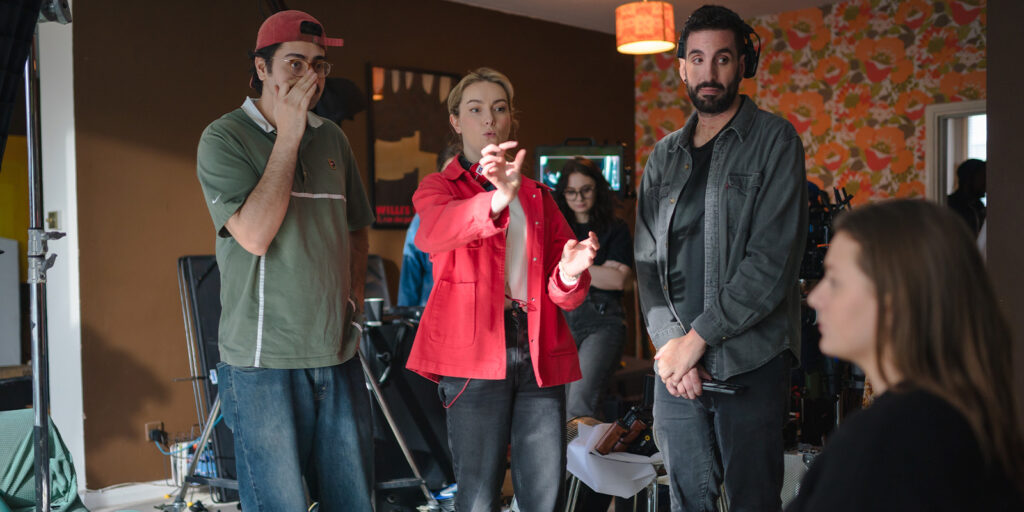
One of our biggest concerns was how a circle would actually read on screen when shot through anamorphic lenses. Of course, we knew it would remain “round” in theory, but we also worried that if it were too soft or went slightly out of focus, the object might stretch and look oval instead. That risk pushed us to do what any good nerdy duo would do – spend a day testing. We played with an assortment of circular objects in front of the lens, checking how they held up under different focal lengths, distances, and depths of field until we felt confident we could control the look. We also tested shooting through items which we attempted in this too.
Short films often come with their own set of challenges, especially since they’re usually self-funded and don’t allow the luxury of extra time or money to throw at problems. But this is where the collaboration really shone. We were lucky to have such a dedicated cast and crew who leaned into the problem-solving process with us.
EM: Definitely placing a circle at the centre of every shot was the trickiest part of this shoot. Rick was so game for the challenge though, and we worked together to figure out different ways to achieve this, with different versions of circles to ensure we had a variety (and therefore a variety of challenges!). Our testing day was extremely helpful and Rick and I had a blast discussing the technical challenges and trying out different solutions. I’m so grateful to Mike and the team at Sunbelt for letting us test different lenses and for sorting us out with our kit.
We were so lucky to have a really collaborative cast and crew; everyone pulled together to make every shot work, and the circles really were the only divas we had on set! It was incredible watching every department get the brief and deliver ideas and methodologies and details that fed into it. Our actors Antonia Thomas and Samantha Spiro were totally on board with the idea and took on the extra challenge of acting within quite limited areas. They were such a joy to work with. One of my favourite tiny details is a look which Antonia gives as she notices a circular prop in the frame; watch out for that!
How did you go about replicating a ’70s feel to the visuals?
RJ: We spent some time in the grade pushing this, having already spoken beforehand about aiming for a 1970s film aesthetic. Emma had pulled some fantastic references before the shoot, and we used ShotDeck to gather more and see what aligned with the look of that era. Our approach was to stay true to those references where possible, but also allow the project to take on its own identity. I love working with references in prep, but there comes a point where you have to let the film become what it wants to be. In the grade, we weren’t afraid to lean into chromatic aberration and grain structure, pushing it just enough to enhance the texture without taking away from the footage. I also made sure to use in-camera filtration, probably a little heavier than I would on a modern project, but I wanted to capture as much of the look in camera as possible.
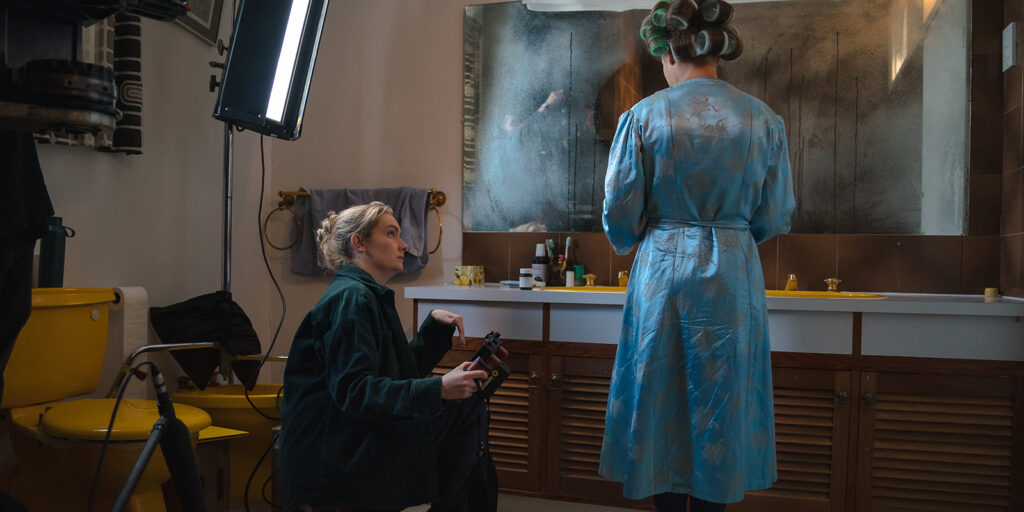
The location itself was a dream – it felt like stepping back in time the moment you walked through the doors. Wardrobe and HMU played a crucial role in grounding the period look too, and I think it’s important to keep all of those elements in mind as a DP, and I love having these convos with other departments.
EM: This was something I was very keen to emulate, whilst leaning into a modern take on the ‘70s aesthetic.Three Days of the Condor, Marathon Man and The Parallax View were all films that are particularly inspirational visually to me. They depict the ‘70s in a realistic, gritty way rather than the more glamorous disco ‘70s feel. We took inspiration from them in our lighting choices, using hard light smashing in through blinds or reflecting through mirrors. I am also a huge fan of the composition in The Ipcress File (1965), which was in mind when planning our various tricks to have circles at the centre of every shot.
Making period films on a low budget sounds like a challenge, but I find it really artistically exciting. As Rick said, our location, art department, costume and hair and makeup departments all pulled together to create an authentic 1970s world alongside the camera, lighting and grip departments. A tight circle, if you ask me.
What drew you to bringing this project to life?
SL: Immediately I loved the way the script was so concise! Putting neurodivergent characters on screen is really important to me but to be able to put OCD in such a stylised and historical context made it really exciting. The framing did mean we had tight schedule concerns, but luckily 1st AD Jess Lee got us through it. We all couldn’t stop thinking about circles for months… This film truly could not have been possible without the support from Sunbelt Rentals, Location Creation, Tysers, WDM Entertainment, Primetime, and Cine Circle.
VE: Scope first came to me via our open callout for the Empower Fund and was selected as a finalist. One of our remits as a disruptor in the industry is to champion projects which shake up the status quo and our collective understanding of certain lived experiences, largely as a result of a legacy left over from an age of media where there was less understanding and curiosity to depict members of marginalised communities as fully rounded individuals.
Emma’s vision was clear, thorough and engaging; the film that we have today is a clever twist on exploring neurodivergence through utilising all the tools a filmmaker has at their disposal; from the precise writing, the breathtaking cinematography and stunning production design, to the engaging performances helmed by Antonia Thomas and Samantha Spiro. As a neurodivergent creative, it is important that we see our lived experiences named and carefully handled, as this allows for kinder workplaces to be cultivated, higher rates of disclosure and talent retention industry-wide, and creating more art that is truly representative of the society in which we live, which is then responsible for creating and shaping larger societal narrative shifts. Art as a vehicle for change; and Scope is certainly full of aesthetic generosity and neurofestivity.