TAKING THE PLUNGE
Cinematographer Steven Breckon reflects on lensing Charlie Polinger’s debut feature The Plague; part body horror, part coming-of-age psychological thriller. From the raw realities of adolescence through to powerful underwater scenes, the team captured a unique tale of teen anxiety.
For cinematographer Steven Breckon, the origins of writer-director Charlie Polinger’s debut feature, The Plague, stretch back almost a decade, to their time at the American Film Institute in Los Angeles. “Filmmakers shoot half a dozen short films over two years, rotating between collaborators and disciplines,” says Breckon. “The programme’s mythology promises that film school is where directors and cinematographers meet the person who will define their careers.
“In our case, that was true,” he recalls. “I ended up working on almost all of Charlie’s films and our thesis film won the student ASC Award.”
Combining water polo with adolescent angst, The Plague edges into body horror, although Breckon is reluctant to label it that: “To me, it’s more of a psychodrama about the experience of puberty and peer groups.”
Set in 2003, the narrative centres on the anguish of socially awkward teen Ben as he struggles to fit in at a water polo summer camp. He becomes a target of cruel bullies when he befriends Eli, rejected by the group for supposedly carrying the contagious “plague”.
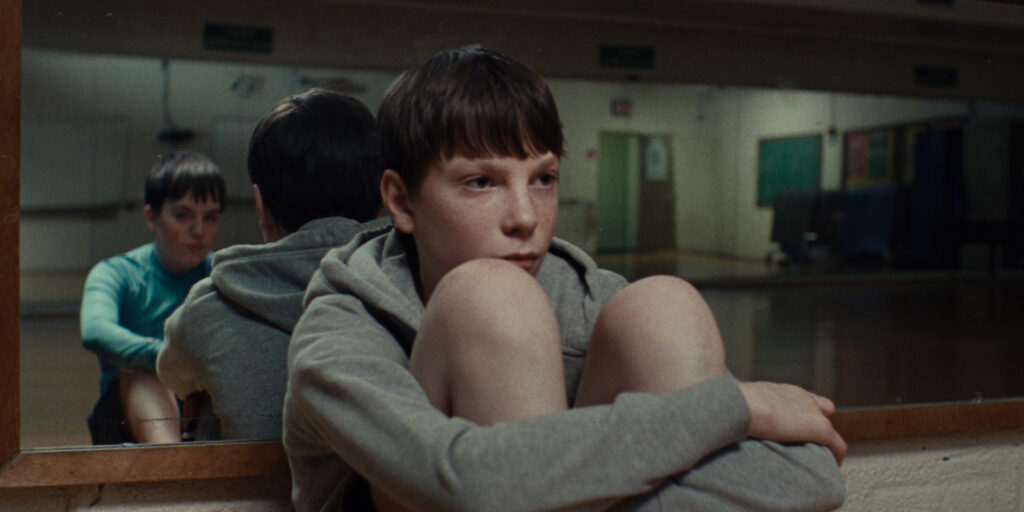
Although the script was unique and daring, as the film centred on 13-year-old boys, none recognisable actors, the project took time to get off the ground.
“An agent passed the script to actor and producer Joel Edgerton and he thought it was a great story,” Breckon says. “He wanted to direct it but when Charlie met with him, he said, ‘I can’t let you direct it, but you can help me make it.’”
With Edgerton on board as a producer and playing the coach at the water polo camp, momentum built to bring the story to life on screen.
Building tension
The Plague was designed as an immersive psychological experience, with the filmmakers exploring how to create anxiety and alienation without relying on conventional horror techniques like jump scares.
“I’m not really a horror guy,” Breckon admits. “It’s difficult to categorise this film, which was an interesting challenge. It’s simultaneously funny and dramatic, but it’s also about building tension and a sense of dread visually.”
Years of intense, creative conversation between director and cinematographer determined the approach. The two share an extensive knowledge of film history and a shared library of inspiration and references. Polinger would text Breckon at all hours: screenshots, clips, and social media posts. “Charlie doesn’t sleep,” Breckon laughs. “He’s on the East Coast, I’m on the West Coast, and at two in the morning I’d get a text: ‘How did they do this? Why do I like this so much?’ It was years of collating ideas.”
Some inspirations were obscure, like synchronised swimming clips Polinger found online, while others came from a shared canon of auteurs. For Breckon, Paul Thomas Anderson’s Punch-Drunk Love was a key influence.
“While a very different story, the anxious camera movement in Punch-Drunk Love was inspiring,” he explains. “There are moments in that film when the camera and other characters are descending on Adam Sandler, backing him into corners and creating a great deal of disorientation. That visualisation of the psychological experience felt like something we could carry into The Plague. We used this kind of moving group tableau shot that could feel overwhelming, then the camera settles on Ben in isolation. It was about setting him apart from the noise.”
Other references included Stanley Kubrick’s Full Metal Jacket, particularly its claustrophobic first half, and the dreamlike camerawork of Federico Fellini’s 8½. “But we realised early we couldn’t aim for that precision with thirteen-year-old boys, so we had to adapt.”
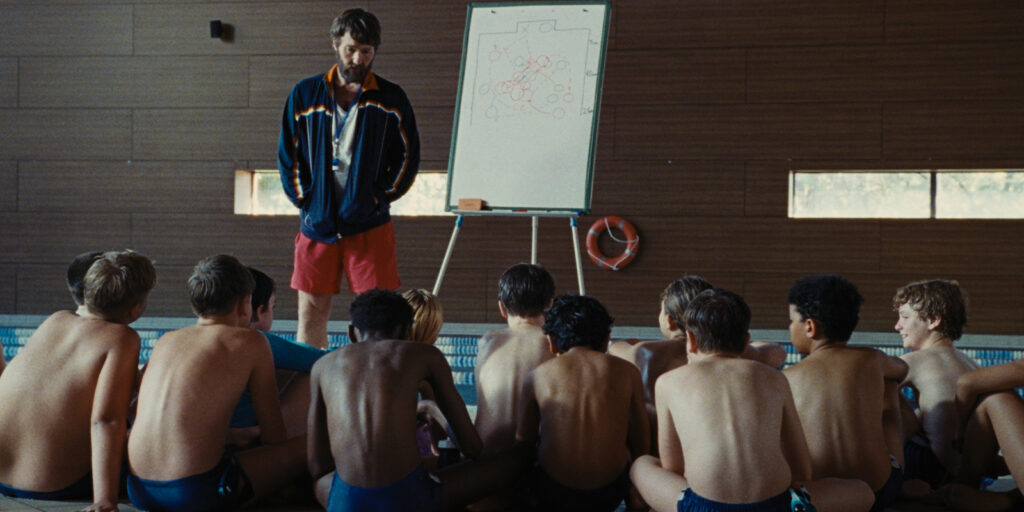
Scenes were constructed to evolve organically, using zooms—sometimes with dollies, cranes, or Steadicam—to create a subtle, increasing sense of unease. This approach suited Polinger’s visual instincts as a director.
The two developed a dreamlike yet authentic visual language to convey the anxiety at the story’s centre, transforming adolescence—and its self-consciousness and strain—into the film’s most terrifying force.
Pool perfection
While The Plague’s visual language emerged from years of reference sharing and aesthetic debate, its execution was carried out under tight time and production constraints. Shot over 25 days in Bucharest, Romania, the team chose the location for its perfect pool rather than financial incentives.
“We scouted multiple provinces in Canada and Sofia in Bulgaria but settled on Bucharest because of this pool location at Dinamo Sports Park,” Breckon recalls. “It gave us a lot of what we needed and, in a way, we calibrated everything to that.”
Working in Romania introduced obstacles, the obvious one being that the film is set in North America. Time was tight, and with a cast of minors, shoot days were limited to eight hours. “Add to that water work, stunts, unruly teens, language barriers; each day was a race against the clock,” adds Breckon.
While typically operating himself, Breckon brought in two operators to help with the time constraints: A Cam op, Liviu Pojoni Jr, and Steadicam op, Alexandru Durac, allowing instant pivots. In some scenes, two cameras were used simultaneously, but they typically aimed for a single-camera approach.
Choosing to shoot the majority on celluloid, the production relied on the ARRI Arricam LT bodies, shooting 35mm Kodak VISION3 500T (5219) film, then switching to digital capture with the Alexa 35 used underwater. “We love shooting on film. There’s a timelessness which felt right for what is essentially a coming-of-age story. It was not without risk though, we only had 100,000 feet of film for the entire shoot, so with 4,000 feet per day, every take was precious.
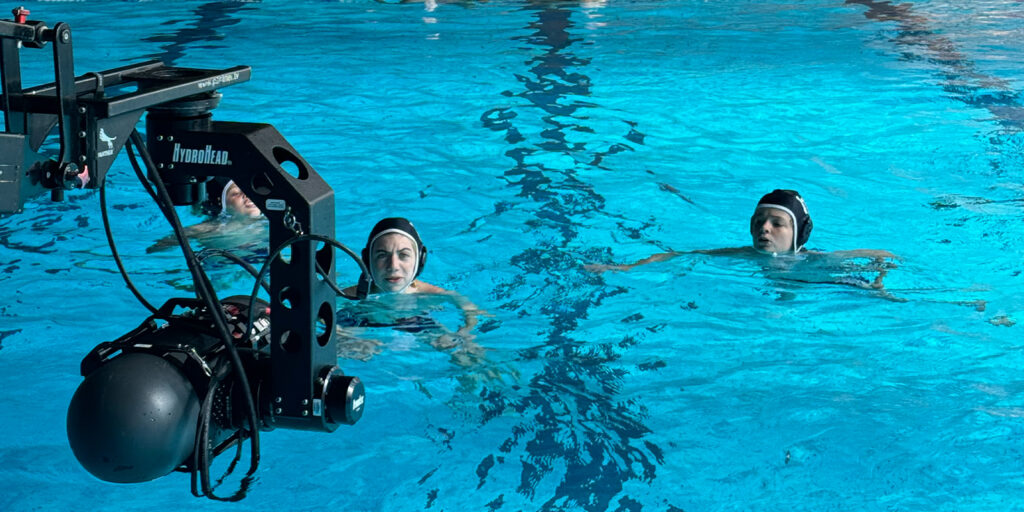
“For underwater, we had no choice—it’s just not practical to open the housing and swap film mags every four minutes with this kind of schedule.”
Breckon cites another principal collaborator, colourist Natasha Leonnet at Picture Shop, for being instrumental in combining these two formats seamlessly. “I was going for an aesthetic that was something like my favorite Italian films of the 1970s, many of which used Technicolor’s IB dye-transfer process: a process involving photographing on a single colour negative, but then making three isolated red, green, and blue positive prints by filtering in the optical printer, then sandwiching these together, striking a master print. It’s very rich, with dense blacks, and great colour separation.”
With no direct emulation available, they consulted Picture Shop’s colour scientist, Josh Pines, who had previously won a technical Oscar for profiling Technicolor photochemical workflows. Together, they found that by creatively mixing a three-strip Technicolor LUT with a ENR process LUT, it came close to what Breckon had in mind.
ENR is a silver retention process named for its inventor, Ernesto Novelli Rimo, a former control department operator at Technicolor Rome and used extensively by Vittorio Storaro ASC AIC. “By retaining silver density in the image, you will increase the contrast by making the blacks blacker, but also by virtue of having silver in the print, it will slightly desaturate the colours, depending upon the level of ENR used. This photochemical technique was used in films like Se7en and Birth.
“ENR gave us strong contrast and dense blacks but drained skin tones, which was a problem since red—the acne [“plague”], Jake’s jacket—was crucial. To restore vibrancy, we combined ENR with a touch of three-strip Technicolor emulation, creating a balance of contrast and colour.”
Fluid creativity
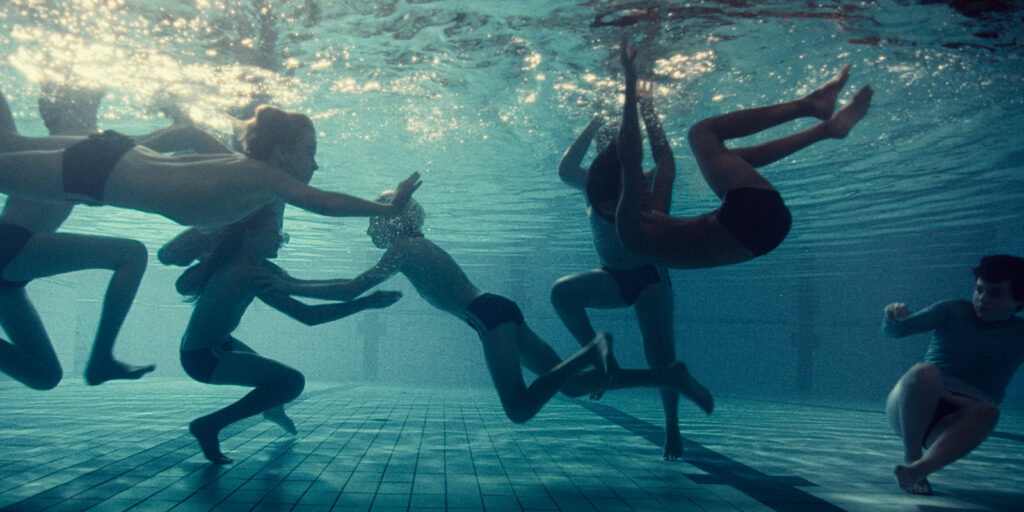
The Plague’s underwater sequences are among the film’s most visually immersive. Water polo, from the surface, Breckon notes, is notoriously difficult to film—it can appear slow and uneventful. “But beneath the surface, another world emerges: violent, claustrophobic, and strangely beautiful,” says the DP, who with Polinger sought that hidden dimension.
“From above, water polo looks miserable; just boys splashing. I wondered, what’s cinematic here? But underwater, it transformed,” Breckon says. “That’s where the violence is, where the subconscious lives. It became an allegory for adolescence—the anxieties and negative self-talk beneath the surface of your mind.”
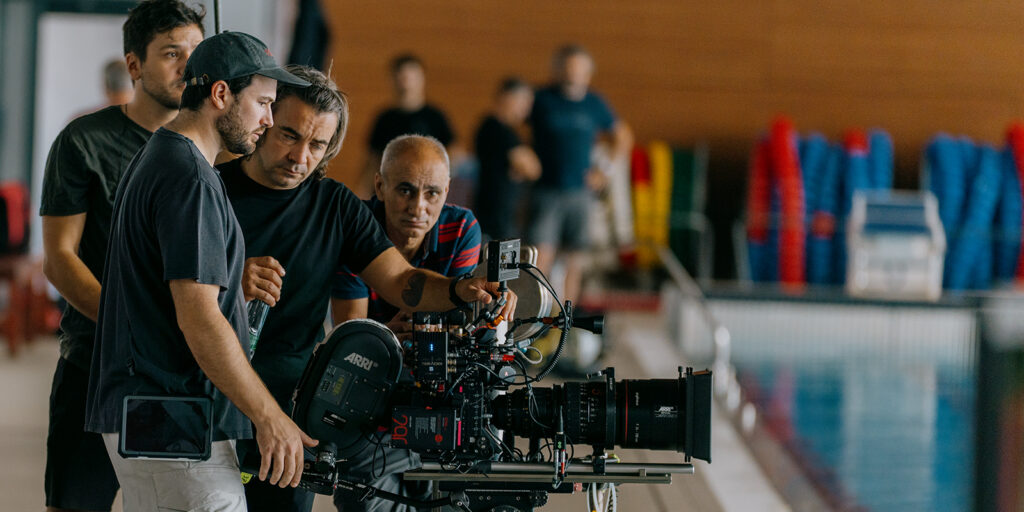
Underwater cinematographer Jens Winkler and his Berlin-based team joined for six days at the Bucharest pool. “[Jens] is the sweetest man,” Breckon recalls. “He was so helpful in deciding the right tools to achieve some of the ideas we had come up with in prep, not to mention dancing with the unpredictability of the boys once in the pool.”
Rather than sports coverage, the visual reference was Renaissance painting. “I wanted it to feel like massive battle canvases—chaotic energy, limbs entangled, bodies twisting,” Breckon explains. “That abstraction and beauty inside the violence was what we were seeking.”
These sequences achieve peril and uneasiness. The Bucharest pool’s natural colour, filtered through the custom LUT, became less bright blue, more oceanic, dark and foreboding. “That LUT stripped away the hyper-blue,” Breckon adds. “It made the water feel oceanic—menacing, less saturated, tying the underwater world to the psychological tone of the film.”
The underwater sequences became a metaphor: the brutality beneath the water mirrors the unseen cruelty of adolescence—anxiety and shame central to the narrative. “I don’t know if anyone watching will read it that way,” Breckon says. “But for me, that’s what those scenes are about: the beauty and terror beneath the surface.”
Feeling the moment
Choices in lenses and lighting were driven by the desire to create a visual texture that could simultaneously convey the timelessness of adolescence and the heightened dread of the “plague”. The primary lenses were rehoused Zeiss Super Speeds, provided by ARRI Rental and modified by the German company Gecko-Cam. “I hadn’t worked with Gecko-Cam before but they were really robust, and had just the right amount of character,” adds the DP.
Alongside primes, zooms played a central role with roughly 50 per cent of the film shot on Angénieux zooms. “Some other DPs hate zooms, but I love them,” he says. “They help me feel the moment. I was inspired by Vilmos Zsigmond’s work on The Long Goodbye. He once said, you can do a straight dolly track, but if you zoom at the same time, it has this quality of wrapping around. That was a lightbulb moment for me. It gives movement this other dimension.”
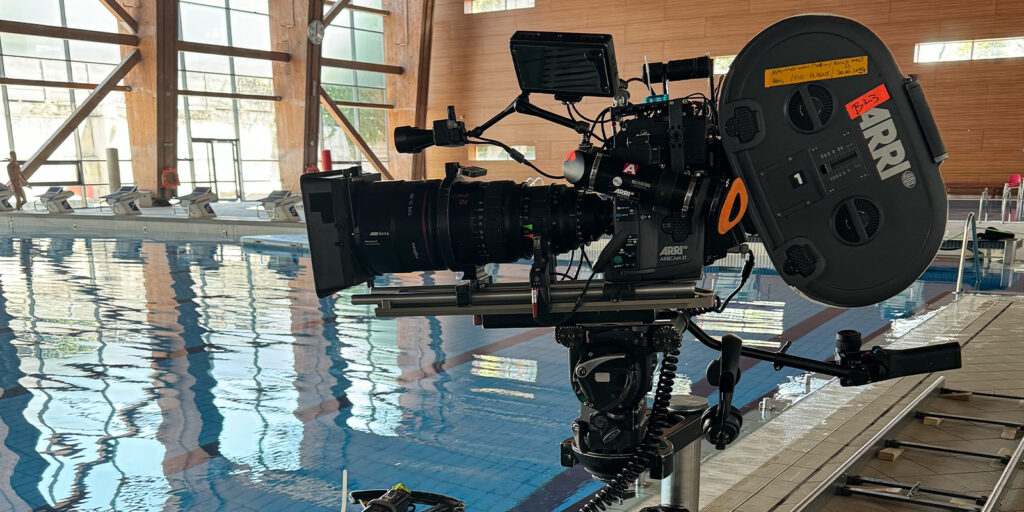
Zooms were rarely used in isolation, instead being combined with dollies, cranes and sometimes Steadicam, often with Breckon operating a wireless zoom controller. “I’d bury these little focal length changes into shots,” he explains. “It added a subtle, unsettling energy. You don’t always notice it consciously, but you feel it.”
Lighting, meanwhile, was shaped by instinct, with large HMIs used for the pool scenes and large tungsten heads for night interiors. “I love hard and directional light,” he says. “Some of my favourite scenes have these strange, fragmented shadows. Ben gets this odd single shadow across his face and you think, what is that? That’s the Conrad Hall school of happy accidents. My instinct was always: don’t fix it. If something beautiful or strange happens, embrace it.”
That philosophy carried into the climactic sequence, which required a new tool. For the final shot—where the world seems to spin wildly around Ben—Breckon devised an optical rig built on mirrors and 3D-printed parts.
“It was an eight-sided mirror with a hand crank,” Breckon explains. “One mirror collects the image, then that image is bounced into the spinning mirror, and another then directs it into the lens. The subject stays still, but the image spins. I’d seen something similar before, but we had to make ours from scratch. Lucky for me, our second AC in Romania, Sergiu Ivanovici, is a hobbyist with a 3D printer, so he prototyped it and it worked beautifully.”
The result was a disorienting yet precise image as the protagonist grapples with the chaos of the world around him. “It was a suitable way to show his point of view collapsing into everyone else’s gaze,” Breckon reflects. “A stationary subject, but the world spinning out of control.”
Energy and unpredictability
Capturing authentic emotion while maintaining a coherent visual language required constant adaptation from the filmmakers as they worked with its cast of predominantly unknown thirteen-year-old actors.
“The boys showed up on set, there was no air conditioning, we were working in hot locations and there were language barriers with some of the crew, so it could be pretty chaotic,” says Breckon. “But that’s exactly what we needed—that energy and unpredictability became part of the cinematography.”
Polinger’s casting choices were unconventional. For instance Kayo Martin, who played bullying character Jake, was discovered through social media and had no prior acting experience. “He’s an influencer and pro skater not a trained actor, but he was fantastic,” Breckon explains. “The other boys had some acting background, but most were just kids being themselves. That was both terrifying and exhilarating.”
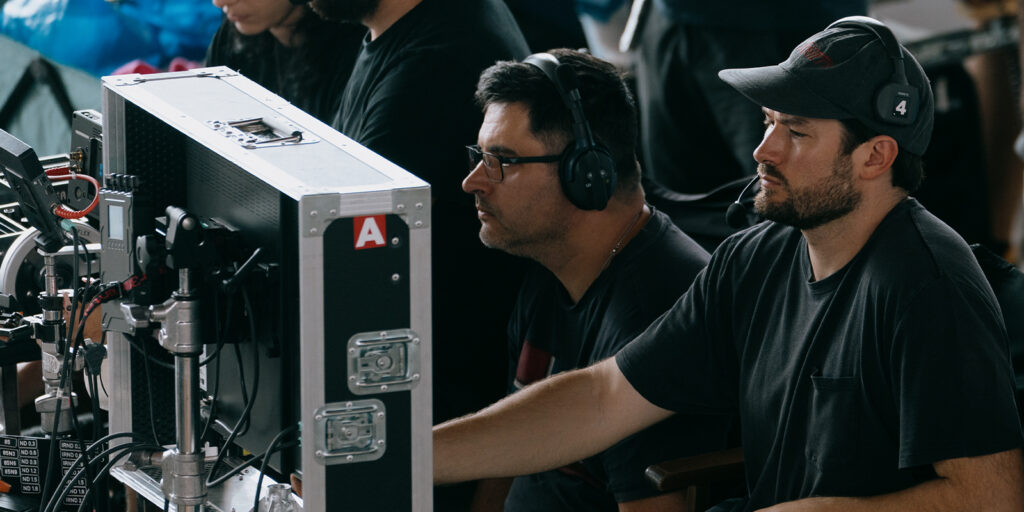
To maintain control in such an environment, the crew devised a careful rhythm. Every day began with stand-ins while the lighting was set and the blocking rehearsed. “Those first few hours were all preparation,” Breckon says. “By the time the teenagers arrived, everything changed. We had to adapt instantly but the early prep let us hit the ground running.
“Charlie and I were constantly evolving the scenes. We’d see what the kids were doing, adjust the blocking, tweak the camera angles. It was collaborative in a way you rarely get with adults and it created this charged atmosphere that the cinematography could feed off.”
For Breckon, the physicality of the shoot added another layer of immersion. “I was drenched in sweat every day. By the final scene, I felt like I was one of the characters in the film – I was completely spent. That exhaustion—the sense of being fully present—translated into the images and became part of the energy.”
Subtle lighting choices, nuanced camera placement, and the choreography of group shots worked in unison to echo the characters’ internal states. “With the kids, everything is organic,” Breckon says. “That’s how you get the tension, the awkwardness, the authenticity. It’s exhausting, but that chaos is exactly what you want when you’re telling a story about adolescence—messy, noisy, unpredictable and completely alive.”
A transformative experience
The Plague became a deeply personal endeavour for Breckon and one which he juggled with pressures outside of the shoot. “One of the most challenging things about this film was my daughter being born in the last week of prep,” he recalls. “Balancing family obligations with the demands of the shoot took a lot of personal growth. Historically, I’ve always thrown myself into projects completely, and I had to learn how to show up for both my family and this film.”
His partner, Hallie Cooper-Novack, a writer in the film industry, provided crucial support and understanding during this time. “She understood what this film was, what it could become, and how special my relationship with Charlie is. She knew that if I was going to do it, I had to be all in. That trust was essential.”
Despite the challenges, the experience became a defining chapter in both his professional and personal life. The intensity and rewards of working with Polinger, the young cast, and the Romanian crew created an environment in which creativity, friendship and family—both on set and at home—could flourish.
“It was exhausting, often overwhelming, but it was also transformative,” Breckon reflects. “Every day demanded something from me, and somehow I came out feeling more capable, more present and more attuned to the nuances of collaboration and storytelling.”
Each creative element of the production mirrored the tension, vulnerability, and resilience inherent in adolescence. And, as Breckon notes, the aesthetic choices—whether shooting on 35mm film for its timelessness or applying the intricate ENR/Technicolor-inspired LUTs—created a world that feels both authentic and heightened, intimate and eerie.
More than a coming-of-age story, for the cinematographer The Plague is testament to enduring creative partnerships and the personal growth that results from embracing challenges fully: “It’s rare to get a project that challenges you technically, emotionally, and creatively all at once. That’s what this film did. And that’s why it feels so special.”