NEW YORK STATE OF MIND
Darren Aronofsky’s Caught Stealing ignites late-’90s Big Apple grit, with Austin Butler leading and cinematography from Matthew Libatique ASC LPS fuelling the chaos in this fast-paced crime thriller.
Charlie Huston’s cult noir novel Caught Stealing gets the big screen treatment in this Darren Aronofsky–directed adaptation. Set in late ’90s New York City, the film brings the author’s hard-edged story to life through a blend of kinetic action, raw emotion and stylised realism.
Austin Butler leads as Hank Thompson, a former minor league baseball star turned bartender whose quiet life spirals into chaos when he becomes involved with the city’s criminal underworld while pet-sitting for his neighbour. The cast also includes Regina King, Zoë Kravitz, Matt Smith, Liev Schreiber, Vincent D’Onofrio, Benito Martínez Ocasio, Griffin Dunne and Carol Kane.
Aronofsky has long entrusted the camera to his frequent collaborator, Matthew Libatique ASC LPS, who worked with him on standout films like Requiem for a Dream and Black Swan. Shot largely across New York City, the film’s visual style captures the mood of the East Village in the decade, shaped by the latter’s keen eye behind the lens.
Libatique says the project came together when Butler had a window in his schedule. “Darren and Austin had been wanting to collaborate and Sony agreed to finance the project,” he adds. “Darren asked me, ‘What’s the earliest you can shoot?’ So, it happened very quickly. In most cases, I know about films years in advance — but this was more like months. It’s a project that, fortunately, came together without much fuss.”
Gallows humour
While grounded in a serious narrative, the film finds space for moments of dark, well-timed humour.
“Was it meant to be funny? says Libatique. “All I can say is that our goal was a very entertaining film. It was the power of performances by Matt Smith, Liev Schreiber and Nikita to name a few in combination with the characterisation given and created by Darren and Charlie that humour became a welcome addition to the storytelling.”
Libatique had just finished Spike Lee’s Highest 2 Lowest, shot in New York on the Alexa Mini LF, but was eager to try something new with Caught Stealing.
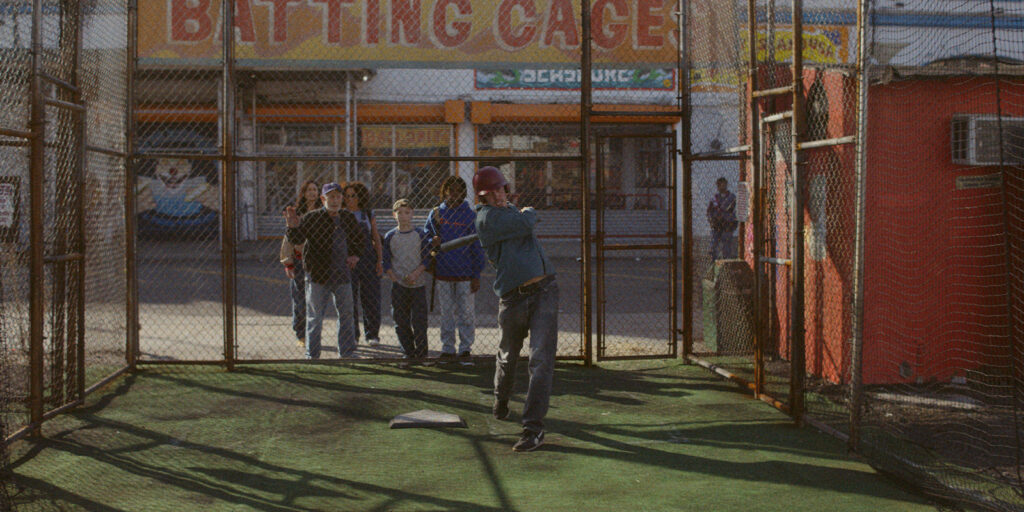
“I wanted to change lenses and sensor, so I opted to use the Sony Venice 2,” he explains. “We also used the DJI Ronin 4D 8K quite a bit for small, moving shots through tight spaces. One of the things that Darren and I talked about in the beginning was how we were going to move the camera without complication, having flexibility, in some of our spaces to be able to change our minds.”
Using the memory of living through the 90’s in the East Village, Libatique chose a cocktail of rehoused Ultra Baltars from Zero Optic and a flashing device called the Color Con from Camtec. “Optically I liked the soft roll off these lenses provided and their ability to change characteristics at different stops,” he says. “Flashing the image with colour or white light also went a long way to creating the vibe we were after. The last element was adding one of Live Grain’s 16mm emulsions.”
Libatique masterfully weaves darkness into both its narrative and lighting, creating haunting moments that linger in the shadows of the story and the frame.
“The goal was natural light, but it was always augmented,” he continues. “I like to think the film is very naturalistically lit. But honestly, there was great effort devoted to that concept: banks of LEDs helped practicals inside the bar at the beginning and we lit outside windows to simulate daylight. For scenes like the alley fire escape ladder, there’s a drone shot on location, but the rest is on stage, with giant soft boxes above acting as skylights.”
Libatique used LiteGear’s LiteMat Spectrums and the interior of Hank’s apartment had a combination of LiteGear Auroris boxes and ARRI X23s. All night exteriors used a collection of lifts with ARRI S360s “and moving lights controlled with precision” by gaffer John Velez and programmer Griffyd Cole.
“At its 3200 base sensitivity — between ISO 3200 and 6400 — the Venice 2’s internal NDs, combined with its high sensitivity, allowed me to severely soften the light or augment it to achieve the naturalism I was aiming for,” Libatique adds. “We used Creamsources, Fillex units—direct LED sources—and Asteras as well.”
Park strife
Libatique’s greatest challenge wasn’t the lighting itself, but rather the logistics and scale involved.
“There’s a sequence where Austin and Matt’s characters go to Flushing Meadows to make a drop and strike a deal — followed by a chase,” he explains. “It was the toughest scene to shoot, with just two days and constantly changing weather. My priority was to get through it quickly so we could move inside the car and let the sun naturally fuel the chase’s chaos.”
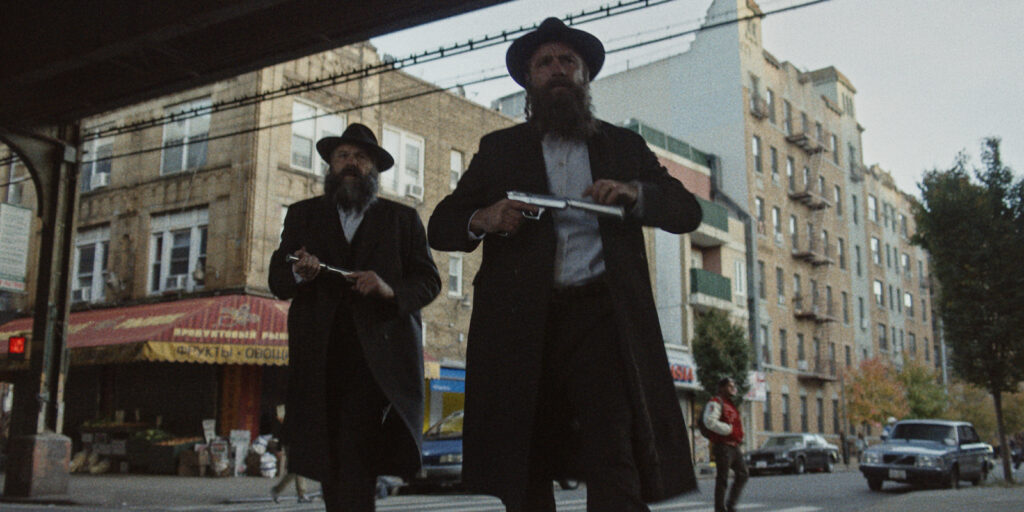
Libatique adds that the sequence, from the park through the subway, required careful handling of natural light and working in tight spaces.
“Flushing Meadows is vast, but we methodically moved through the scene from point A, to point B, to Point C. — starting at The Fountain of the Planets to the Unisphere (the iconic stainless steel globe in the park) and ultimately Shea Stadium,” he says.
“We essentially guided the crew through the park while managing sunlight and equipment logistics.”
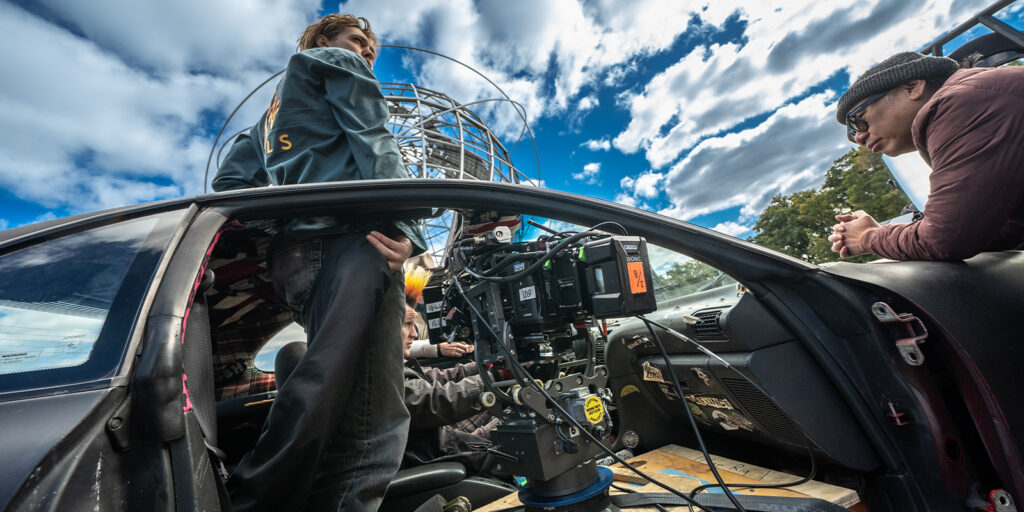
For the chase, the production used a rig called the “biscuit car” — a flat vehicle mounted on another vehicle and driven by a precision stunt driver, allowing actors to ‘drive’ without handling the wheel.
“Locking a camera onto an actor this way gave them an authentic driving feel. Shooting without second unit support and within tight exterior schedules made managing weather and light a real challenge,” Libatique adds. “But that energy is what brings action scenes to life.”
However, that’s not the part of the film the DP considers his most fulfilling
“I’m proud of the work inside Hank’s apartment,” Libatique says. “Oftentimes, you start a film and you haven’t warmed up yet — the crew hasn’t warmed up, you’re still getting to know each other. I’ve had the good fortune of working with the same people in New York for a long time, so that doesn’t really happen anymore. But even for me, I’m still just sort of finding my legs. That said, I think we hit the ground running on this one.”
He adds that Hank’s apartment setup set the visual tone for the rest of the movie — for everything that came before and everything that followed.
“There’s a scene where he comes back at night after the shooting at the bar,” Libatique continues. “He comes in, turns the light on, then turns it off again. The challenge there was that it’s supposed to be 4 or 5am when he’s leaving the bar, so the sun’s just starting to come up. We had to be very careful about when we shot the exterior. But the anxiety I had—because on every film, I always have anxiety about one or two scenes—this was one of them. I kept wondering, How am I going to create this realistic darkness with almost no light, if it’s supposed to be night? So I just leaned into the idea of the rising sun and used the sky to light the scene. I think it turned out really well.”
While some cinematographers enjoy a healthy level of autonomy and others follow the director’s instructions to the letter, Libatique and Aronofsky’s working relationship is the definition of ‘collaboration’ on every film.
“Darren has a sharp sense of editing and pace, understands camera placement, movement,” he explains. “He commits to moves, uses them, paces shots well. Working together so long, we have shorthand. There’s a shot strategy based on his pacing, so some things are understood in advance. But it’s never “just instructed”—everything’s collaborative. He wants people doing their best work and when everyone does that, it all feels like one single vision.”
Shot between July and December 2024 — over roughly 19 weeks — the film also features a fair amount of VFX work, though it’s far from obvious when watching the final cut.
What’s more, the film doesn’t rely solely on intelligent direction, beautiful cinematography and powerful human performances. A cat called Bud, played by a Siberian Forest VFX tom named Tonic, holds his own with feline finesse. More than just a touch of cuteness, Bud plays an important role that adds colour and mischievous charm to the story.
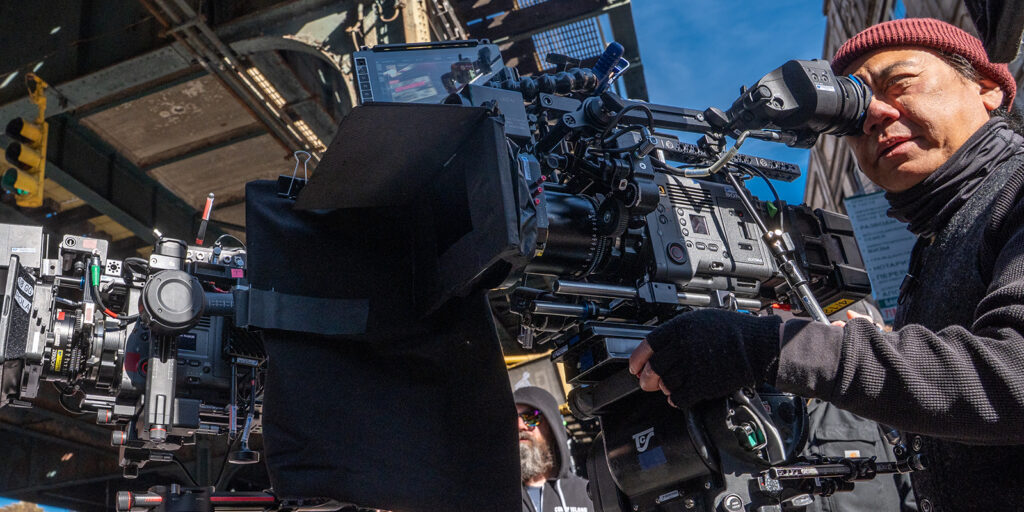
“Obviously, the cat did a great job, but there was augmentation of the animal,” Libatique recalls. “A lot of that was built in. We thought we would use way more cat, but we ended up defining this amazing cat actor, and a lot of it’s real. So there was a bit of planning. There were things in the chase sequence that were planned, like removing rigging—ultimately, there were a lot of VFX shots, a lot of re-timings in the film.”
He highlights the aforementioned Flushing Meadow sequence, which kicks off the car chase.
“We had to build skies to match because we had luck of the draw with weather,” Libatique adds. “One day was sunny, the next cloudy and another day had mixed sun and clouds. We had constant weather changes. So the effects team literally painted sunlight on the ground and added clouds in the sky to match the scene.”
In that case, he was very involved, approving those visual effects. Most of the shots were approved by the VFX supervisor, who worked very closely with Aronofsky and also editor Andy Weisblum. “They are both great collaborators,” Libatique adds. “Everyone does their job to create a single vision, and those guys shepherd the post-production process, showing me shots as we go along.”
A fresh take
From a technical standpoint, Libatique says he enjoyed the choices the team made: lensing, the sensor, the live grain, the mixing of tools. “I like exploring visuals and textures, building upon discoveries from past films like The Whale,” he concludes. “But I’m not interested in repeating myself; I want fresh approaches rather than just doing the same things over again.”