
A TERRIFYING TENANT
The Man in My Basement sees down-on-his-luck Charles become even more unlucky when a strange man takes residence in his cellar. Using lights and, more importantly, the absence of them, Ula Pontikos BSC worked with director Nadia Latif to bring the character’s infiltrated home – and his nightmares – to life.
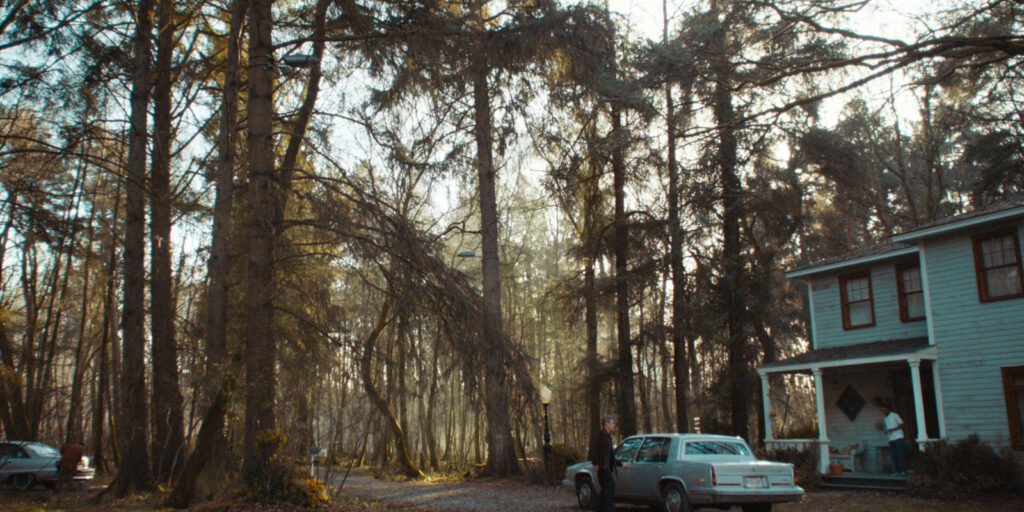
The Man in My Basement takes place in a familiar setting for a thriller – the woods. But, as viewers of director Nadia Latif’s debut feature quickly come to realise, the film has little interest in sticking to conventions.
In fact, while the name and IMDb classifications may hint at straightforward sinister viewing, The Man in My Basement is less a run-of-the-mill thriller and more a psychological exploration of guilt, grief and the growing importance of honouring ancestral roots.
Based on the 2004 novel of the same name by Walter Mosley, the film follows an increasingly tense tête-à-tête between Corey Hawkins’ barely-getting-by Charles and Willem Dafoe’s mysterious Anniston – an enigmatic figure who seeks to rent Charles’ basement space for a secret project – with the pair’s strange arrangement leading Charles to reassess his life in increasingly deranged fashion. For DP Ula Pontikos BSC, such a bold approach to the narrative required an equally bold approach to the visuals.
“The script was brilliant,” she reveals. “What drew me in was its dual nature – the tension between those intimate, uninterrupted exchanges between the two main characters and the dreamscape of Charles’ mind, where he’s piecing together the fragments of his life. That contrast between raw reality and internal chaos felt deeply cinematic.
“I was immediately struck by how visual the story was. It explored themes I could relate to – the experience of caring for an ill relative, the pressure of holding a home together, and that complicated sense of belonging, or not belonging, to a place. But it also delved into issues of race and heritage, whose nuances I can only begin to grasp.
“As a cinematographer, I think of myself as a vessel – translating emotion through light and movement. Light is the language we use to express what can’t be said. I don’t need to rationalise every choice; I just need to respond to it and manage to translate the director’s vision onto the screen. Each story for me becomes an emotional landscape, and my role is to find its visual rhythm. In that way, the film becomes a dialogue – between what I see, what I feel, and what the audience might remember and respond to.”
Getting set
It’s safe to say Pontikos’ efforts paid off. From The Man in My Basement’s opening scene to its poignant finale, this is a film that carves its own path thematically and aesthetically, never afraid to take bold swings or lead audiences down one path before pulling them unexpectedly onto another.
Throughout the feature, as Charles descends into madness as Anniston forces him to tackle his inner demons, there is an ever-present sense of tension, unease. And playing a key role in bringing this tension to life is the film’s unique approach to lighting, with soft, warm textures often lulling the audience into a false sense of security – before harsh whites and sickly greens snap them back to a harsh reality. Executing this plan effectively required Pontikos to work closely with gaffer Peter Chester during a “tricky shoot” that split one setting across four different sets.
“It was a relatively challenging shoot – we had around 130 scenes to shoot rather quickly, and many of them were highly detailed,” Pontikos explains, with the Sony Venice 2 and H Series spherical Panavision lenses the main camera set-up of choice. “For me, the idea was that Charles’ house was always in motion, reflecting the pressures building inside him. The house became an extension of his psyche, embodying what he was feeling.
“That meant the lighting had to shift constantly, so the house itself evolved alongside Charles. For his nightmares, we settled on a cacophony of strobes, deep reds, and the glow of the TV – a visual language that externalised his internal state.”
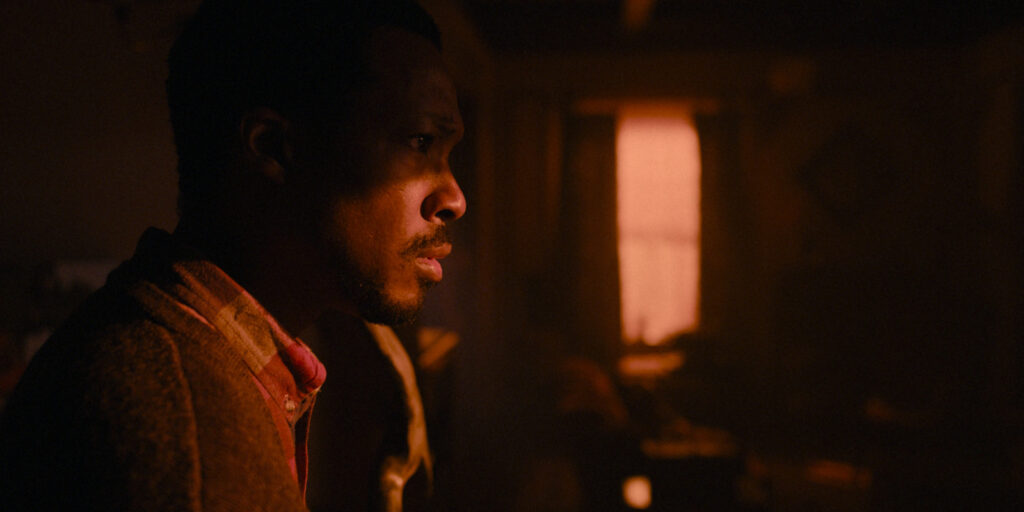
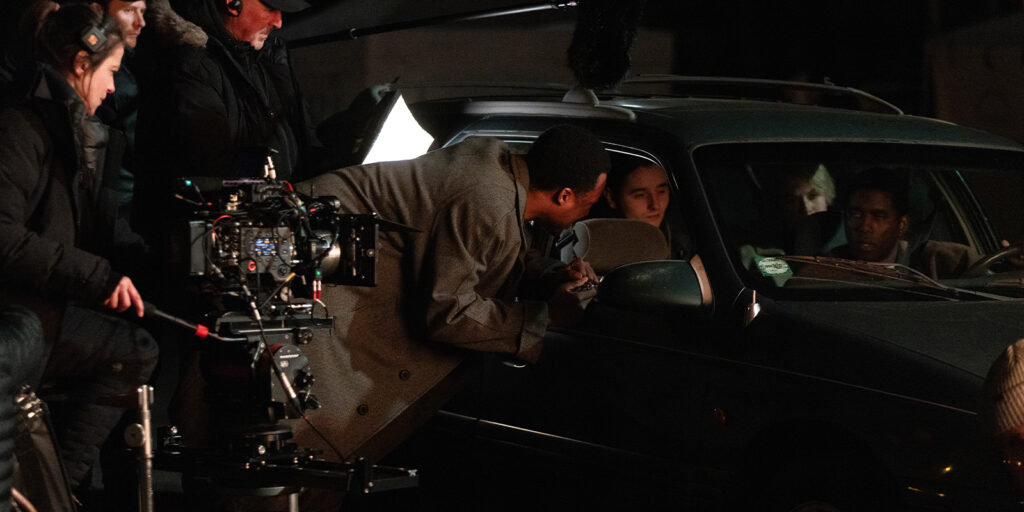
Bringing these intricate scenes to life required a wide variety of different set-ups, with Pontikos and her team both harnessing and battling against the natural light of an unpredictable Welsh winter – with production taking place in Carmarthenshire throughout January 2024.
“In the studio, we mainly used tungsten light, except for what I called the north side, which was fitted with a row of LED fixtures.
“The house was actually a composite of four different sets. We had an exterior – just the front and one side – a separate basement set, and the ground and first floors. There was a lot of jumping between sets, and we had to make sure the flow felt seamless. Many people asked Nadia and me where the house was actually built.
“Some scenes looked out from our shell of a house to the exterior, while others looked into the interior sets. The first floor was broken up from the ground floor, so when Charles moves between levels, we had to make it feel continuous. We carefully timed where the set broke and worked to create a lighting design that made the transitions between exterior and interior, day and night, as smooth and natural as possible.
“Tungsten lighting was my primary base, which we adjusted – cooling or warming it – depending on whether it was a day or night scene. To match the exterior’s orange glow, I used LEE 013 straw tint with CTO gels on tungsten fixtures. For daylight, we relied on standard Dinos with CTB gels. Later, for the nightmare sequences, we incorporated a lot of strobe lighting to heighten the intensity.”
Shadow operations
While more experimental lighting designs were used throughout the film’s most intense scenes, one particular approach is often most noticeable, with soft, warm lighting consistently framing Charles as he wrestles with his thoughts. Even within this specific set-up, Pontikos and co manage to take viewers through a range of emotions.
“The key for me was the orange light,” Pontikos continues. “The story is set in the ’90s, around the time of the Rwandan genocide, which appears on TV screens as part of the substory. I wanted the orange to feel warm at first, almost familiar, but also sickly and oppressive. You see it most clearly in one scene where Charles comes home from a party, drunk and disorientated. The orange light surrounds him, making the house feel alien and unsettling. I liked the idea of taking something that seems gentle and turning it into something that reflects his inner tension.”
For all that light played a key role, however, it’s often through the absence of light that The Man in My Basement proves most effective. In extended sequences, the background of shots are shrouded in darkness, with shadows both teasing hidden secrets and echoing the gloomy nature of the narrative. As a cinematographer, pulling off such set-ups is always a challenge – but Pontikos and Latif found it essential for doing justice to the story.
“I think our approach to shadows became particularly important in the nightmare scenes,” she explains. “It was chiaroscuro-driven – the idea that something could creep or hide in the darkness.
“When we first meet Charles, he can’t afford much electricity, so the lighting is very sparse. He’s on a budget, and the only time he really lights the house fully is when he’s showing it off, along with his heirlooms, to potential buyers.
“More broadly, the lighting reflects how he keeps the world outside at a distance, and himself contained. When we get to know him, he switches on just a few lights – most of the house remains dark. Upstairs, there’s only one light in the corridor, and that floor is mostly in shadow. Even during the day, the curtains are drawn, letting in only glimpses of sunlight. Ultimately, every lighting choice was guided by Charles’ mental state.”
Where there’s a Will
Though large portions of Pontikos’ decision-making were led by Charles’ story, though, perhaps the most inventive choices revolved around Willem Dafoe’s unnerving character, Anniston.
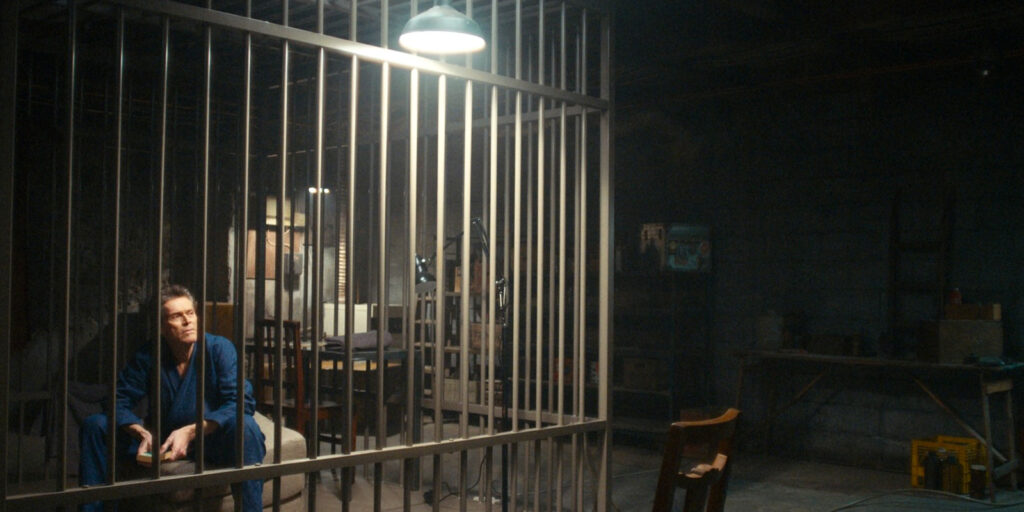
Throughout the film, despite Dafoe largely appearing in one very small, very isolated setting, the antagonist is lensed in a wide variety of ways – with Pontikos deliberately making use of the full spectrum of Dafoe’s abilities.
Unsurprisingly, Pontikos found perhaps the greatest joy in framing Dafoe, one of the most expressive and compelling character actors working today. “He was an absolute joy to work with, a true professional,” she says. “The script made the dialogue scenes particularly challenging – it’s always a fine line between telling the story visually and giving the actors the space to do their best work.”
Part of the challenge with having such a talent on board, however, was putting the right constraints on their use of Dafoe for the sake of the story. While certain scenes have the 70-year-old close to the camera in bright, clear lighting, in the final act the crew had to hide the actor in darker spots as his character’s influence over Charles wanes.
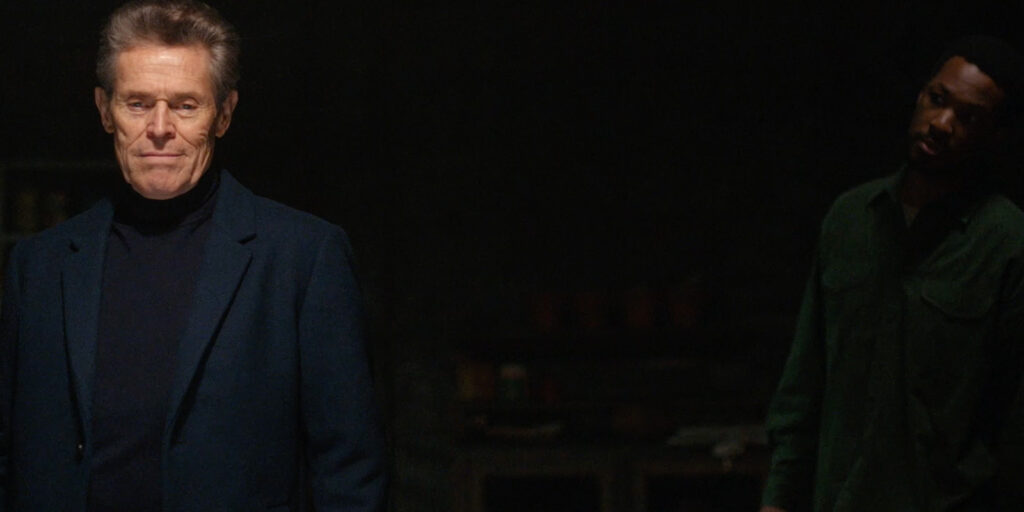
“Once we introduce Willem’s character at the doorway, the only other time we see him is in a single space, which had to follow a clear visual philosophy,” she explains. “There’s always one main light, and he’s either slightly in its shadow or directly beneath it. He rarely disappears into darkness, which helps define his presence and the way we read his character.”
“However, there are moments where he is deeply silhouetted,” she continues. “For example, when Charles restricts Anniston’s access to light and then comes in to switch the staircase light on while turning another off, you see Willem in near-complete darkness, with just a rim of light. He’s very, very dark. The idea was to show a shift in the dynamic between the characters. This was in Nadia’s script, and it became emotionally and narratively justified to keep him in silhouette.
“It’s really about where you place the camera. It was crucial that we captured those silhouettes at the moments that felt right for the story, rather than just when they looked visually striking.”
While The Man in My Basement may not be what viewers expect going in, they arguably shouldn’t be surprised. The unexpected is very much expected when you have one of Hollywood’s most fascinating performers on board – even when he’s not always front and centre.