
A LOVE LETTER TO MANCHESTER
With ambitions of crafting a fresh take on the British romantic comedy, cinematographer Rachel Clark BSC and director Alicia MacDonald framed Finding Emily’s unique love story while capturing the vibrant energy of student life in Manchester and the city’s distinctive atmosphere, music and culture.
Original concepts and a clear shared goal were among the driving forces behind Finding Emily when director Alicia MacDonald and cinematographer Rachel Clark BSC (Edge of Summer, I Am Ruth, Queenie) set their sights on telling the story in an inventive way and avoiding making a conventional romantic comedy.
“We clicked straight away, and I knew I really wanted to make a film with her,” says Clark, who was impressed by MacDonald’s ambition to push beyond the familiar formulas of the genre. Many well-known British rom-coms such as Notting Hill or Love Actually, as Clark highlights, focus on characters who are already established in life; people in their thirties or forties with careers and relationships already in place.
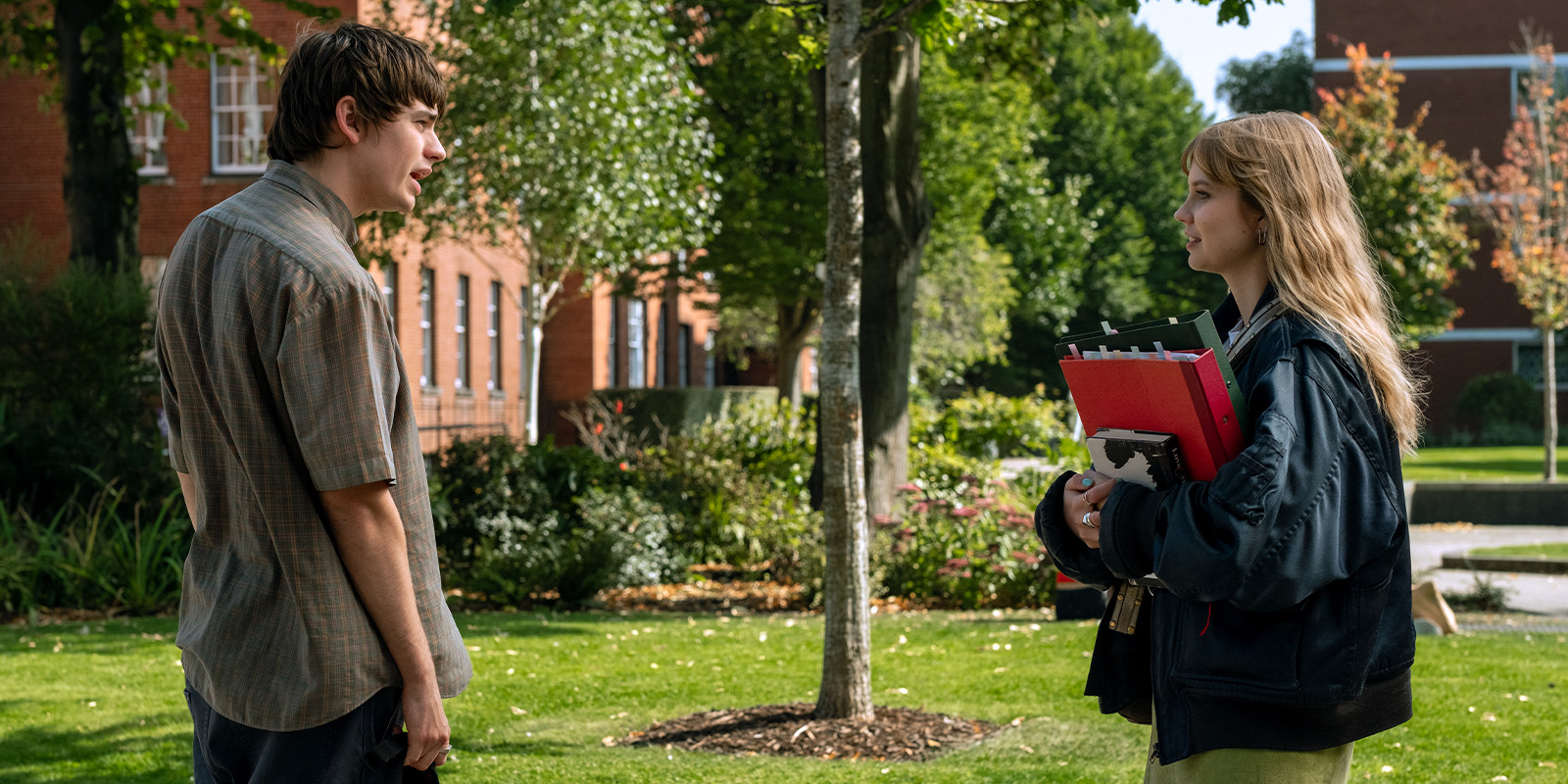
Written by Rachel Hirons, Finding Emily instead centres on younger characters; students and people in their late teens and early twenties navigating the uncertainties and delights of that special stage of life. While American cinema frequently explores teenage romance, British equivalents rarely do, particularly stories focusing on university life, a perspective Clark and MacDonald found refreshing.
In a twist on the traditional meet cute tale, young musician Owen (Spike Fearn) crosses paths with his dream girl Emily on a night out in Manchester, but his quest for true love is thwarted when he is given a wrong number. Joining forces with psychology student – also called Emily (Angourie Rice) – to track her down, they embark on a search mission, trawling through every Emily on campus.
The decision to move the story away from London and instead celebrate Manchester on screen in an authentic way was important and made the production feel unique. “While Manchester has a large production industry, much of the work shot there is television, there isn’t a lot of work made there destined for the big screen. Primarily the city is cheated for another town or country. We were excited to shoot Manchester for Manchester and celebrate the city as much as possible,” says Clark.
When telling this story, they wanted the film to have a real sense of place, make the city become part of the film’s identity and a lead character, capturing its vibrant energy, rich culture and distinctive vibe. It was a love letter to Manchester.
MacDonald had already undertaken extensive preparation before Clark joined the project and although it was the director’s first feature, she had directed a considerable amount of television comedy and series including an episode of another Working Title production, Lena Dunham’s Too Much.
As Finding Emily was originally scheduled to shoot the previous year, MacDonald spent months watching romantic comedies, studying what worked and what she wanted to avoid. Among the references that stood out to MacDonald and Clark was Rob Reiner’s When Harry Met Sally (Cin. Barry Sonnenfeld) as it also has a strong sense of place.
“You can’t imagine that film being shot anywhere other than New York; it’s embedded within the narrative. One of our aims was to do for Manchester what When Harry Met Sally did for New York,” says Clark, who during early discussions with MacDonald began imagining a version of the story that could only exist in Manchester.
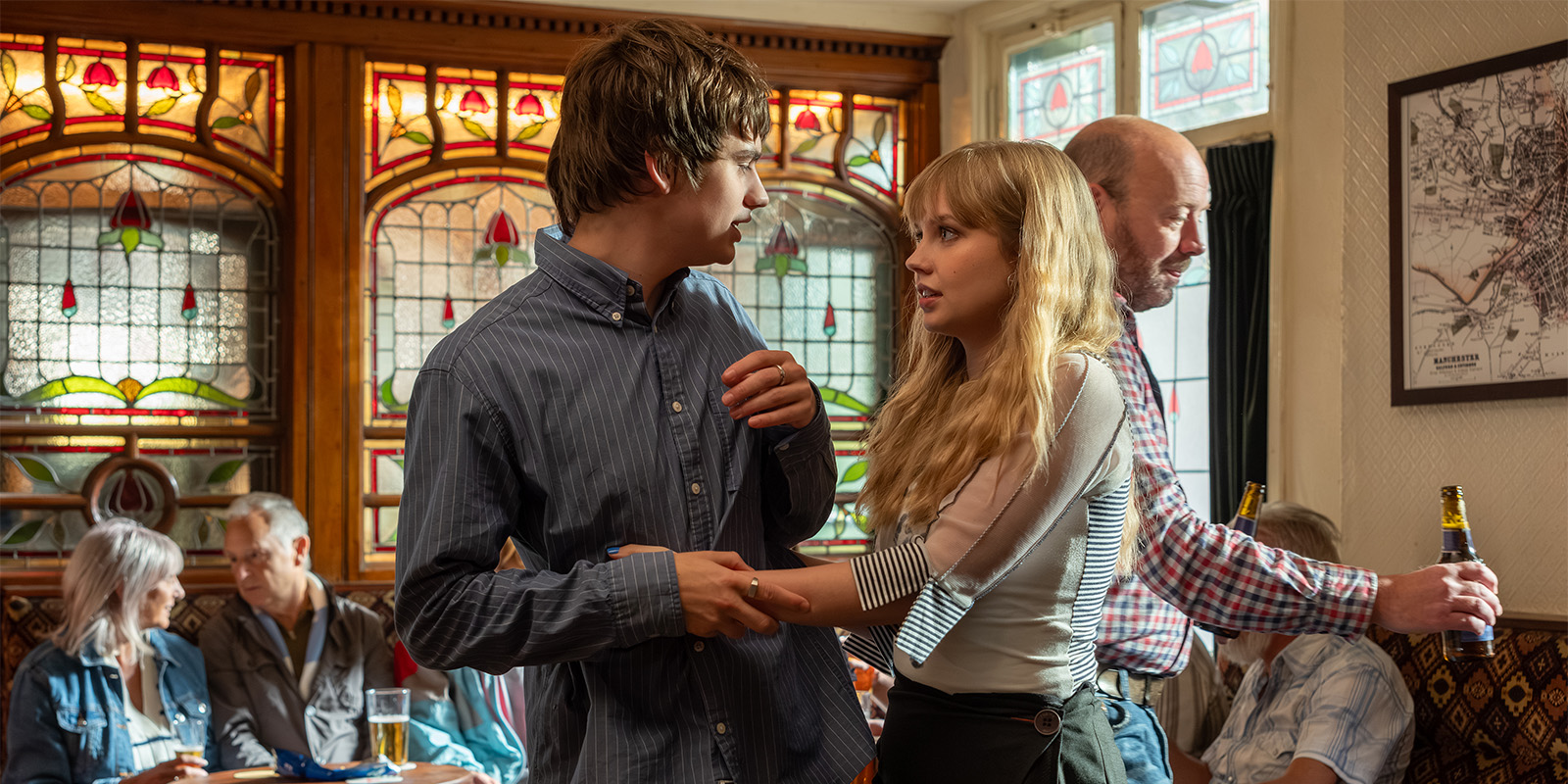
Due to the number of sites involved the location search was a collaborative process that required two location managers and two teams, with each team member being Manchester locals with an enthusiasm for showcasing their city. “They constantly suggested new possibilities, unusual viewpoints, overlooked buildings, or spaces that had never appeared on screen. That sense of local pride spread throughout the production,” says Clark. “Many of our HODs had a strong connection to Manchester, being from there or many having been to university there.”
Music also formed a backdrop to the production, tying in with one of the central themes of the story – Owen’s dream of becoming a successful musician. Manchester’s strong musical heritage shaped the look and feel of the film as several well-known music venues were used as locations, and local bands were incorporated into the soundtrack and some sequences.
“During prep Alicia compiled a vast playlist filled with Manchester artists, love songs and alternative love songs. It played constantly during scouts and in the production office, determining the atmosphere we created on screen and helping everyone involved immerse themselves in the culture of the city,” adds Clark.
Key locations included the real Manchester University Student Union for club scenes (filmed during the summer holidays); Manchester University; the Night & Day gig venue; Piccadilly Records record shop; Peveril of the Peak pub; the public library (which had a domed skylight roof that could not be covered, meaning filming of the night sequences had to be shot at night) the Emile Pankhurst statue; the Curry Mile; Canal Street; and student apartments and old terrace houses to demonstrate the contrast between the two protagonists’ lives.
“The old University building was a tricky location. It’s a listed building and had never been used for filming before. It had no power so many miles of cable were run around the building across multiple floors from a generator outside. There were quite a lot of restrictions and limitations to what we were able to do there which required lots of conversations and head scratching in prep to find solutions that worked creatively and within budget. Lighting many of the spaces was incredibly challenging as most of the windows faced an internal courtyard with absolutely no access. We hoped to crane equipment over the building into the courtyard but this proved impossible at the last minute due to weight restrictions so every fixture, head, lighting stand, piece of scaffolding and decking had to be hand carried and passed through a small sash window. It was essentially like putting a ship in a bottle,” says Clark.
“It limited the size of the lamps and heads we could use and really prescribed the lighting package available to us for certain rooms and corridors in the building.”
While seven weeks were set aside for prep and another seven for filming, much of the prep period was consumed by location scouting while MacDonald juggled casting an extensive ensemble cast and script revisions. Meanwhile Clark spent much of her prep time closely collaborating with production designer Bobbie Cousins, costume designer Sara Hassan and the “location managers of dreams” Lois Williams and Jessica Dove.
“Bobbie, who is originally from Manchester, created a soft, earthy palette with muted pinks, blues, and greens and used references from old Manchester paintings, really celebrating the city’s industrial heritage. We carried his bible of colours, carpets, wallpapers, and textures on recces,” says Clark. “As so many members of the crew had some connection to Manchester, everyone felt personally invested in representing the city in the best way.”
City of music and culture
The filmmakers pored over references from Manchester’s music scene, including old photos of legendary nightclub The Haçienda. “We used colours inspired by the era such as blues and purples, particularly referencing the track “Blue Monday” by Manchester band New Order. The club scenes shot at Manchester Student Union required a lot of work from both myself, the art department and lighting. The venue is predominately a bar and gig venue, it’s a dark underground basement with black walls and very low black ceilings,” says Clark.
“We talked a lot in prep about how to transform the space to be flexible for both our day and night scenes. Bobbie did an amazing job designing and building bespoke lighting into the bar and DJ areas, made some “windows” to backlight for daylight and added wall scones we could hide our own LEDs inside. This was complemented by a tonne of moving lights programmed into a desk for the club scenes.”
A combination of Clay Paky Sharpy movers and Martin MAC Aura wash lights were used with a couple of other larger moving fixtures for specific lighting effects. “During the week of pre lighting we spent a lot of time with the desk op experimenting with different movements and colours for different tracks because I knew we’d have multiple scenes in there. Bobbie built beautiful copper-orange lighting elements into the bar set which we paired with blue tones. Owen also supports Manchester City, so the blue colour palette worked well thematically.”
Gaffer Kieran Waites introduced Clark to the Fiilex G3s and G6s which became the work horses on set each day, alongside small eye lights, some negative fill and some diffusion or bounce. “I loved the flexibility and speed of the G3s and they became indispensable to us, especially in the tight interior locations,” she says. “We tried to keep as much off the floor as possible, lighting through windows with larger lamps and Lightbridge Reflectors.”

For visual inspiration, the filmmakers looked at the youthful college vibe at the centre of films such as Mark Webb’s 500 Days of Summer (Cin. Eric Steelberg ASC) and Gil Junger’s 10 Things I Hate About You (Cin. Mark Irwin ASC CSC) while MacDonald continued to emphasise that she imagined the project as “an independent film more than a traditional studio rom-com”. Natural lighting and a grounded, observational style were central to their approach and films like Joachim Trier’s The Worst Person in the World (Cin. Kasper Tuxen) and Celine Song’s Past Lives (Cin. Shabier Kirchner) were also amongst the useful tonal inspirations.
“Alicia was keen to avoid the overly glossy, warm tungsten aesthetic often associated with the genre. Manchester is a northern city. It can be cold, it rains. We wanted to be honest about that. So we talked about blues and greens, cooler tones, and natural lighting rather than making everything look glossy and artificially sunny,” says Clark. “Ironically we had incredible weather for most of our shoot and very little of the famous Manchester rain we had so heavily prepped our studio execs what to expect.”
The “Love Lens”
Clark initially envisaged capturing Manchester on a grand widescreen scale and shooting the film in 2.39:1 anamorphic. MacDonald, however, was unsure if this was the best fit for the story and as they reviewed their references, they realised many of the films whose tone aligned with what they set out to achieve were shot in 1.85:1 using spherical lenses.
“We also noticed several of the glossy romantic comedies we wanted to avoid had been filmed anamorphically,” adds Clark. “Shooting on film was ruled out early on, so we opted very happily for a digital workflow.”
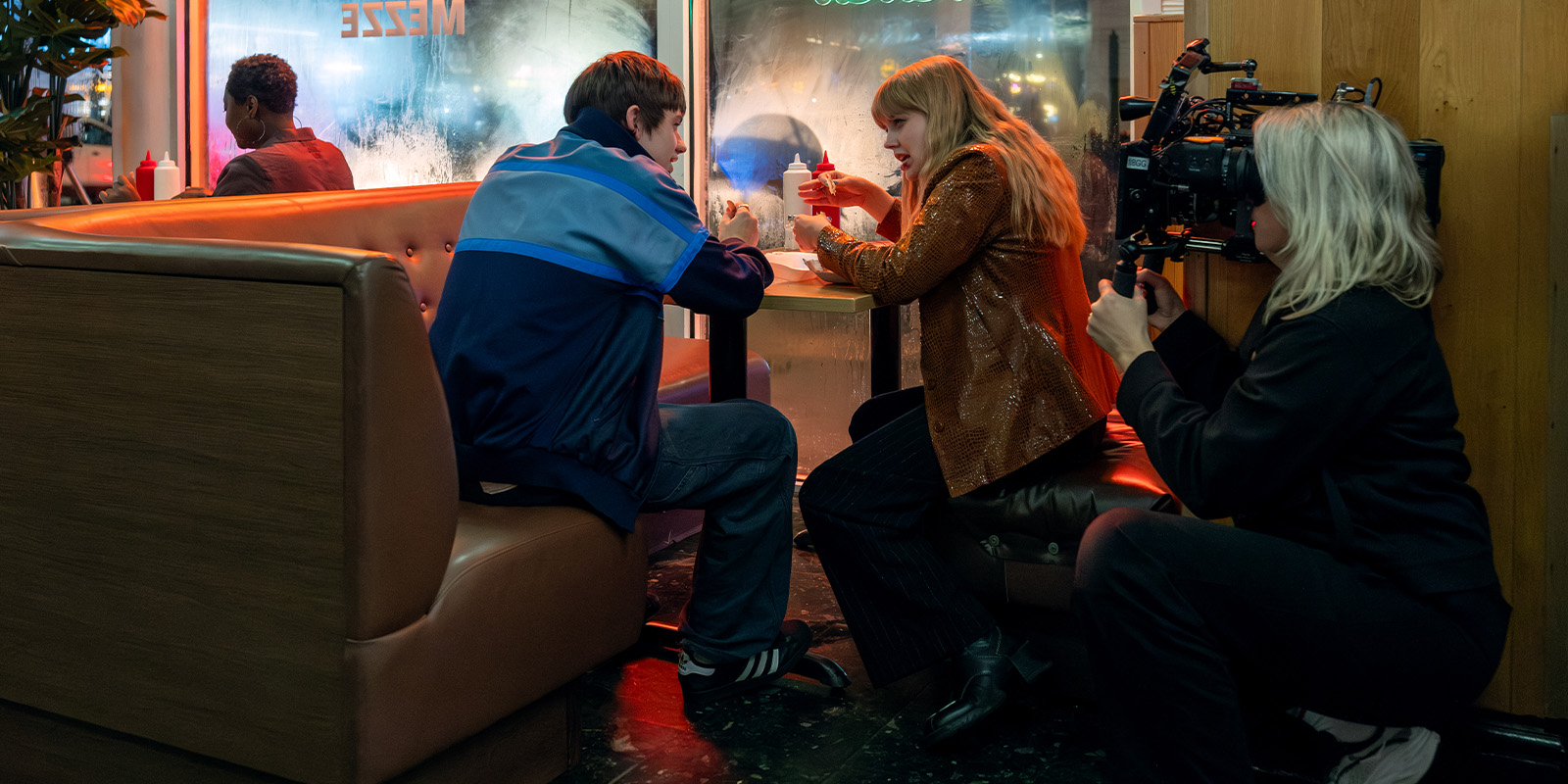
Despite testing a variety of cameras, instinct drew Clark to the Sony Venice 2 which she paired with vintage rehoused Konica Hexanon full-frame lenses, supplied by No Drama in Manchester. “I tested a vast array of lenses but as I put the Hexanon’s on the camera I fell in love with them. There was just something special about them. They felt honest and authentic, I loved the timelessness of them and felt it was righter for our film. I loved the fall off, how they rendered skin tones and the flares were beautiful. Our two hero lenses were the 57mm and 85mm. It was exciting to shoot a film on the Konicas as I don’t think they’ve ever been used on a feature film before. There are only three sets of the Ancient Optics Rehoused Konica Hexanons in the world so we had to source a second set for B camera, which we got from One Stop Films in London.
“We also used what we nicknamed the ‘Love Lens’ — a T1.1 50mm Leica Noctilux — for scenes where the characters start to fall in love and notice each other. It created a soft and dreamy bokeh and intimacy without being over-the-top and the actors got really excited about it and would ask, ‘Are we using the Love Lens today?’”
Framing the relationship
MacDonald wanted to achieve an honesty in the visual approach and as the story revolves around the evolving relationship between two central characters and their physicality and interactions, Clark often framed them together in two-shots and adopted a simplistic approach to coverage.
“The physical space between them and how they exist together in the frame became really important and an indicator of emotional connection while wide shots helped establish Manchester as a setting and honoured the environment,” says Clark.
“We used Steadicam extensively for walk and talk sequences and had a full-time A Cam Steadicam operator, Henry Landgrebe, which allowed flexibility when the schedule changed and provided a great creative collaboration. Handheld was rare and used to add kinetic energy to some club and flat scenes. There was also some crane and jib work for crowd scenes and a Technocrane was used for the graduation ball sequence. Alicia was very clear that she didn’t want big swooping romantic camera moves; she wanted everything to feel grounded.”
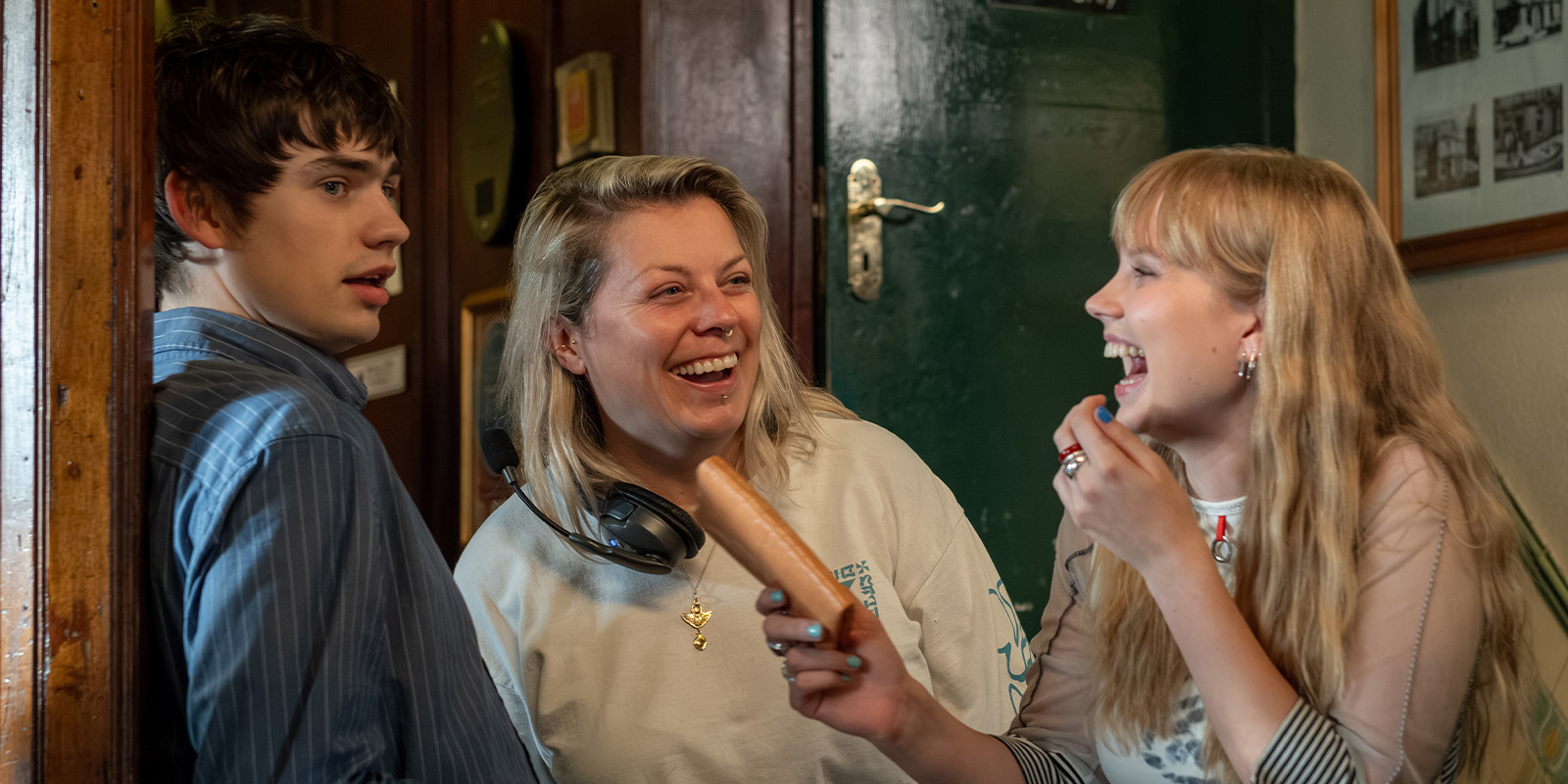
Clark – who likes to operate and shot B camera throughout – also praises “amazing local grip” Stuart Gibson who was recommended to her as well as frequent collaborator, focus puller Louise Murphy, another crew member with a strong connection to Manchester.
In the grade Clark worked with colourist Jateen Patel, focusing on balancing shots, refining skin tones, and dealing with Manchester’s constantly changing weather, with the overall look fairly close to what was established on set with DIT Sam Okell when working with the show LUT.
Fresh take on the rom-com
Always on the lookout for unusual ways in which to tell the light-hearted love story, the team created a bespoke camera rig to achieve a POV shot which sees Owen in disguise and undercover wearing a helmet as he enters a house party packed with Emilys. A lengthy experimentation process was necessary to achieve the POV while ensuring the actor’s hand and props were in shot.
“We needed to work out how to convey the feeling that Owen is looking for Emily. He’s the lead character but for the whole scene we’re not going to see his face because he’s in a Daft Punk-style helmet with a mirrored surface, so we needed to find a way to film the helmet without seeing ourselves in it,” says Clark.
“We considered putting a little lipstick camera inside the helmet so you could see Owen’s eyes and tested lots of other rigs to try to get across how nervous he is that he might get caught. The first tests felt too wide angle, gimmicky and not like we were really with him.”
Deciding filming through the helmet was the best solution, the filmmakers asked the art department to cut a helmet in half which could be mounted on the front of the camera. “So I had the camera on my shoulder and operated it handheld, but with the helmet on the front. We also needed the actor’s hands to be in the shot, carrying lots of pizza boxes around the house. So to film the scene I was almost cuddling him while holding the camera and helmet as he put his hands in shot.

“A key part of the film’s storyline revolves around text messages and emails, so myself and Alicia spoke at length about our hate for shooting screen inserts. We were looking for inventive ways to convey the story without shooting devices or having text pop up on screen. The sequence in Owen’s house with all the Emilys popping up around him as he gets hundreds of emails was really fun to shoot. Trying to do a one shot Steadicam in a tiny terraced house with multiple people and a Steadicam moving through narrow doorways proved challenging but it was worth it as I love the end result. We also really didn’t want to do anything in VFX but to do as much in camera as possible and I’m glad we achieved that.”
Another innovative idea MacDonald and Clark discussed from the project’s inception which became a reality despite budget and time constraints was incorporating a music video as the credits run. The sequence is a nod to Northern band The Verve’s iconic music video for “Bittersweet Symphony” which sees lead singer Richard Ashcroft encounter various characters as he walks down the street. “It was such a fun thing to shoot on the last day, incorporating lots of the characters and themes from the film as Owen and Emily walk down a Manchester street,” says Clark.
Through careful location choices, adopting a restrained and authentic visual style and ensuring there was a strong sense of place throughout, the team were successful in creating a romantic comedy that feels fresh, contemporary, quintessentially British and is a fitting portrait of Manchester and its buzzing music and student scene.
“It was such an exciting collaboration between a crew of the same age and at the same point in their career,” says Clark. “It was great to have fun at work and ask, ‘What else can we do?’ We all egged each other on a lot and worked very hard as we wanted to give it everything we could to prove that British films shot in the North could be successful, entertaining and look great.”