
BY ORDER OF THE PEAKY BLINDERS
More than a decade after first shooting the Peaky Blinders series, cinematographer George Steel BSC helps craft a cinematic send-off, combining celluloid shooting, digital capture and a vast location shoot to bring the epic story to the screen.
Following its six celebrated seasons on the BBC, Peaky Blinders has finally reached its conclusion – not with a TV special but a lavish, Netflix-backed feature-length movie. The story of Tommy Shelby, played by Cillian Murphy – the long-time leader of the eponymous, Birmingham-based, gang of bootleggers – draws to a close in World War II, just as the show’s creator Steven Knight always envisioned. Intriguingly, Peaky Blinders: The Immortal Man also brings closure for others behind the scenes, especially the film’s British cinematographer, George Steel BSC.
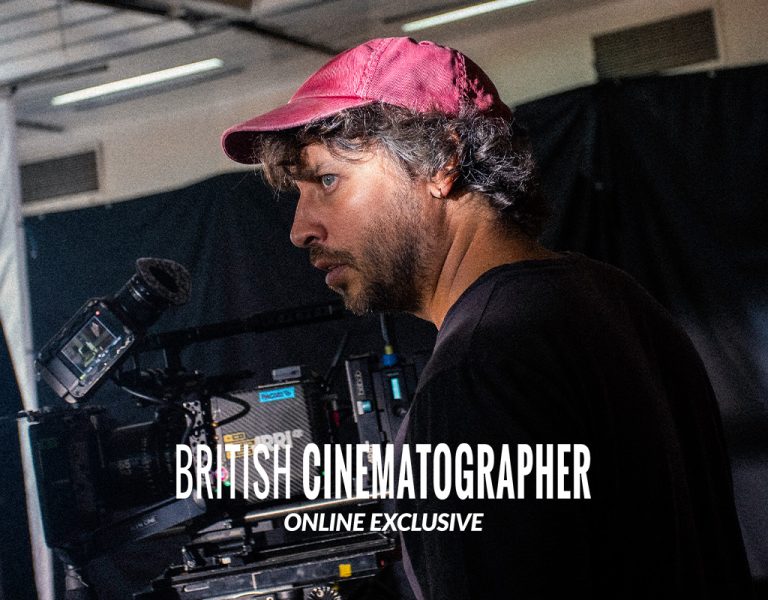
Steel was director of photography for the first season of the show, back in 2013, playing a key role in creating the show’s look. “Director Tom Harper and I have been together ever since,” he says. Beginning with movie sequel The Woman in Black 2: Angel of Death (2014), Steel has since shot TV series War & Peace (2016), Wild Rose (2018), The Aeronauts (2019), and Heart of Stone (2023) all for Harper. Now they’re back working together on The Immortal Man, bringing one of the most popular franchises this past decade to an end. “I genuinely felt quite grief-stricken,” Steel admits, “and I think the audience will too.”
Once Upon a Time in… Birmingham
A location-heavy production, shot over 10 weeks during the final three months of 2024, Steel feels it finally achieves a long-held dream. Back in 2012, Steel and several other key personnel – including gaffer Wayne King and colourist Simone Grattarola – dreamt of creating a show that, visually, recalled Western epics like Heaven’s Gate and Once Upon a Time in the West. While the Midlands may not equate to the Great American landscapes, the idea was to mythologise Brummie gangsters in the way American filmmakers did so regularly with their own anti-heroes.
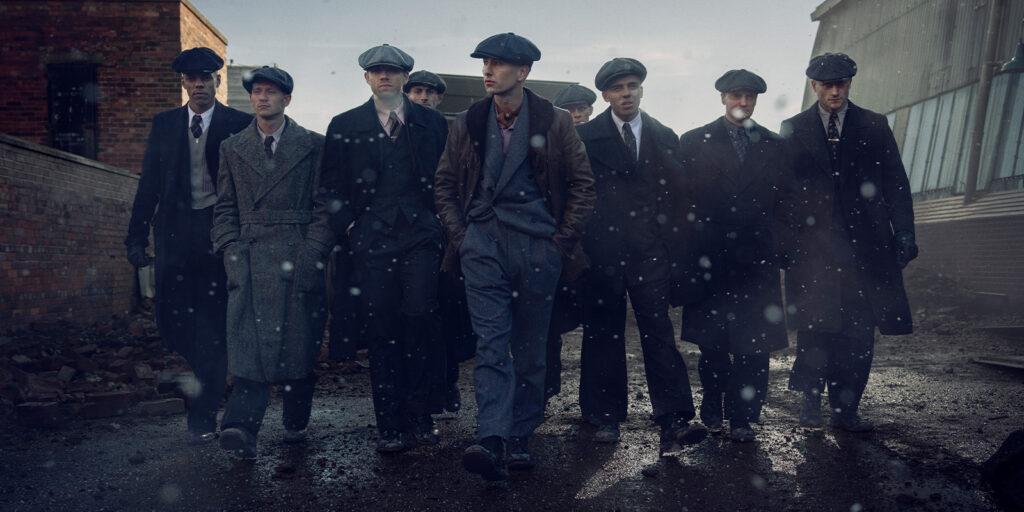
“What I felt like is that we never really, actually managed to achieve that, at least in those first six episodes. It became, slightly, something else,” explains Steel, who wanted to shoot in anamorphic, until the BBC determined it must be shot in the 4:3 ratio. If that steered the show away from the vision he and others shared, The Immortal Man brings the world of Peaky Blinders back full circle. Crucially, the project was shot, partially, on 35mm film, helping bring a lush quality to the story.
“I think that film is still, in many regards, the gold standard. And Tom Harper was very adamant that we shoot film,” says Steel. “We wanted the texture. We also wanted the depth of colour that is more easily achieved on film, to be honest, than on digital. What we found is that the separation of colours is just steeper. Colour-wise, film is certainly unsurpassed. We wanted it to be a colourful film. What I didn’t want it to be was desaturated.”
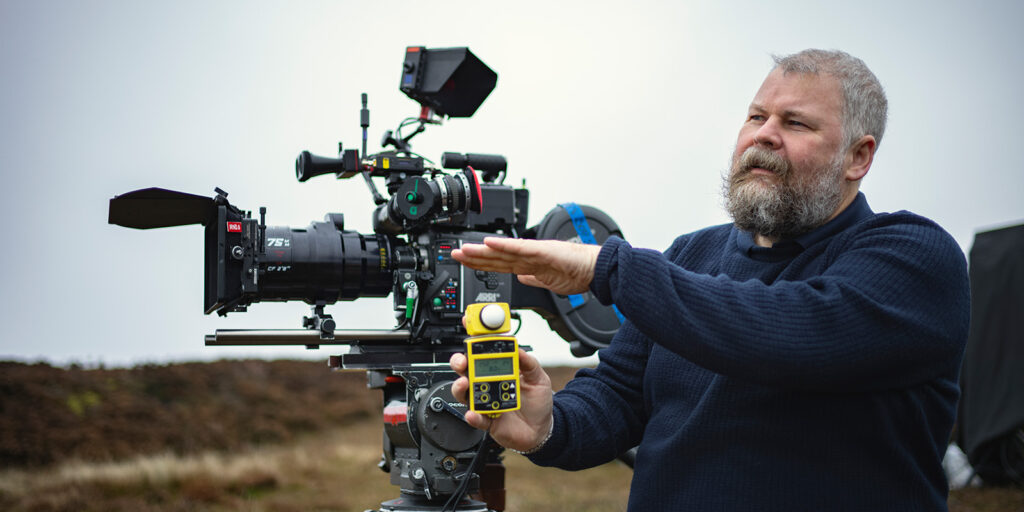
Shooting on the Arricam LT, Steel elected to use Kodak S0-56 – an as-yet-unreleased stock, due to be available in Summer 2026. “It’s basically a still stock repackaged as a cine stock,” he says, noting how it perfectly highlighted reds and magentas. “Birmingham, when you go there, is quite a magenta city. Amongst the buildings, there is this underlying magenta that sits in the brick work.” The cinematographer chose to pair the camera with Panavision G Series anamorphic lenses. “They’re a characterful but solid lens,” he says. “They’re quite versatile, because they’re quite small, not too heavy.”
Digital after dark
With so much of the film set at night, the production also shot on digital, using the RED V-RAPTOR [X]. “I’m a big fan of the RAPTOR as a camera,” says Steel. “It’s very clean, it’s very small. I think that sensor is as good as anything, and in our tests, actually, we found that the skin tone it gave us was what we are after. The truth is with digital cameras it’s first-world problems. They’re all great. And the latitude that you get out of them makes it easier to work with, especially at night.”
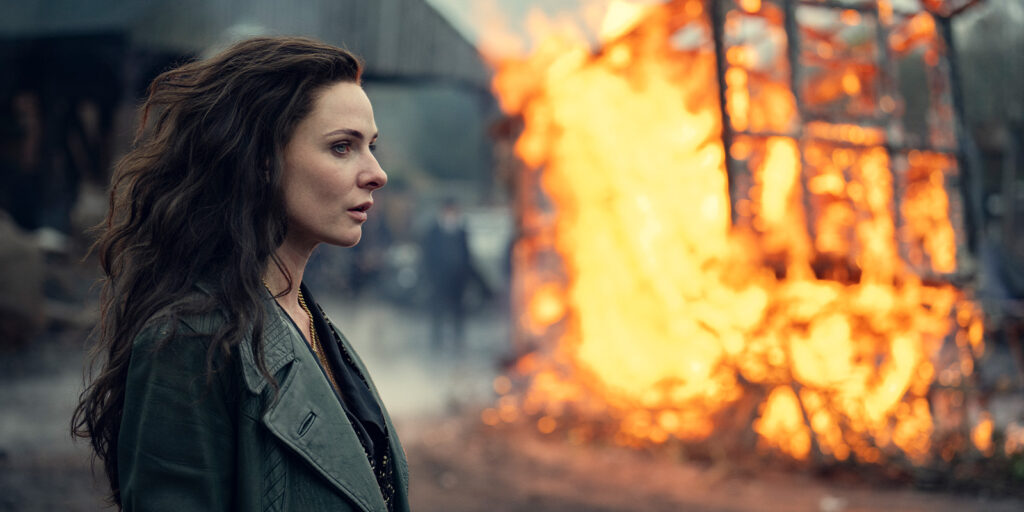
Joining Steel in the production, and our interview, is Ben Wilson Assoc. BSC ACO, who acted as the film’s second unit director of photography. Like Steel, he was heartened by the chance to use the V-RAPTOR [X] for nighttime scenes that heavily featured pyrotechnic work. “You can actually see detail in the flame,” he notes, “which is pretty astounding that a camera could even see that level of darkness through to that massive ‘burn-y’ look. So the camera was well suited to this sort of job.”
Wilson, who was new to a Harper-led show, was recommended by Steel’s focus puller and 1st AC, Ben Brown. With the story centred around Nazi forces aiming to bankrupt the British economy by flooding it with forged banknotes – a plot that sees both Tommy and his rogue son Duke (Barry Keoghan) caught up – it’s a script filled with action. With scenes ranging from the bombing of the Birmingham Small Arms factory to a flame-riddled finale at the docks in Liverpool, it meant that an experienced second unit team was vital.
Naturally, Wilson’s work needed to be in synch with Steel’s. Or as he puts it: “Don’t go off on tangent. Don’t be silly. Don’t try to reinvent the wheel.” His unit’s integration into the main production left him pleasantly surprised. “George will be on the set running his team, and then he’ll try to encourage the second unit to come and be part of that team, so that we would work alongside the main unit.” Often, the main unit would move on from a scene, leaving Wilson’s team to complete any outstanding shots. “By the time the handover came, we were all tight,” says Wilson. “It’s a really good way of doing it.”
Wilson’s second unit team included gaffer David Dalton, best boy Darren Bird, key grip Dean Morris, focus puller and 1st AC Jonathan Wright and additional camera operator Simon Finney, who all fitted in seamlessly alongside Steel’s team. “It wasn’t like a main unit just going, ‘We’re out of here.’ It was like, ‘What can we do to help?’” says Wilson. “Tribute to George for creating an environment where you’re not feeling vulnerable or alone, looking at some video image thinking, ‘Oh, we’re going to try to copy this or fix that.’ You’re part of it. You feel you belong to it.”
Similarly, Steel surrounded himself with familiar faces. “Everyone really pulled a blinder, as it were, because it wasn’t easy,” he says. Among them: Harry Bowers, his B camera operator – and previously his focus puller on the first season of the show; Alex Finlayson, B camera 1st AC; gaffer Wayne King; and key grip Andy Woodcock. The tight-knit nature of the crew was crucial to the success of the production. “The way that Tom [Harper] likes to work…a lot of it is actor-led,” says Steel. “[Often] plans will change, for the better. And so you have to react very quickly to keep getting your days.”
Achieving authenticity
Steel describes the production as a “roadshow”, with filming taking place in around 50 locations across the north of England, including Manchester, Liverpool, Derbyshire and the Lake District. “It was essentially a location film,” he says. “We were nowhere for very long.” Stage work was also completed at Shepperton Studios and Digbeth Loc. Studios, in Birmingham. The interior of the Garrison pub, a familiar venue in Peaky lore, was built on a soundstage, as well as the cockpit of a World War II plane, for the scene where the Birmingham Small Arms factory is bombed.
The factory explosion was shot at Shepperton, with the help of Theo Demiris, the visual effects supervisor, and Paul Dimmer, the special effects supervisor. As much as possible, real pyrotechnics were employed. “To actually film real stuff at the right angles and then overlay that into the main unit work is only going to make it feel more authentic and I feel that definitely shows,” says Wilson. “There’s a real earthiness to it. So it’s a real joy to be part of a real traditional way of doing it; the real way of doing it, a good way of going to it, and not reaching out to – God forbid – an AI version of it.”
For some of the big pyrotechnic scenes, the team used up to seven cameras, including drone work. Mostly, Steel’s team deployed two cameras, occasionally stretching to three; Wilson’s second unit outfit used a minimum of two cameras. “Tom is quite a single-camera director,” says Steel. “He quite likes the single camera, and then you just got to slot in your second camera where you can.” Also on hand was The Helicopter Girls’ Peter Ayriss, the production’s drone pilot, and The Aerial Film Company’s Will Banks, the camera helicopter pilot. “They were excellent,” adds Steel.
When it came to lighting The Immortal Man, Steel’s approach with gaffer Wayne King was “a mix” of traditional movie lights, LEDs and natural light. “I’m quite a fan of the new LED lights, just for speed more than anything, to be honest. And we tested them quite extensively, and actually the differences are relatively minor in look between a tungsten light and an LED on tungsten. Some may disagree with that. I’d like to have an argument about it!”
Undoubtedly, making The Immortal Man was a considerably different experience to the original show. “We certainly had more money, that’s for sure,” says Steel. “On the first season, we broke one cable and we couldn’t afford to replace it…someone had to drive to London and sleep in their car to pick up a new one,” he adds. “We certainly had more toys on this.” With “a whole array of gimbals”, the main unit and the second unit was also able to make good use of a Technocrane Supertechno50+ for more elaborate shots.
While Steel notes the production was “quite traditional” when it came to stationing the camera, using sticks rather than handheld, the crane was a vital piece of equipment. “We used the crane a lot for movement and for versatility and for speed as well,” says Steel. “Because with a crane you can get a multitude of angles and tracking shots.” Wilson adds that modern telescopic cranes are not only flexible, but also perfect for shooting complex pyro scenes. “[It’s] equipment that allows crew to be safe, just to stop them from getting hurt, allowing us to be distant.”
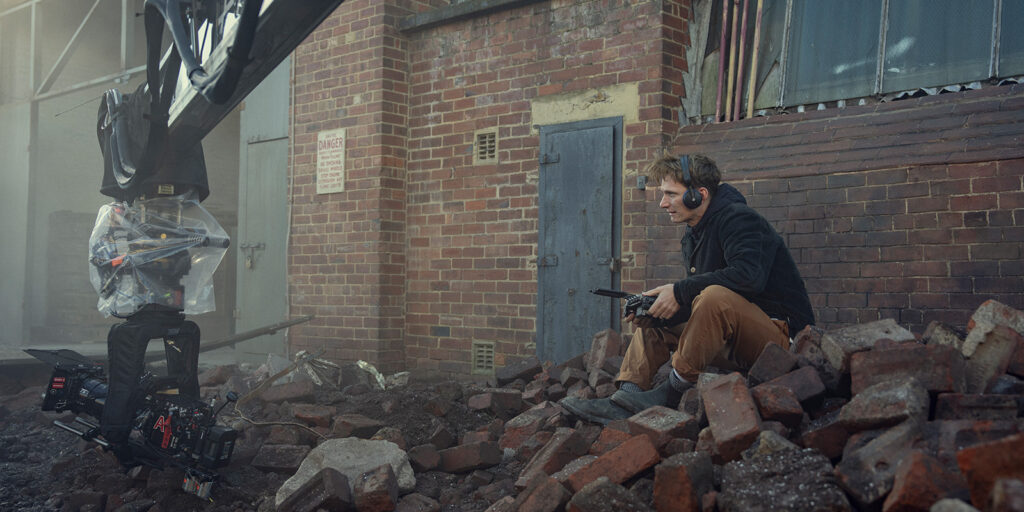
Although it was a relief to have access to such toys, Steel adds a note of caution. “It’s not like we were shooting a Marvel film. There was a lot of scrutiny on the budget, and we had to be smart, because we also wanted to travel.” Whilst jumping “from stage to stage to stage” in a studio is relatively cheap, moving a film crew across the north of England is anything but. “Taking people around is an expensive bit of filmmaking but I think it translates,” adds Steel, who praises executive producer Andrew Warren and producer Guy Heeley for aiming to get all the money on screen. In particular, the finale, as characters gather around a pyre caravan on a deserted moor for a funeral.
“Tom was like, ‘You know what we need? We need a helicopter to lift this [caravan] and put it on this precious moorland.’ And I burst out laughing, because we just talked about how we had some budget pressures. And I looked round to Guy to share the smirk, and he was like, ‘You know what? You’re right. That’s what we need to do.’ And that’s what a real producer does. That’s someone who I’ve got respect for, who wants to make the best film that it can be, and actually worked out how to do it. He had to deal with the nonsense of filmmaking but always was generous. A team player and someone supportive.”
Dream team
Throughout the shoot, Kodak developed the 35mm footage “because it was new and it had a slightly different process of developing”, says Steel. The UK-based facility Cinelab then stepped in, with its DFD (Digital-Film-Digital) process key to enhancing the image, by adding true 35mm film characteristics. The finished film was transferred to a 50D Kodak camera negative stock, processed and then scanned back to digital. “I’ve worked with Cinelab before. They’re very competent. I’m a fan,” says Steel. “And I’m a fan of that process. It certainly beds in VFX together and gives the digital footage slightly more filmic qualities.”
Working closely with Cinelab, who carried out the DFD process, Dirty Looks ensured the workflow was seamless for DI editorial and the grade, which took place in the company’s spacious 4K DI grading theatre in their new Fitzrovia studio. When it came to the grade, Steel was able to turn once again turn to Simone Grattarola, Time Based Arts’ director of colour, who worked with Resolve as the grading tool.
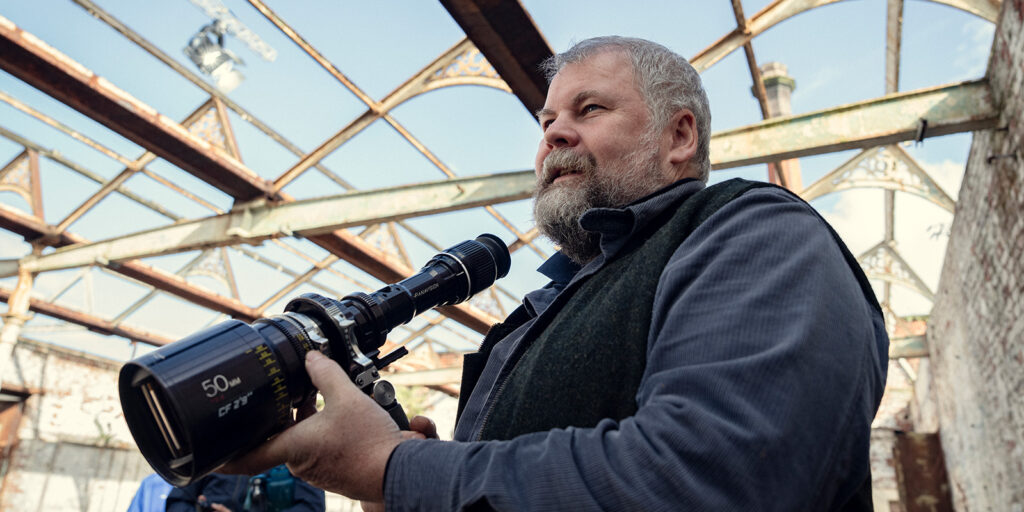
“Tom [Harper] can be very particular about levels of contrast and darkness, in relating to performance and making sure that he’s connecting with the characters,” says Steel. “He’s a really good sounding [board]. He’ll come in and be like, ‘You guys have gone mad. It’s too dark!’ As a team, we’ve done a lot of projects together. So it helps, the fact we can be totally honest with each other about things that we are enjoying or find stupid or too try-hard, or whatever. It’s a round robin…and we slowly whittle it down into the final look.”
Steel also credits Jesse Llande, the on-set DIT, who was new to the team. “He did a really excellent job. And he managed to slightly quell my madness sometimes. On-set grading can be a very dangerous thing. But what I normally do is that I get stills, and then I grade them at home and create a look-book of how I wanted it to feel emotionally. As a reaction to the performance or the scene. That look-book is more extreme than ultimately the film ends up. But sometimes it isn’t.”
Of course, the finished look of Peaky Blinders: The Immortal Man came from the top down, starting with director Tom Harper. “His storyboards were fantastic,” comments Wilson. “They’re really very in tune with the final image of the film. With that sort of guidance there, you had a lot of information to go on. And if we honoured that, we were always getting close to a result.” Steel nods in agreement, fully aware that he, Harper and the rest of the team have done what they set out to do. “I feel like the film is actually the interpretation of Peaky Blinders that I always wanted to make.”