
LIGHTS, CAMERA, KRYPTON!
That thing you saw in the sky this past summer may not have been a bird or a plane, but more likely Warner Bros’ newly lifted hopes for a rebooted DC film universe, thanks to the critical and box office success of James Gunn’s Superman.
Superman reaches back to the Christopher Reeves-era version, using John Williams’ music as a kind of caped “James Bond theme,” to hint at a larger superhero universe (some of which is on display in this film), and in a sense, to infer those intervening film stories of the Man of Steel hadn’t actually happened.
At least, not on this timeline.
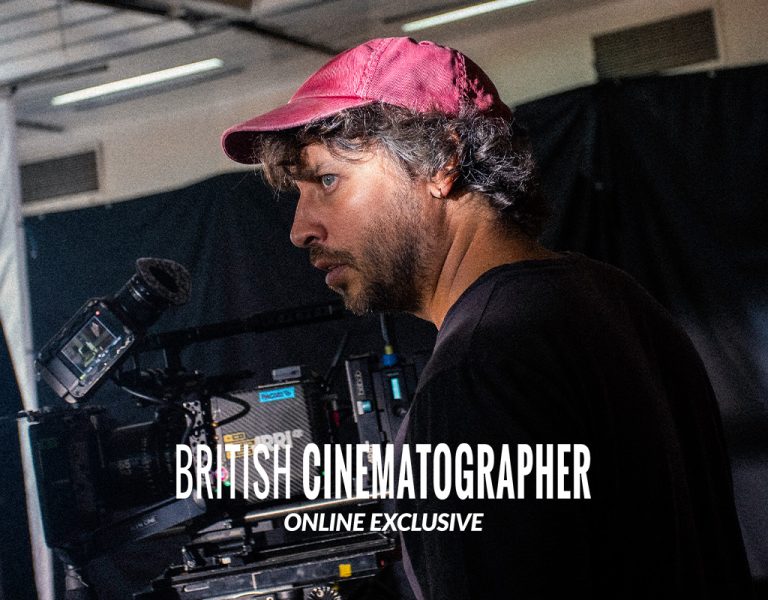
A large part of making sense of what Gunn was after on this particular Earth fell to cinematographer Henry Braham BSC who’s been collaborating with the director since they were telling stories about certain galactic guardians in a universe derived from that other long-standing comics imprint.
But then Warners tapped Gunn to oversee the latest reboot of their attempts at DC storytelling – from wondrous women and Snyder cuts through to dark knights. And he went in with a plan. And while “James is very specific about how he sees things,” Braham says “the way I use the camera is so intuitive (but) yes a lot of these scenes are very designed. But within that [is] the greater idea of the way James sees and wants to tell that story.”
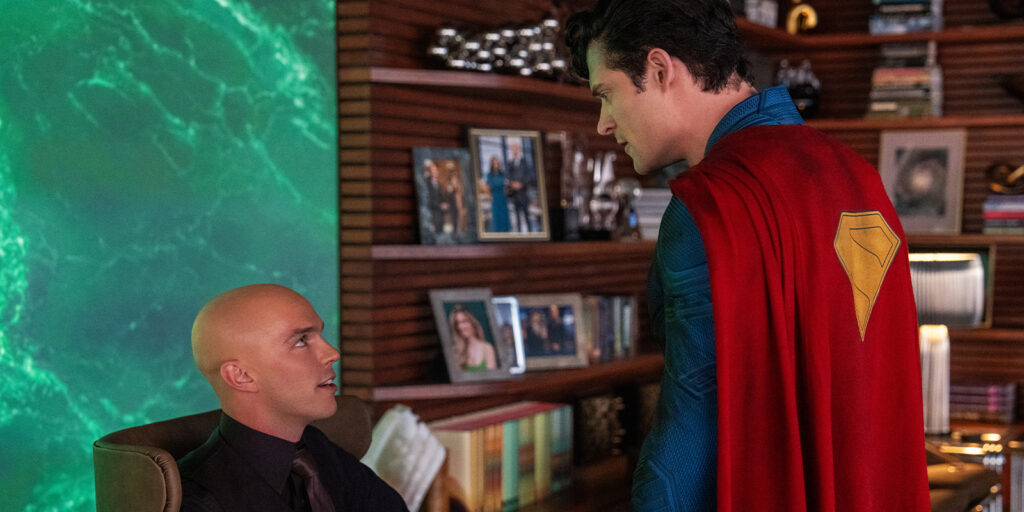
Gunn had “done a huge amount of preparation for that,” which Braham thinks is generally true of those who are both writers/directors: “As they write they kind of visualise the setting.”
To help Braham visualise it, one might naturally assume he’d refer to the rich trove of visuals about Krypton’s native son – not only decades worth of film and TV, but some rather remarkable, essentially storyboarded sequences from the comics themselves, whether back to Superman’s creators, Joe Siegel and Jerry Shuster, silver age Curt Swan, the Neal Adams 70s, or more recent zeniths for the red-and-blue from creators like Grant Morrison, Alan Moore and Frank Quitely.
But surprisingly, when you set out to talk about what you might assume to be superhero influences on a superhero movie, you wind up talking about Orson Welles, John Cassavetes, and Robert Altman, instead.
Welles comes up when discussing how he worked with the visual effects crew to follow through with lighting and colour schemes, and he mentions how massive Superman’s sets were, and how much was done practically, and then says “if you took a film like Citizen Kane — that’s a massive visual effects picture [too], huge for the time,” and one is immediately reminded of the “thawed frame” – Charles Foster Kane’s newspaper staff emerging from a photograph into a new office, to show the passage of time – as well as other visual innovations in a film that’s considered a masterpiece of drama, but not necessarily “special effects.” Until you consider it more deeply – Xanadu sequences and all.
“What we do now,” he says “is no different.” The approach he takes with Gunn is simply “what’s the best way of doing this? Then we break it down into what’s physically feasible.”
The approach to that feasibility comes from Braham’s “philosophy of enabling the camera to be intuitive – and it’s something James was interested in. We worked together on this kind of approach – he particularly likes it because it’s a way of capturing performances in a very grounded and personal way […] because if you shoot on a large format – then the camera can be physically connected – it captures a different kind of performance than the camera [being] removed from the scene.”
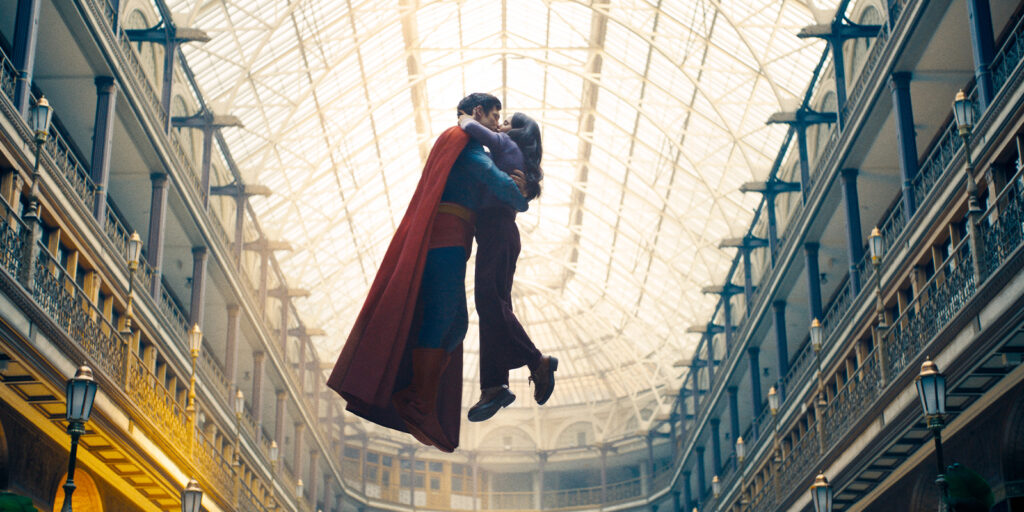
Which is what gets you to the references about Cassavetes, Altman, and their almost improvisational approach with actors. For Braham, he hopes they’re “not aware of the camera at all […] I never put marks on the floor for the actors and restrict them in any way,” he says, and yet when they repeat takes, “the relationship between the actors is more often than not the same […] but I’ve got complete control.”
By which he means, shooting handheld – yes, even for a summer tentpole picture. “There’s a relationship between the camera and performers and everything [else] […] It’s uncanny how accurate you can be.” Braham cites his recent collaboration with director Doug Liman on Road House, where they’d “repeat the action three or four times,” leaving editors with “a huge amount of material” to work with that was also, more importantly, “visually consistent.”
Lighting with purpose
Another aspect of that visual consistency is that he “tend[s] to use a lot of practical lights – it so depends on what the idea is and what the scene is, and the light will come from that, what kind of light fixture, based on […] whatever source is appropriate. The key point being: it’s important.”
Which speaks to another aspect of his approach, that even despite an unmarked soundstage, “nothing happens by accident… nothing is not thought through.”
For Braham, “it’s important to me that we’ve defined what the visual idea of the movie is,” before anything is shot, so his “process is to shoot material, and to work and develop with the director,” before the more formal phase of production begins.
For Superman, he worked with Company 3 colourist Stefan Sonnenfeld, to find “the texture of the print, the photographic nature of the film. You start out thinking you know what the idea is,” but that changes as the discovery phase continues.
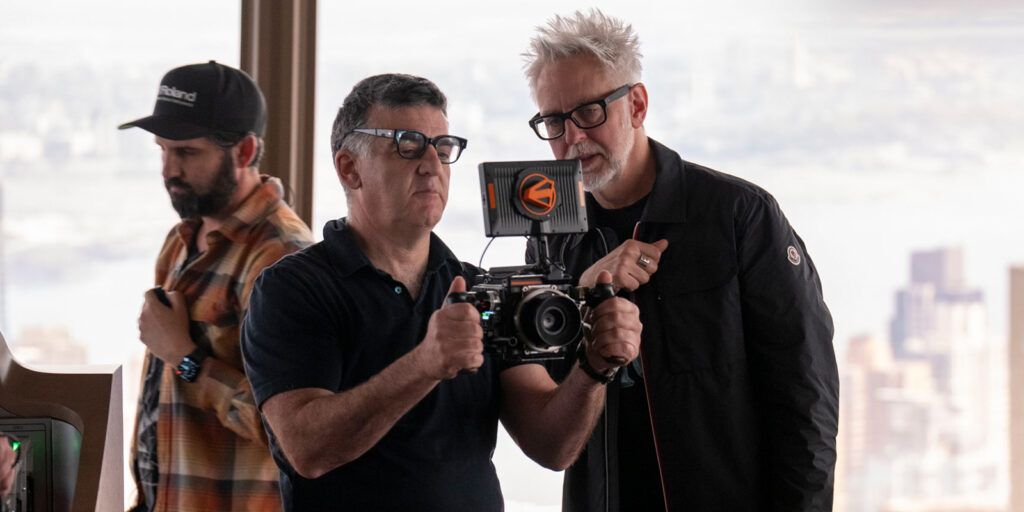
A process that is both “informal and formal – the formal process,” being a meeting of department heads and crew “a couple of times a week as a large group, to talk through specific sequences. You listen to other people’s opinions about what they’re doing in their areas – and you start to bounce off each other,” which becomes its own type of discovery as “the informal process is that we talk all the time.”
Which is good, because “in terms of the photographic approach – as that becomes developed and set in stone – it’s very important [for] everybody to see what that’s going to be.”
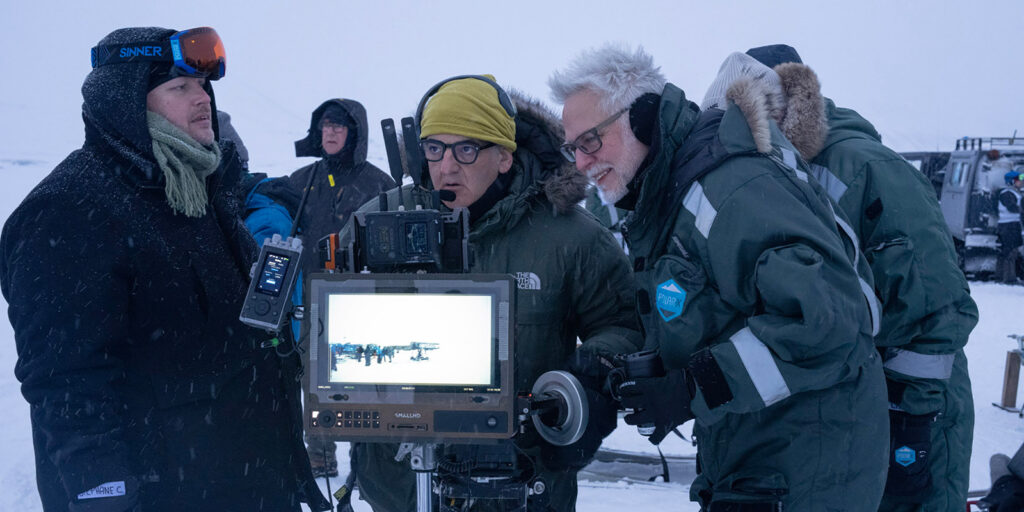
That “seeing” for Superman took place via a RED Raptor (with support from Panavision Atlanta and Panavision London) which Braham described as “physically very small, and that’s very important to me — how intimate I can make the scene. […]I like the RED because of the size of and the format. The footprint of the camera is enormously important.”
That small footprint allows him to come close to his “perfect environment, it’s the actors [and] me.” And, he’s quick to add, his camera assistants, who he describes as geniuses (“you do have to be a genius to work this way”) along with boom operator, Jeffrey A. Humphreys, who also “has to be very sensitive to what is happening.”
Braham likens this approach to an even earlier, pre-Citizen Kane style of filmmaker, noting that films in the silent era “were made on tiny cameras” which grew much larger with the advent of sound, and “it wasn’t until we could have small cameras again that you could get back out in the streets,” or at least “not in black-and-white.”
Of course, the small footprint of digital cameras also provides a large frame VistaVision format, to which he adds “mostly Leitz M 0.8 lenses – slightly modified (with the film also partially shot with the Angénieux Optimo Ultra 12x).
The glass is what matters. What I’m interested in is imperfection.” Though he adds that “Leica is very precise, high-quality glass. On the other hand, it responds well if you use it imperfectly.” The lenses, he says are “perfectly imperfect.”
Those imperfections on seeming flawlessness are also, he opines, what draws us to superhero stories in the first place. Braham acknowledges that he’s “not expert in the origin of comic book culture,” but if you consider “the Greek Myths, the forerunners, characters with superhuman powers [they also have] human flaws, so we can identify with them.”
Which is right there in the subtitle of the book that Morrison, the writer of the lauded All Star Superman graphic novel, wrote about superheroes as modern demigods: Supergods: What Masked Vigilantes, Miraculous Mutants, and a Sun God from Smallville Can Teach Us About Being Human. Though to get a sense of Superman’s roots, it wasn’t Smallville, but Cleveland, where Braham found “a sense of optimism in contrast to the realities of daily life.”
Cleveland, of course, doubles as NY in many a film and TV shoot – including this one – but the synchronicity here is that it was also the hometown of Superman’s inventors, Siegel and Shuster, where their budding science fiction and pulp interests, along with a call for original comic book material, led to what became the invention of the modern superhero, and provided some badly needed income – eventual copyright lawsuits notwithstanding – during the Great Depression.
Small camera, big advantage
But a resurgence of small-but-mighty cameras doesn’t mean the changes since that first era of movies and superheroes haven’t been profound. Thinking of those “huge sets” the movie used, Braham recalled he was “walking on the Warners lot in Burbank some months ago [and] these studios now are not big enough for these styles of movies.”
Superman’s stages were in Atlanta, at Trilith Studios – formerly Pinewood – and a lot of what happened in post helped serve as “set extensions,” and of course “some animation for Krypto,” the super-dog who returns pets to the pantheon, and who will be seen again in next summer’s Supergirl.
Then there was the use of LED screens, such as the scene where “interdimensional imps” have escaped into the Metropolis night sky, dancing around like cosmic jellyfish, while David Corenswet’s Clark Kent, and Rachel Brosnahan’s Lois Lane, argue in their apartment.
Lois wonders if Clark-as-Supes needs to tend to them, but he dismisses their mischief as below the threshold of his emergency attention, as other meta-humans deal with the incursion.
It’s part of the levity that makes the film a winning mix, though as for the mix of filmic techniques, Braham says that even such impish scenes harken to earlier film techniques. “It was done by ILM, like old fashioned back projection –(but) now it’s high-resolution screens. When you look at how the scene works in shots, you can see that’s all real” – in other words, the celestial creatures were right there for Corenswet and Brosnahan to look at and react to – “but it’s old fashioned back projection.”
A philosophy of merging the modern with the traditional that one can imagine appealing to our Kryptonian emigre quite a bit. And one likely to sustain him in further cinematic flights.