
OUT OF TIME
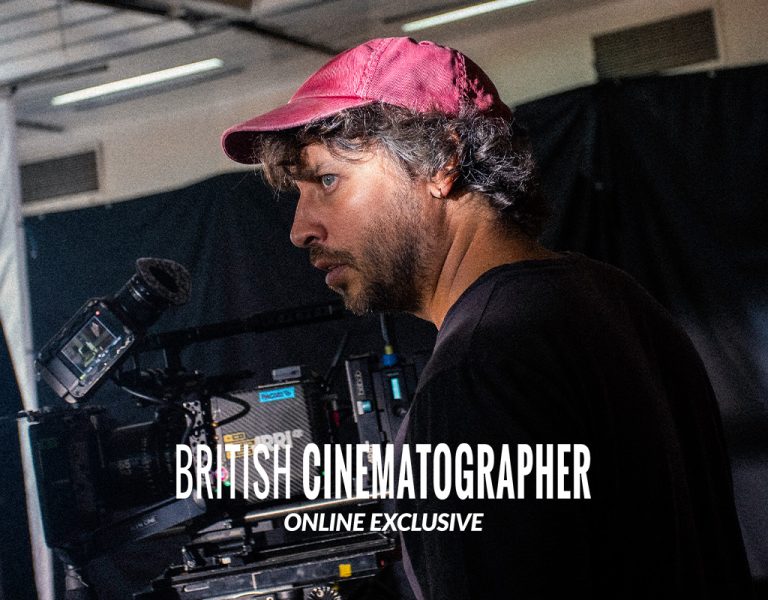
An international breakout this awards season, The Secret Agent is a time-capsule throwback that frequently defies expectations. Cinematographer Evgenia Alexandrova AFC talks about digging up old memories and shedding new light on the past.
Brazil’s Best International Feature Oscar nominee The Secret Agent is set in a very specific time and place in the country’s history – the northeastern coastal city of Recife, in 1977. But Russian-born, Paris-based cinematographer Evgenia Alexandrova AFC proved to have the ideal eye for the political thriller – an international co-production with backing from France, Germany and the Netherlands – thanks to her affinity with Brazil. Alexandrova had previously shot a film in the country, 2023’s Heartless, which caught the eye of The Secret Agent writer/director Kleber Mendonça Filho. “He really liked the colours, apparently,” says Alexandrova, modestly, of Heartless’ unforced, natural look.
The Secret Agent – the (fictional) tale of Armando (Wagner Moura), an academic turned dissident who falls foul of the authoritarian regime and seeks escape for himself and his son – is a very personal story for Mendonça. But while Alexandrova is from a different background, the script resonated powerfully. “I was born in the USSR, in Leningrad at that time,” she explains, “and I have very much imprinted the history of dictatorship times that happened in my country. There are some small signals that are very characteristic to dictatorship regimes that are very well shown in Kleber’s script.”
Mendonça would’ve been a similar age to Armando’s son, Fernando, at the time the story takes place. “I think Kleber really was nostalgic about the ’70s in Brazil, so he really wanted to reproduce those times,” she continues. “We didn’t want to do only close-ups, trying to avoid all of the modern stuff. We really wanted to do a lot of open shots and a lot of dolly shots, just panning around and just living in the world of those times.” To be able to shoot a 180-page script over 10 weeks on location necessitated a huge amount of pre-production planning, and a stricter shot list than Mendonça had been used to.
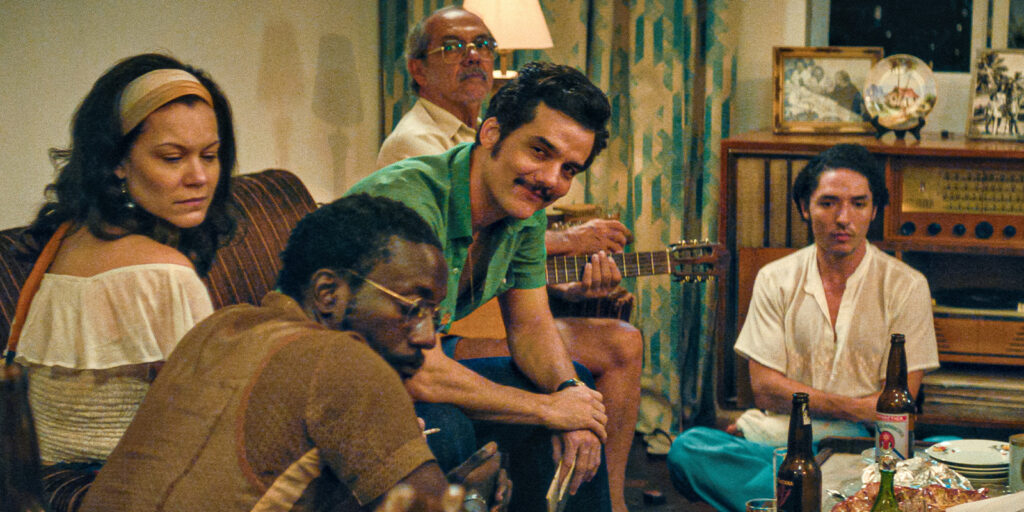
The writer-director’s own memories of Recife fed directly into the film. “Kleber was such a specialist in [the history of the area],” Alexandrova explains. “We were arriving on set and seeing a hundred buildings somewhere on the horizon and he could point out those that were there [in the ’70s] and those that were not. It was very impressive. And there’s one shot where one of the characters is walking on the bridge, and Kleber insisted on changing the colour of the pavement because you had different colours in those times.”
Though a reference on Sir Roger Deakins CBE ASC BSC’s podcast has led some to believe that Alexandrova has more of a background in documentaries than she does (she’s shot more fiction), the work she has done on docs did feed into The Secret Agent. “It impacts me in terms of staying alert to what I’m filming and not trying to bring the ideal image but more the image that resonates with this specific location, with this specific talent’s energy, with this specific [sunlight] this day, so it makes me more open with my eyes and with my brain when I’m on set.”
Just add (lots of) colour
What was planned from the start, though, was the vibrant use of colour – one of many ways in which the often-nightmarish noir of the film defies convention (Mendonça weaves in comedy and surreal flourishes to a story that is also tense, thrilling and moving). “From the very, very beginning, we decided that we wanted the film to be bright and colourful, and that we didn’t want to underline the drama that was going on [through] desaturated colours and underexposed images,” she explains. “The horrors of the dictatorship, they used to happen in plain daylight.”
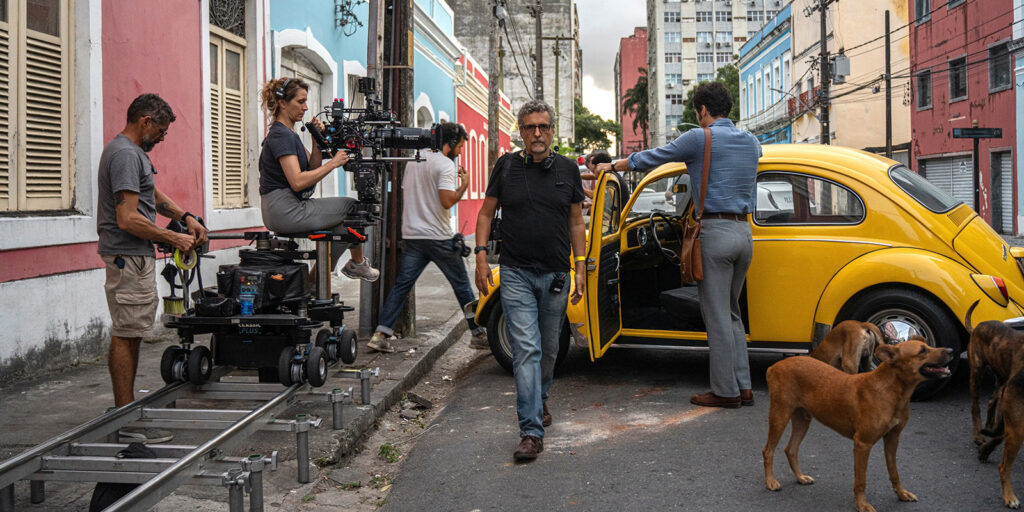
To capture The Secret Agent’s visuals, Alexandrova used ARRI’s Alexa 35 with Panavision B Series lenses. The Alexa 35 was chosen as the main camera because it “has a very wide dynamic range, but I still kept some images maybe slightly overexposed, when you see some windows and they’re kind of blown out,” she says. The goal was for the film to look “imperfect… like it was made in a very artisanal way”. Some of the local equipment proved helpful in that respect. “For example, the dolly tracks were coming from the northeast of Brazil and they were very ancient, so in the film you can see there are a lot of vibrations in dolly shots. But we never tried to stabilise those, neither in post-production nor on set.”
It was Alexandrova’s first time working with this series of Panavision lenses, which also added to the film’s sought-after imperfections. “I found them beautiful, especially the fact that they were unpredictable,” she says of the lenses. “We had to be careful about where we put our character in the image because the border of the frame was very blurry. But the texture [the lenses] gave to the image and to the skin tones was absolutely beautiful. I didn’t filter at all, so it was lens only. And, how they dealt with all the different types of skin tones – because Brazil is so diverse – it just worked out perfectly.”
Different languages
While Alexandrova and Mendonça didn’t limit themselves to ’70s-specific techniques, they did make use of split diopter at key points and went old-school when shooting the driving scenes. “[The actors] were really driving cars, so we decided to use the language [of the] ’70s and ’80s, where the cars were lit from the inside. Even though in the modern world it makes no sense anymore, somehow the language of this cinema of the ’70s integrated this decision very smoothly in the film.”
Even when the film flashes forward for some present-day sequences, the equipment didn’t really change, despite lengthy discussions about the presentation of these contemporary scenes. “We were considering changing the equipment and using non anamorphic lenses, spherical, maybe even taking some full frame equipment for it to look modern,” Alexandrova says. “But in the end, the film is so rich already. It felt like it would be too intentional to overemphasise the modern times.”
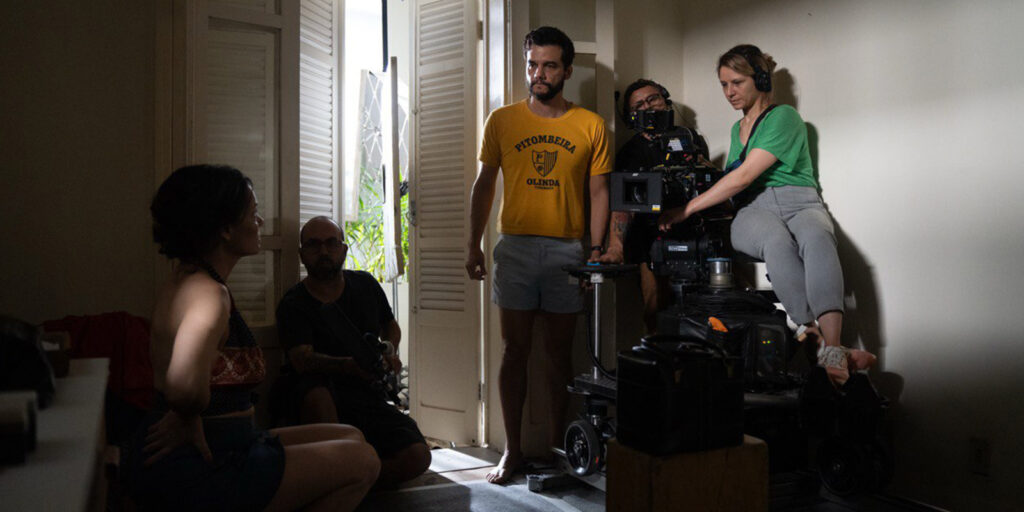
Among Alexandrova’s favourite shots in the film include an innovative use of two-camera dolly shots. “We actually found some interesting ideas, putting two cameras on the same dolly track, without it being a 3D film,” she laughs. “But there is this moment, which we found on set. It’s when Wagner arrives for the first time at his new workplace… and there is a dolly shot that goes from outside to inside [a big room] with this lateral movement, and when we passed behind the column we changed the shots. So, there is a longer lens at the beginning and then when it passes behind the wall, it suddenly opens up. And I thought it was brilliant.”
And although Alexandrova namechecks films like Three Days of the Condor and New Hollywood classics like Taxi Driver as references for her and Mendonça, there’s one specific ’70s masterpiece the film is in dialogue with: Spielberg’s Jaws. Shark fever enraptures the locals thanks to a grisly news story, and Armando’s son is desperate to see it. “I think I saw Jaws first back in Russia, definitely on TV,” she recalls with a grin. “It was dubbed, and I don’t even know if the whole image was in there because they used to crop everything like crazy on TV. I found at the time that it was very realistic. And watching today, I mean you can say it wasn’t. But as a kid I was very much impacted.” The ’70s continuing to resonate in the present day? That’s what The Secret Agent is all about.