
IN THE MOMENT
Filmography so far (project title, director, year released)
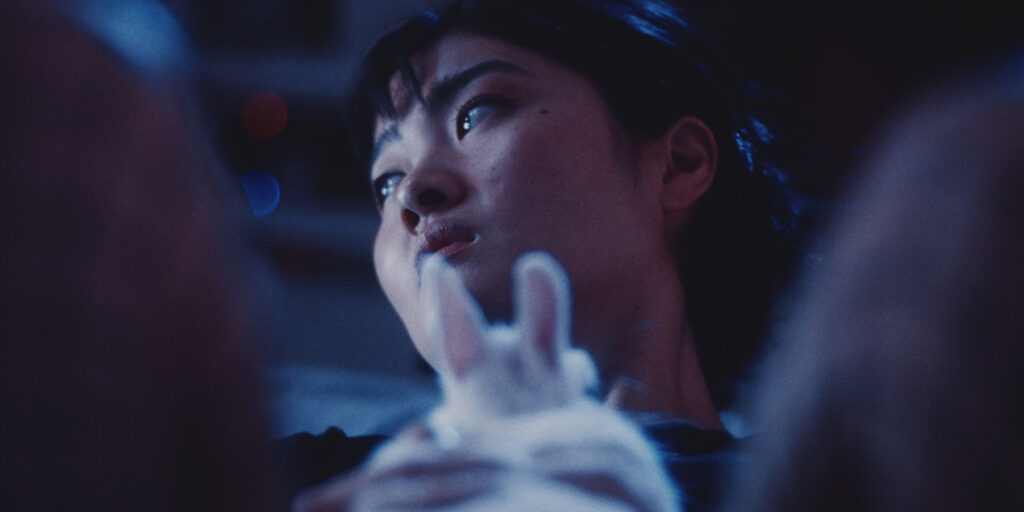
Bunnylovr (Dir. Katarina Zhu, 2025)
The African Desperate (Dir. Martine Syms, 2022)
When did you discover you wanted to be a cinematographer and what inspired you to follow this career path?
I grew up as a very artistic and creative kid with no real outlet. I had no intention of becoming an artist but somehow filmmaking chose me. Two moments come to mind. While being a lost and confused student in college, I found myself as an art PA on a student film set. When I saw the DP, I had a really intense instinctual reaction. I immediately knew that that was what I needed to do. I had an intense desire to light something, to figure out the set like a puzzle and create an image that felt more like a sculpture. From then on, I did everything I could to move in that direction. The day after my time as an art PA, I asked the producer if they could take me on as a grip PA and the rest is history.
The second moment was when I watched a screening of Barry Lyndon alone somewhere in New York City. I was so intensely moved by the images. A deep dream began formulating to one day be able to craft an image as perfect as what I was seeing on screen. I realised then that image making was a language for me and something I needed to use to express who I was, what I wanted to say.
Where did you learn your craft?
Through my experience as a lighting technician and electrician for many years before I became a DP. To this day I am still mesmerised by the way light can tell a story and all the ways it can exist in different qualities and expressions. I love watching what the sun does throughout the day in any given space, nothing can really compare. I’m still trying to simply replicate it.
What are your favourite films, and what makes them stand out to you?
Chungking Express (Cin. Christopher Doyle and Wai-Keung Lau), Hiroshima Mon Amour (Cin. Takahashi Michio and Sacha Vierny), Days of Heaven (Cin. Néstor Almendros ASC), Ratcatcher (Cin. Alwin Küchler BSC).
I am drawn to films that are both grounded in harsh realities yet somehow have a connection to something spiritual and cosmic, and ultimately loving. I am drawn to emotional, evocative, messy yet precise, simple raw images and feelings.
Who in the film world inspires you?
Agnès Godard; Robby Müller NSC BVK; Gordon Willis ASC; Darius Khondji ASC AFC; Harris Savides ASC; Jonathan Glazer; Conrad Hall ASC; Alice Rohrwacher; Jack Fisk; Agnes Varda; Mati Diop; Gillo Pontecorvo; and Hirokazu Koreeda.
But also, my friends and fellow filmmakers including my gaffer Warren Purfoy; my DP friend Maria Rusche; my artist and director friend Martine Syms; my AC Ariel Pomerantz; my key grips Forrest Penny Brown and Rudy Covarrubias; and a new and exciting director Katarina Zhu. This industry is built by the greatest, most courageous and loving types of people.
What’s the most useful advice you’ve received?
Always be vigilant. Be grateful for every encounter you have, every film you get to make. Make the most of it every time no matter the outcome.
What advice would you give someone considering becoming a cinematographer?
Focus on the part that keeps you passionate and alive and excited.
What lights your fire outside of work?
My daughter, Naomi.
What piece of kit could you not live without?
Maxi Brute 12 Light.
Which film would you love to have shot?
In the Mood for Love (Cin. Christopher Doyle, Pun-Leung Kwan and Mark Lee Ping-bin), Beau Travail (Cin. Agnès Godard) or Paris, Texas (Cin. Robby Müller NSC BVK).
What’s the best and worst thing about your job?
Best: the adrenaline rush of “the moment”.
Worst: always needing to re-regulate your nervous system.
How would you best describe your approach to cinematography?
Visualisingthe moment when sensation meets emotion in ways that words or performances cannot express.
What are your aspirations for the future?
I want to shoot movies that reflect my life and push me to learn and grow as a human being. I want my personal life and professional life to feel porous and part of one big, deep desire to make humanistic, challenging and curious films. I want the people around me in my life to be part of this process somehow, either as a participant, viewer or actor. I hope to know more about the world and be able to express myself and exist through the dialogue of image making.
What do you think are the industry’s biggest challenges?
There are more ways than ever to be aware of the doom that surrounds us. I think the biggest challenge for our generation of filmmakers is learning how to lean into hope. Even when things fall apart, we still bet on hope. We bet on real people, real human stories. We continue to lens in a way that is attuned to the heart above all else.