ShotDeck, the world’s leading cinematic image library, has announced the winners of its 2025 Recreations Contest – which tasked participants with recreating shots from their favourite film, series, music video or commercial available on the website.
Filmmakers were asked to match a shot as creatively and accurately as possible, all in-camera and with no AI or computer-generated imagery involved.
Lawrence Sher ASC, ShotDeck founder and Academy Award-nominated cinematographer, explained: “The Recreations Contest is about honouring the art of visual storytelling and the joy of collaboration, which is key to what we fundamentally believe in.
“Every year, I’m blown away and inspired by the level of talent and dedication on display, and it’s our privilege to be able to champion it through the contest.”
Over $125,000 worth of prizes were up for grabs across multiple categories, with the contest rewarding storytellers, from emerging talents to established professionals, with high-end filmmaking gear.
This year’s sponsors included: Sony, ZEISS, Blackmagic Design, Aputure, Rosco, Filmmakers Academy, FilmLight, Arthouse Film Lab, Musicbed, Saturation, FilmConvert, Nanlux-Nanlite, Other World Computing (OWC), American Cinematographer, RED Digital Cinema, Scriptation, and DEEP-LIGHT, among others.
ShotDeck annually awards prizes, including for Grand Prize, Runner-Up and Honorable Mention winners, across multiple categories, including Best Production Design, Most Difficult Lighting, Best Team Effort, Best Family Recreation, and Best Hair & Make-Up.
Here, we hear from Emrys Black about how she recreated a scene from Nosferatu, which saw her win Grand Prize in the MVP Award category.
The full list of winners is available on the ShotDeck Instagram page.
Can you tell us a little bit about your background in filmmaking and/or photography?
From a very young age, I knew I wanted to go into filmmaking. I don’t really know where it came from. I didn’t watch many films as a child – in fact, I actually found them too scary. But, instead of turning me away, that fear pushed me to understand how they were made. I developed a routine where I would watch a movie through the gaps of my fingers and then immediately look up behind-the-scenes footage, because once I understood the mechanics, the fear disappeared. Breaking the process down made it feel like a very complicated puzzle, and I loved watching all the pieces come together. That curiosity is what really hooked me.
I grew up in a smaller town on the West Coast of Florida. My mother is a physician and my father an engineer, so there was a natural assumption that I might follow a similar path. But, I knew early on that I wanted something more creatively expansive. Filmmaking felt like the perfect way to bring together everything I loved. I grew up drawing and painting, reading constantly, playing the flute and piano, and dancing throughout my childhood. In high school, I spent most of my time in theatre, both on-stage and behind the scenes. I have also always, always loved cameras, and I couldn’t imagine myself pursuing a career that didn’t allow me to explore all of those interests in one place.
I’ve been incredibly lucky to have a supportive family and friends who encouraged me to take that leap and who often became the actors and crew on my earliest projects. Right now, I’m in my second year studying Film and Television at New York University’s Tisch School of the Arts, surrounded by generous professors and the most inspiring group of peers. As I’ve progressed, my love for cinematography has been reinforced, and I’m now working toward a career as a director of photography. It genuinely feels like I’m somewhere that would have seemed impossible to my younger self, and I’m so excited to keep discovering where this path leads.
What inspired you to enter the ShotDeck Recreations contest?
It actually came together in a pretty unique way, because I had already decided that I wanted to do shot recreations, specifically from Nosferatu (2024), before I even knew the contest existed. At first, I wanted to do them purely as a learning exercise. I loved the look of the film and was curious to see how close I could get to it with very limited resources. Then I saw the post about the ShotDeck Recreations contest, and everything clicked. Suddenly, what had been a personal exercise had a clear purpose and a real deadline. It was a lucky coincidence in terms of timing, but the contest itself catalysed the project and pushed me to take it further than I otherwise might have.
How did you decide which shot from ShotDeck’s library to recreate? What was it about that shot that caught your attention?
When I first watched Robert Eggers’ Nosferatu, I immediately fell in love with the gloomy visuals. The compositions, the way light sculpted the characters, and the desaturated blues and moody backlighting all felt so striking. As I was watching, I noticed that some of the actors looked vaguely similar to some of my friends, and suddenly the idea of recreating this film in particular felt both exciting and personal.
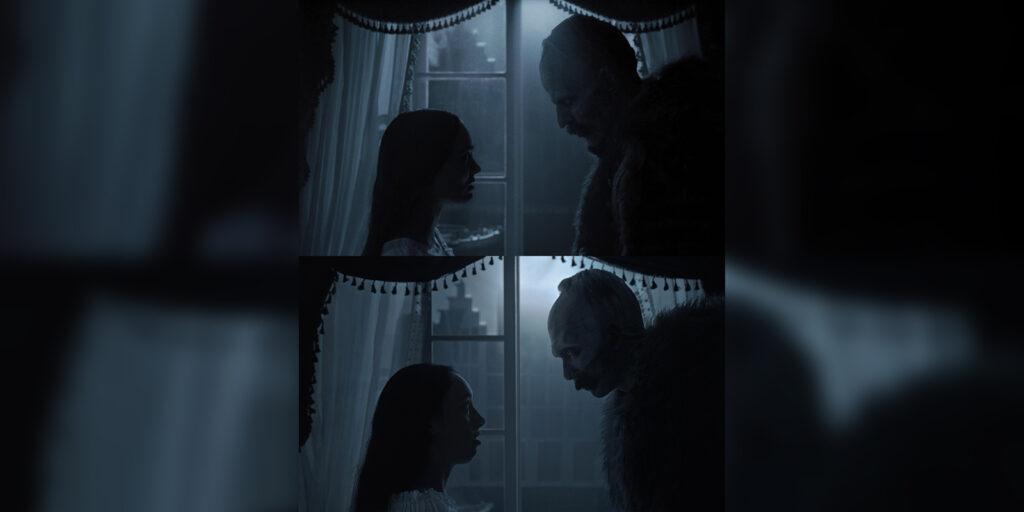
From there, I chose the shots that had captivated me the most, but I couldn’t just choose one. I focused on shots featuring the characters I could see my friends in: Ellen, Count Orlok, and Anna. The window scene with Ellen and Orlok immediately stood out. I loved the cold, almost monochromatic tones, the way the sheer curtains and nightgown framed the characters, and the dramatic backlighting over the city skyline. I’ve always adored period pieces, so the careful costumes and textures made the shot even more compelling. That became the primary shot of focus, and the other shots followed naturally, the idea being we already have actors in costume and makeup, so why not do more? That’s why I added the close-ups of Ellen and Orlok, and the iconic shot of the shadowed hand creeping up Ellen’s face. I was also drawn to Anna’s warm, candlelit scenes, which contrasted beautifully with the cooler blues and helped make the shots feel like a cohesive set of images. I didn’t want to overwhelm myself or the team by attempting too many recreations, but I think we found a good balance, eventually ending with seven. Each shot gave us the chance to explore different techniques and focus on specific aspects of the cinematography while keeping the images visually connected.
Before you started work on your submission, what challenges did you anticipate? Were there any unexpected challenges that arose during the production process?
The biggest challenge, though mostly self-imposed, was timing. From the moment the idea came together to the day of the shoot, I gave myself just five days to prepare. It was one of those “we don’t have nearly as much time as I’d like, but we’re going to do it anyway” situations. The night before was hectic; construction was still happening, sets were being painted, and the special effects makeup hadn’t arrived. But somehow, everything came together. A few last-minute calls, friends coming over to finish painting and hang curtains, and finally receiving the makeup prosthetics turned all this stress into excitement. I mean, it’s impossible not to enjoy working on a project like this with a group of your hometown friends, especially when one of them is fully dressed as Count Orlok. It was also reassuring to see how much we could accomplish together in such a short time.
The second biggest challenge was technical, focusing on set design and colour. To achieve the monochromatic blue look, I adjusted white balance, as well as green and magenta shifts so that minimal colour correction would be needed in DaVinci Resolve. This meant paying close attention to the colours of walls, curtains and props, and running tests in black-and-white to ensure the darker elements held the correct contrast against the background. It was a process of careful iteration, but it paid off, getting pretty close to the intended tonal and atmospheric qualities of the original.
Where did you shoot your submission?
We shot the recreations in the downstairs area of my parents’ house in Florida. Following flooding from Hurricane Helene in 2024, this first floor had been left completely unusable. But over time, the space was cleared and cleaned, and it became this open, empty space. In a way, that destruction became a gift. The cleared area gave us exactly the room we needed to set up the shots, and it felt almost poetic to transform a place that had been ruined into the heart of a creative project.
What equipment did you use?
I shot the recreations on a Sony FX3 with the Sony 24-70mm f/2.8 GM II lens. To try and emulate the highlight blooming in the original 35mm colour negative shots, I added a Moment Cinebloom 10% diffusion filter. For the window scene, I used a single fixed-temperature light with a softbox, set up behind a stretched white sheet to blend the constructed skyline into a smooth sky while still backlighting the subjects. A reflector in front bounced some of that light back onto their faces. That same light also served as the key for the other recreations. To make the oil lamp, I used a 2700K 500-lumen Candelabra light bulb, held inside two vases which were each coated with a thin layer of white paint.
Who were the different members of your team and what were their roles?
I had an absolutely wonderful team, which made the shoot a lot of fun. Maya Johnson was in charge of costumes and curtain wrangling, while set design and construction were handled by Michael Black and myself. The painted skyline was beautifully created by Molly Gaetz, with additional detailing by Julia Peterson. Laith Becker, Levi Hennessey and Carson Wilbur made up our grip team. Behind-the-scenes photos were captured by Tessa Davidson, and our on-set meals were lovingly provided by Janet Black.
I acted as both director and director of photography, and I also handled hair and makeup for Count Orlok. The team was rounded out by our talented actors: Emilee Scott, Valentino Martone and Addy Reese, playing Ellen, Orlok and Anna, respectively. Everyone brought so much creativity and energy to the project, and it was incredible to see it all come together.
Can you take us through the shooting process?
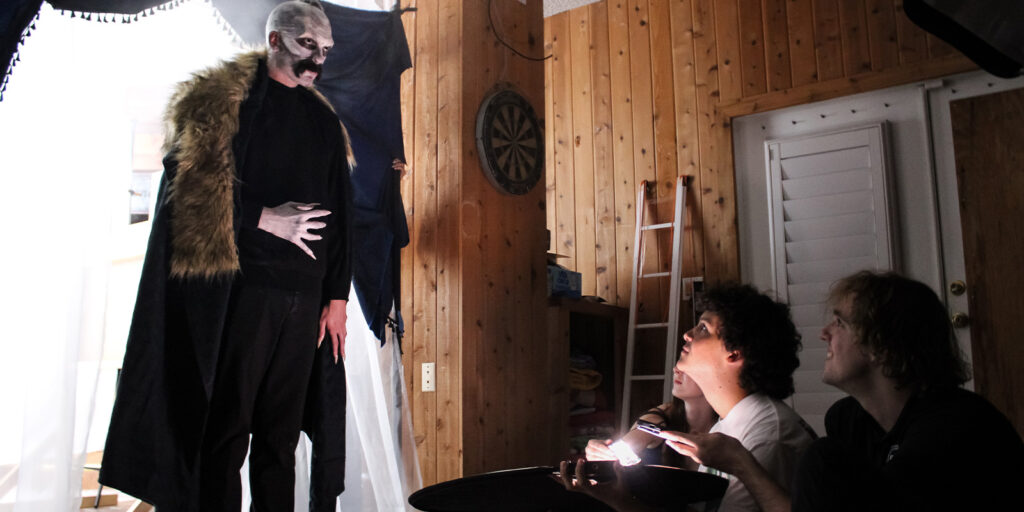
The process began with a lot of measurements. I had drawn out a multi-layered design for the window background: a simple white sheet at the back, then the skyline cutout, the hanging window frame, sheer curtains, and finally the darker curtains above those. To figure out how to build it, we started by measuring everything carefully. I sectioned off the frame so that Ellen’s head would reach about halfway up and Orlok would tower above her. I set up my camera on a tripod, used my dad as a test subject, and moved him around the space to find the right composition and spacing. I taped out the borders of the frame in a 1.66:1 aspect ratio and noted exactly how high the pieces and actors needed to be. With those measurements in hand, we set off to buy lumber and drywall.
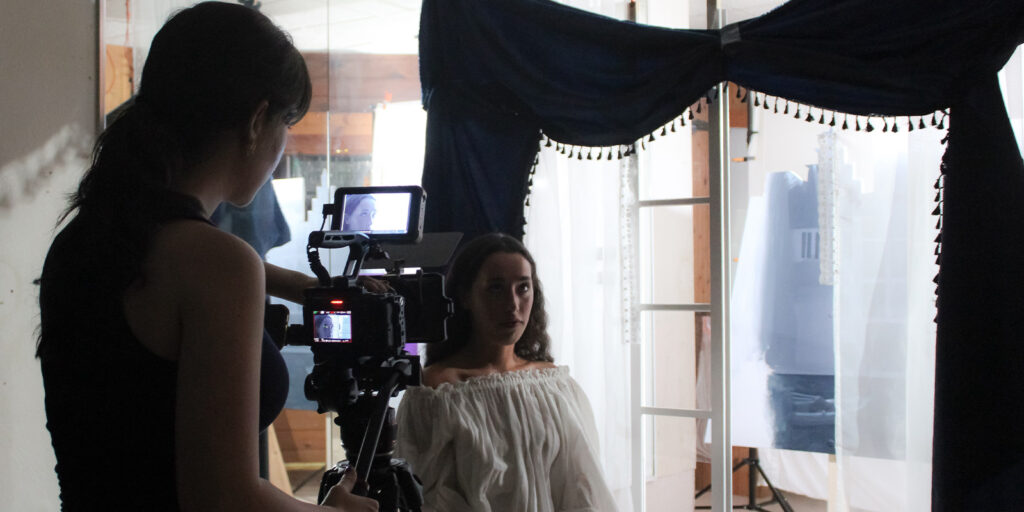
Our scheduled shoot day was just three days away, so we had to move fast. Over those days, we sketched the skyline onto the drywall, built legs to hold it at the right height, and painted the set. We scoured thrift stores for costumes and fabrics, then searched craft stores for ribbons to dress up curtains and shirt necklines, and even found some fake fur for Orlok’s coat. I finalised the lighting plan and taped out tripod positions so the compositions would be accurate and we could transition quickly. Those days were a blur, and the dedication that my team had was truly what got it done.
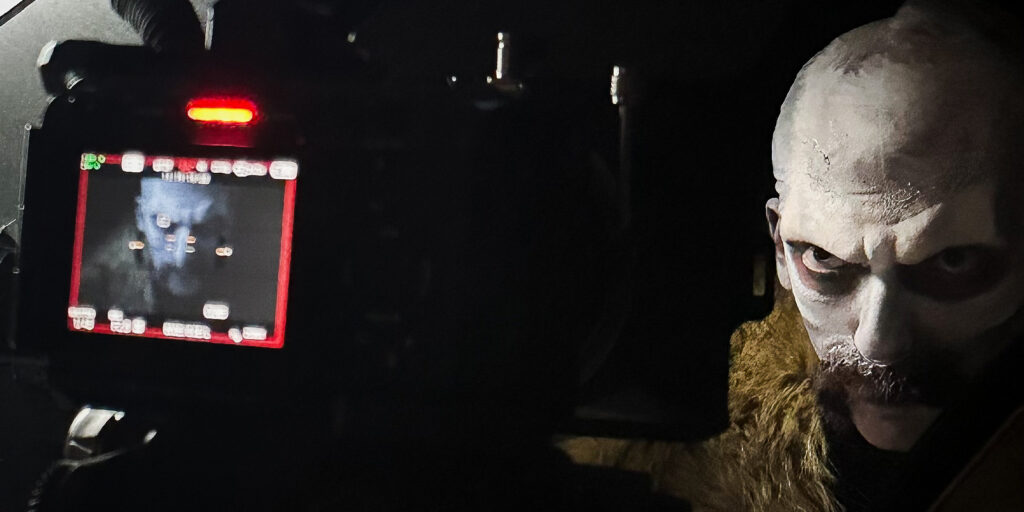
Then came the day of the shoot. A lot of preparation made for a really smooth set. Two hours prior to cameras rolling, Valentino sat down with me in the makeup chair and I began on Orlok’s look, which I was especially excited about. I ordered a bald cap and a foam latex brow bone prosthetic, and made the hair and moustache pieces by brushing out yarn, glueing it into wefts, and shaping it on a styrofoam mannequin. Once Orlok looked adequately frightening, we were ready to go.
With most of the heavy cinematography work already figured out in testing, I could focus primarily on physical direction and subtle details. For example, we added two linear shadows behind Ellen’s head by sticking pieces of duct tape behind the sheer curtain, a detail we had previously missed. The window shot was definitely the most complicated. Two people held the curtains in the proper position, another sprayed haze, and another held a reflector to bounce light back onto the actors. The other shots were simpler, with simpler backdrops that let the performances stand out, but the lighting got more complex. We used multiple black foam boards from the craft store, all handheld at various angles to shape the light precisely. For the shot of Orlok’s shadowy hand crawling up Ellen’s face, we had Valentino stand in front of the light with a clawed hand extended, and held a small pineapple-shaped pillow above his arm to get a more accurately scaled head for the frame. There were a lot of hands holding all sorts of things in front of the key light to get the look just right.
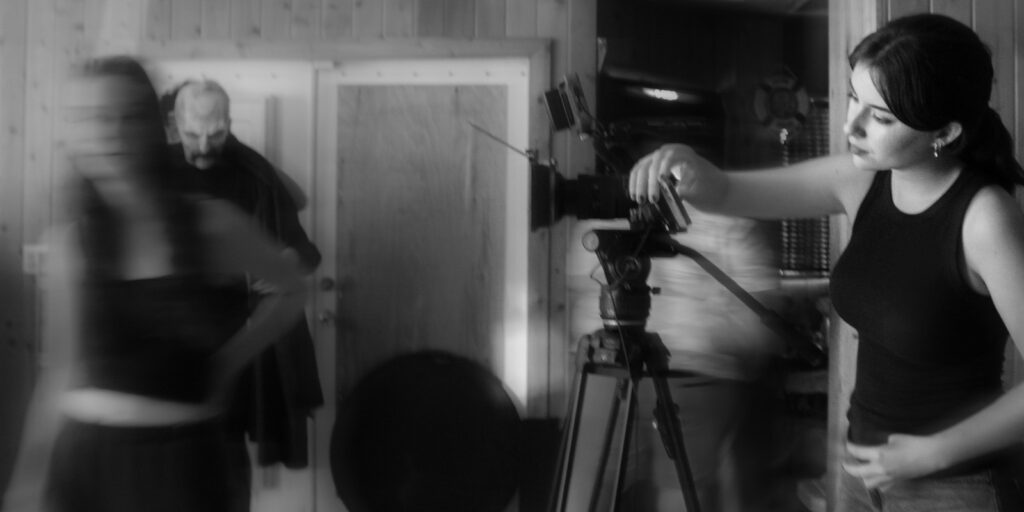
The team worked like a well-oiled machine. And to me, the best part of the whole experience was the audible excitement from the whole team every time a tweak landed perfectly. That energy never faded, from shot one all the way through to shot seven.
Is there anything you wish you’d done differently?
Honestly, I wish I had planned more shots featuring Valentino as Count Orlok. Once the makeup was on, the long nails attached, and the fur coat draped over his shoulders, he completely transformed and fully committed to the character. There are so many funny behind-the-scenes photos of him, but I really wish I had captured more actual footage or recreated more shots with Orlok as a central figure. I think part of me was a little cautious about how the makeup would turn out, so I focused more on shots with Ellen and Anna. Looking back, I definitely would have leaned into Orlok more, he was such a fun and striking presence.
How did it feel to be announced as a winner of the contest?
It feels completely surreal, truly. It’s incredibly rewarding to see all the work we put in being recognised. Knowing that a group of teenagers with a camera, a light, some paint, curtains and a lot of shared ambition could pull this off is such a validating feeling. Seeing our work alongside so many other incredible recreations is still a little shocking, honestly. We’re all just beyond overjoyed and already buzzing for the next project!